World Championship Match
Researched by Nick Pope
| Games | 1 | 2 | 3 | 4 | 5 | 6 | 7 | 8 | 9 | 10 | 11 | 12 | 13 | 14 | 15 | 16 | 17 | 18 | 19 | Wins |
| Steinitz | ½ | 1 | ½ | 0 | 0 | 1 | 1 | ½ | ½ | 1 | ½ | 0 | 1 | ½ | ½ | 0 | ½ | 1 | ½ | 6 |
| Gunsberg | ½ | 0 | ½ | 1 | 1 | 0 | 0 | ½ | ½ | 0 | ½ | 1 | 0 | ½ | ½ | 1 | ½ | 0 | ½ | 4 |
Time Control: First 26 moves in one hour and forty-five minutes, 15 moves per hour thereafter.
Purse: £75 prize (Gunsberg receiving draw odds for the purse).
Game fees: $20 for the winner, $10 for the loser, and $10 each for a draw.
Preliminaries
Agreement entered into the Sixth day of December, 1890, by and between William Steinitz, of New York, and Isidor Gunsberg, of London, to play a Chess Match in the City of New York, under the auspices of the Manhattan Chess Club, either in private or in public, as may be arranged between the players and the Manhattan Chess Club, for a prize of seventy-five pounds sterling, deposited by Mr. Gunsberg with Mr. L. D. Cohn, the Hon. Treasurer of the Manhattan Chess Club, to be paid by that gentleman to the winner of the match, and also for fees arranged and agreed to by the Manhattan Chess Club.
Number of Games.—That the match shall be determined by either player winning ten games (drawn games not counting), but with the following exceptions: (a) That if the players score nine games each, the match shall be declared as drawn. (b) That if twenty games are played without the match being determined, then the winner of the majority of the games shall be declared the winner of the match.
Time Limit—During the first sitting of 3½ hours each player shall complete twenty-six moves in the time at his disposal, namely one hour and forty-five minutes. Afterwards, however, the game shall proceed at the rate of fifteen moves per hour all through.
Days of Play.—In the first week the days of play shall be, Tuesday, December 9th, Thursday, December 11th, and Saturday, December 13th, but afterwards the play shall proceed at the rate of four games a week, namely, on Monday, Wednesday, Thursday and Saturday, but no more than one game shall be played per day, and an adjourned game shall be considered as a game, for that purpose.
Duration of Play.—The duration of play shall be seven hours on days of play and shall be divided as follows: Morning session, 1.30 p.m. to 5 p.m. Evening session, 7 p.m. to 10.30 p.m. Adjourned games shall be finished on the day following the adjournment irrespective of the appointed days of play.
Abstention from Play.—Abstention from play can be secured by each player three times during the match, by either player giving two clear hours' notice in writing before the time fixed for commencing a new game, both to his opponent and to the official in charge of the match and directed to the Manhattan Chess Club. This rule shall, however, not apply to adjourned games.
Property Right in Games.—Property right in the record of all games played in the match shall inure to each player who shall have the separate right of publishing any or all the games during the match, and a collection of the games after the match, and that each, W. Steinitz, I. Gunsberg, player may obtain copy-right for the games and his own notes both in America and in England or elsewhere, but that neither shall have any commercial claim on his opponent's published games or collection thereof.
Referee.—Professor Isaac L. Rice, President of the Manhattan Chess Club, New York, is hereby mutually agreed to be an is appointed the Referee in the match.
Minor Rules and Regulations of the Match between Messrs. Steinitz and Gunsberg:
1. Each player shall nominate an umpire prior to the commencement of the match. The gentleman thus nominated shall be a member of the Manhattan Chess Club, and his election shall be approved of by his opponent. Should either party, however, reject two gentlemen thus named, the Committee of the Club may be appealed to by the opponent for the purpose of electing another umpire, whose appointment shall be final.
2. Each umpire may nominate one substitute to take his place in case of unavoidable absence, and the appointment of such substitute shall be confirmed in the same manner as that of the original umpire.
3. The umpires or their substitutes shall be present in the room where the match is being played during the progress of each game, and they shall settle all disputes that may arise between the two players. In case the two umpires should disagree or if either player claims that their decision is contrary to the conditions of the match, the decision of the Referee, unappealed, shall be final.
4. The games shall be played within an enclosure which shall only be accessible to the players, their umpires or substitutes and the offices of the Club under whose auspices the match is played.
5. Tickets of admission to the Club during the progress of the match, or to the premises on which the match is being played (whether in private or in public) shall be issued subject to the conditions of the match and may be cancelled at any time at the request of the umpire of either party.
6. The spectators shall be required to keep strict silence and to refrain from any applause or signs of disapproval.
7. The moves of each game may be repeated on a large suspended Chess board. The spectators may also use pocket Chess boards for the purpose of following the game, but they shall not analyze or discuss the game under progress.
8. Neither player shall absent himself from the room during the hours appointed for play, except for a reasonable time. The player who has made his move may walk inside the enclosure in the manner which shall in no way distract the attention of his opponent. Either player who shall exceed the time limit in any way, shall forfeit the game, which shall be scored by his opponent. The clock of a player who does not appear at the time appointed for commencing a game, for resuming an adjourned game, or who absents himself during a game, shall be started as soon as it is his turn to play, in the same way as if here were present in the room, and the time of his absence shall be considered as having been consumed over the board.
9. The player whose turn it is to move at the time of adjournment, shall enclose his move in a sealed envelope which shall be handed to his opponent's umpire. The move thus made shall be marked in words; for instance, "Queen to King's third," in a conspicuous part of the score sheet, and shall afterwards be transcribed in the ordinary way at the resumption of the game, when the envelope containing the last move shall be opened by one of the officials at the time appointed for resuming play.
10. Either player who shall analyze a pending game by moving his pieces over the board, or even mentally in consultation with others, shall forfeit such game and shall also be liable to a fine to be adjudged by the Referee according to Rule 13. The mere looking at the board or at a diagram showing the adjourned position shall not constitute an offence, but neither player shall be allowed to set up the position excepting for the purpose of editorial work.
11. At least two sets of double stop-clocks for regulating the time limit, which are to be carefully tested beforehand by the two umpires, shall be provided at the commencement of the match, and should one of the clocks be found defective during a game, after marking the time already consumed by each player, the defective clock shall be replaced by a reliable time piece.
12. The games of the match shall be governed by the Code of laws published in teh last edition of the German Handbuch, with this exception, that if both players repeat the same series of moves six times in succession, then either party may claim a draw.
13. For any act of a player during the match which may be unjustly offensive or injurious to his opponent, a fine may be inflicted by the referee of not less than ten dollars and not exceeding one hundred dollars.
14. For any violation of the main conditions already agreed upon, which may delay the commencement or progress of the contest, or which may otherwise injure the financial proceeds expected from the public exhibitions, or which may tend unduly to increase the expenditure of either player, a fine of from ten dollars up to one hundred dollars may be imposed by the referee upon the offending party, if claimed by his opponent.
15. For any breach of the Rules and Regulations the referee may inflict a fine of from five dollars to fifty dollars for each offence. All fines shall be paid at once to the referee and shall belong to the opponent of the offending party.
16. The referee shall only act on the representations of either player or his umpire, but an exact copy of the complaint made to the referee shall be sent simultaneously to the opponent of the complaining party, and the latter shall have three days' time in which to file his answer, on receipt of which the referee may give his decision at once. Any frivolous or groundless charge may, however, on the motion of the accused party, be adjudged by the referee according to Rule 13.
17. The entire official correspondence between the two players and the Manhattan Chess Club shall be taken into consideration by the referee for the purpose of interpreting the conditions of the match.
In reference to the prize of £75 to the winner herein named, it is stipulated that in case the match be drawn the above amount shall be returned to Mr. Gunsberg.
In behalf of the Manhattan Chess Club, I agree to all the stipulations as far as they concern the named Club.
Witness our hands this ninth day of December, 1890.
In the presence of:
Number of Games.—That the match shall be determined by either player winning ten games (drawn games not counting), but with the following exceptions: (a) That if the players score nine games each, the match shall be declared as drawn. (b) That if twenty games are played without the match being determined, then the winner of the majority of the games shall be declared the winner of the match.
Time Limit—During the first sitting of 3½ hours each player shall complete twenty-six moves in the time at his disposal, namely one hour and forty-five minutes. Afterwards, however, the game shall proceed at the rate of fifteen moves per hour all through.
Days of Play.—In the first week the days of play shall be, Tuesday, December 9th, Thursday, December 11th, and Saturday, December 13th, but afterwards the play shall proceed at the rate of four games a week, namely, on Monday, Wednesday, Thursday and Saturday, but no more than one game shall be played per day, and an adjourned game shall be considered as a game, for that purpose.
Duration of Play.—The duration of play shall be seven hours on days of play and shall be divided as follows: Morning session, 1.30 p.m. to 5 p.m. Evening session, 7 p.m. to 10.30 p.m. Adjourned games shall be finished on the day following the adjournment irrespective of the appointed days of play.
Abstention from Play.—Abstention from play can be secured by each player three times during the match, by either player giving two clear hours' notice in writing before the time fixed for commencing a new game, both to his opponent and to the official in charge of the match and directed to the Manhattan Chess Club. This rule shall, however, not apply to adjourned games.
Property Right in Games.—Property right in the record of all games played in the match shall inure to each player who shall have the separate right of publishing any or all the games during the match, and a collection of the games after the match, and that each, W. Steinitz, I. Gunsberg, player may obtain copy-right for the games and his own notes both in America and in England or elsewhere, but that neither shall have any commercial claim on his opponent's published games or collection thereof.
Referee.—Professor Isaac L. Rice, President of the Manhattan Chess Club, New York, is hereby mutually agreed to be an is appointed the Referee in the match.
Minor Rules and Regulations of the Match between Messrs. Steinitz and Gunsberg:
1. Each player shall nominate an umpire prior to the commencement of the match. The gentleman thus nominated shall be a member of the Manhattan Chess Club, and his election shall be approved of by his opponent. Should either party, however, reject two gentlemen thus named, the Committee of the Club may be appealed to by the opponent for the purpose of electing another umpire, whose appointment shall be final.
2. Each umpire may nominate one substitute to take his place in case of unavoidable absence, and the appointment of such substitute shall be confirmed in the same manner as that of the original umpire.
3. The umpires or their substitutes shall be present in the room where the match is being played during the progress of each game, and they shall settle all disputes that may arise between the two players. In case the two umpires should disagree or if either player claims that their decision is contrary to the conditions of the match, the decision of the Referee, unappealed, shall be final.
4. The games shall be played within an enclosure which shall only be accessible to the players, their umpires or substitutes and the offices of the Club under whose auspices the match is played.
5. Tickets of admission to the Club during the progress of the match, or to the premises on which the match is being played (whether in private or in public) shall be issued subject to the conditions of the match and may be cancelled at any time at the request of the umpire of either party.
6. The spectators shall be required to keep strict silence and to refrain from any applause or signs of disapproval.
7. The moves of each game may be repeated on a large suspended Chess board. The spectators may also use pocket Chess boards for the purpose of following the game, but they shall not analyze or discuss the game under progress.
8. Neither player shall absent himself from the room during the hours appointed for play, except for a reasonable time. The player who has made his move may walk inside the enclosure in the manner which shall in no way distract the attention of his opponent. Either player who shall exceed the time limit in any way, shall forfeit the game, which shall be scored by his opponent. The clock of a player who does not appear at the time appointed for commencing a game, for resuming an adjourned game, or who absents himself during a game, shall be started as soon as it is his turn to play, in the same way as if here were present in the room, and the time of his absence shall be considered as having been consumed over the board.
9. The player whose turn it is to move at the time of adjournment, shall enclose his move in a sealed envelope which shall be handed to his opponent's umpire. The move thus made shall be marked in words; for instance, "Queen to King's third," in a conspicuous part of the score sheet, and shall afterwards be transcribed in the ordinary way at the resumption of the game, when the envelope containing the last move shall be opened by one of the officials at the time appointed for resuming play.
10. Either player who shall analyze a pending game by moving his pieces over the board, or even mentally in consultation with others, shall forfeit such game and shall also be liable to a fine to be adjudged by the Referee according to Rule 13. The mere looking at the board or at a diagram showing the adjourned position shall not constitute an offence, but neither player shall be allowed to set up the position excepting for the purpose of editorial work.
11. At least two sets of double stop-clocks for regulating the time limit, which are to be carefully tested beforehand by the two umpires, shall be provided at the commencement of the match, and should one of the clocks be found defective during a game, after marking the time already consumed by each player, the defective clock shall be replaced by a reliable time piece.
12. The games of the match shall be governed by the Code of laws published in teh last edition of the German Handbuch, with this exception, that if both players repeat the same series of moves six times in succession, then either party may claim a draw.
13. For any act of a player during the match which may be unjustly offensive or injurious to his opponent, a fine may be inflicted by the referee of not less than ten dollars and not exceeding one hundred dollars.
14. For any violation of the main conditions already agreed upon, which may delay the commencement or progress of the contest, or which may otherwise injure the financial proceeds expected from the public exhibitions, or which may tend unduly to increase the expenditure of either player, a fine of from ten dollars up to one hundred dollars may be imposed by the referee upon the offending party, if claimed by his opponent.
15. For any breach of the Rules and Regulations the referee may inflict a fine of from five dollars to fifty dollars for each offence. All fines shall be paid at once to the referee and shall belong to the opponent of the offending party.
16. The referee shall only act on the representations of either player or his umpire, but an exact copy of the complaint made to the referee shall be sent simultaneously to the opponent of the complaining party, and the latter shall have three days' time in which to file his answer, on receipt of which the referee may give his decision at once. Any frivolous or groundless charge may, however, on the motion of the accused party, be adjudged by the referee according to Rule 13.
17. The entire official correspondence between the two players and the Manhattan Chess Club shall be taken into consideration by the referee for the purpose of interpreting the conditions of the match.
In reference to the prize of £75 to the winner herein named, it is stipulated that in case the match be drawn the above amount shall be returned to Mr. Gunsberg.
In behalf of the Manhattan Chess Club, I agree to all the stipulations as far as they concern the named Club.
Dr. Fred. Mintz.
Witness our hands this ninth day of December, 1890.
W. Steinitz.
I. Gunsberg.
In the presence of:
Geo. F. Betts.
International Chess Magazine, Nov 1890, pp325-328
Steinitz and Gunsberg Will Begin Play To-day.
The interesting fight for the supreme position in the world of chess between W. Steinitz of New York, the present champion of the world, and I. Gunsberg of London, will begin at the rooms of the Manhattan Chess Club, 31 West Twenty-seventh street, to-day.
The rules which Steinitz originally proposed should govern the match, together with Gunsberg's suggestions as to certain other regulations or amendments, were published some months ago in The Sun. With several minor alterations these rules have been finally adopted and a brief recapitulation of the leading conditions is all that is now necessary.
The match will be one of ten games up, draws not counting and there will be a maximum of twenty games. In case neither player scores ten wins after twenty games have been played, he will be declared the winner who has scored the majority of wins.
the match will be declared drawn in case each player scores nine games. In such a scarcely probable eventuality the £75 subscribed as a prize for the winner by English amateurs will be handed back to Gunsberg. This arrangement is due to an omission on the part of Steinitz when the conditions were being finally framed.
During the first 3½ of play the time limit will be 26 moves in 105 minutes, and then during the rest of the game play will proceed at the rate of 15 moves an hour.
This week, play will take place to-day, Thursday, and Saturday, between the hours of 1:30 and 5 P.M., and from 6:45 till 10:15 P.M., while in subsequent weeks it will be continued during the same hours on Tuesday, Thursday, Friday, and Saturday.
The match will be conducted in private, but there will also be some public exhibitions during its progress.
STEINITZ AND GUNSBERG PLAY.
THEIR FIRST GAME A DRAW - MOVES MADE BY THEM.
The chess match between W. Steinitz, of New-York, and I. Gunsberg, of London, for the championship of the world, was begun yesterday afternoon, in New-York, under the auspices of the Manhattan Chess Club. The proceedings were opened by Colonel G. F. Betts, who first of all welcomed the competing masters to the club. After a few further appropriate remarks he introduced the players to the members of the club present in these words: “I have the pleasure, gentlemen, to introduce to you Mr. Gunsberg and Mr. Steinitz, and may the best man win.”
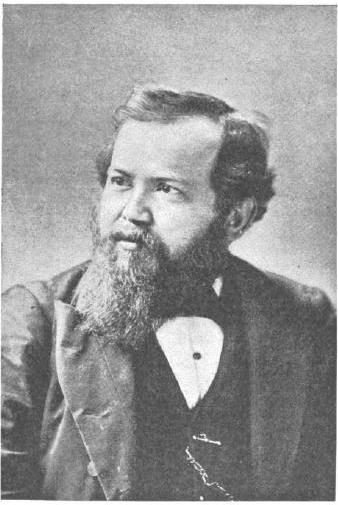 The two players, with the umpires, a few subscribers, and others, ascended to the floor above, where, in a private room, it had been arranged that play should be conducted. At the time when the first game began, at about 2 p.m., there was a moderate attendance of members and visitors in the club, and such of them as did not posses the privilege of witnessing the actual play watched the moves as they were almost simultaneously recorded on a huge diagram board which occupied a prominent position on the walls of the principal clubroom.
From time to time, as the play advanced, comment and criticism on the moves prevailed in this lower room, while in the room above where the players were engaged the stillness was indicative of the importance of the contest.
Both players appeared to be in good health when they came to the club in the morning, a thing which cannot be wondered at in the case of Gunsberg, who has enjoyed the benefits of a sea voyage, followed by a week of rest. With Steinitz there is more cause for surprise when it is remembered, not only that he has been exceedingly busy for some months, but is also a frequent sufferer from insomnia.
Just before the beginning of play, Mr. Gunsberg lodged an objection to the admission of press representatives to the room of play. This he had power to do under the regulations, and the objection was sustained.
Steinitz, being drawn to make the opening move, proffered his opponent a Queen’s Gambit, which Gunsberg declined. On the fourth move Steinitz introduced quite a novelty in P-K B 3, which, no doubt, very few chess players would anticipate. Then he brought out his K Kt to K R 3, which will probably be considered an odd move, following that up with Kt-B 2. Gunsberg’s defence, 4 Q Kt-B 3, was based on the idea of breaking through the centre, and he offered battle by advancing his K P on the ninth move. This forced the exchange of the Q centre pawn, but still he could not rid himself of White’s K P.
On the eleventh move a good chance of improving his position was missed by Steinitz, in playing Kt-Q 3, with the result that one of his pawns became isolated, and, by clever manoeuvring, Gunsberg made a counter demonstration on the Q side against the weak pawn which greatly delayed White’s attack on the other wing. About this time the game was adjourned till 7 o’clock [...]
Upon play being resumed at 7 o’clock, the same kind of struggle continued for two moves by each player. Gunsberg had slightly the best of the game if it were pursued to an ending, but the prospects of the middle fight were still somewhat in favor of his opponent, and under these circumstances Gunsberg readily accepted the draw, which was now offered by Steinitz. This close of the game was arrived at at [sic] a few minutes before 7:30. At an earlier stage of the game, some half-dozen moves back, Steinitz declined a draw, which was offered to him by Gunsberg.
New-York Daily Tribune, 1890.12.10
BEGINNING OF THE SERIES BETWEEN STEINITZ AND GUNSBERG.
They Sart With the Queen’s Gambit, and on the Fourth Move the
American Makes Things Interesting - The Result Is a Draw
The fight for the chess championship of the world began in this city yesterday. Gunsberg, the English player, has been recuperating during the past week, and starts, in apparently good health, a contest which is looked upon in English chess circles as a foregone conclusion in favor of Steinitz, while players in this country look forward with equally settled anticipation to the defeat of the English representative and the retention by Steinitz of the foremost position as a chess master which he has held so long and so worthily.
There is no avoiding the fact that enthusiasm over this match has not been raised to the customary high pitch which is manifested in a fight of such importance; and this is readily accounted for by the disappointment which has been created by the interruption of the cable match - a contest which, as every chess player knows, not only involved certain important principles entirely new to the chess world, but had unquestionably reached the most interesting stage during its progress. No doubt as the present match between Steinitz and Gunsberg proceeds, that disappointment will gradually give way to the interest which must necessarily centre round any prominent event which may be in progress.
Fully an hour before the time appointed for the beginning of the match the members of the Manhattan Chess Club began to assemble in their rooms, where Steinitz had already arrived, with a sense of country freshness about his appearance which he had evidently brought with him from Upper Montclair. In the midst of the general conversation rallied upon general topics, upon his games with Tschigorin, and upon the contest in which he was about to engage.
Meantime Gunsberg had arrived. He was in a very quiet mood, out of which he could not even be aroused by the same process which had proved so effective in the case of his veteran opponent. He had very little to say to any one, and when asked what he would do if Steinitz fired off an Evans gambit at him, he replied with what may almost be described as his characteristic quiet meekness, “I don’t know.”
Steinitz was drawn to make the first move, and play was just about to commence when Gunsberg entered an objection to the presence of reporters. This objection, it was seen, was empowered by the conditions, and the umpire accordingly sustained it. Steinitz raised no opposition to the admission of the press. Gunsberg’s action, it is believed, is almost, if not entirely, without precedent.
In the large club room on the floor below that in which the play was going on, a giant chess board was fixed against the wall, and as each move was made in actual play it was sent down by a messenger and recorded on the board for the edification of those assembled in the club room. Here, throughout the progress of the game, each move was commented upon either briefly or at length, according to its importance or insignificance. Meanwhile, the spectators who had gathered engaged with each other in play, or lounged about discussing the position as it developed. Just before the first adjournment quite a crowd had gathered round the diagram board and more interest was felt in the game than had been the case at any other period during the afternoon.
Gunsberg’s defence by moving 4...Q Kt-B 3, which blocked his Q B P, was based on the idea of breaking the centre, and he then offered battle by the advance of the king’s pawn on the ninth move, which forced the exchange of the queen’s centre pawn, but, on the other hand, he could not get rid of white’s K P, which formed the head of a strong line of pawns directed against black’s king’s side.
On the eleventh move Steinitz missed an opportunity of much improving his position by moving Kt-Q 3. The result was that his Q B P became isolated, and black, by very clever manoeuvring, made a counter demonstration on the queen’s side against that weak pawn, which for a long time delayed white’s attack on the other wing. This was practically the state of the game on Gunsberg’s twenty-sixth move, which he sealed at the adjournment of the afternoon’s sitting - white was threatening the king’s side, while black menaced the other wing.
Prior to the adjournment, Gunsberg, after the eighteenth move, offered his opponent a draw, which the latter declined. On the recommencement of play at 7 o’clock the same sort of struggle as had been going on before continued for two moves on each side, queens and bishops being shifted from one side to the other for purposes of attack. Gunsberg had then the best of the game if it came to an ending, but the chances of the middle fight were still somewhat in favor of white. Under the circumstances the draw, which was this time offered by Steinitz, was readily accepted by Gunsberg.
When within half an hour after the resumption of play it was announced to the spectators that a draw had been offered and accepted there was for the moment some little surprise manifested. This surprise, however, disappeared when the position was put up to the finish and examined. It was declared with confidence by some of those in the room that Steinitz could not possibly have won the game if it had proceeded.
Prof. I. L. Rice, the President of the Manhattan Chess Club, acts as referee in the match, and the umpires are Prof. Holladay for Steinitz, and Mr. Vorrath for Gunsberg. Dr. Fred Mintz had the entire control of the arrangements, which were pronounced very satisfactory by everybody present. It may be added, further, that the hours of play have been finally settled as follows: Afternoon session, 1:30 o’clock to 5 o’clock; evening session, 7 o’clock to 10:30 o’clock.
The next game will take place at 1:30 o’clock to-morrow.
The Sun, New York, 1890.12.10
THE FIRST GAME OF THE CHESS MATCH A DRAW.
Twenty-six Moves at the Manhattan Chess Club - The London Man
Attacks Vigorously and Obtains an Early Pull - The Plays Reproduced
on a Bulletin Board.
A visitor to the splendidly appointed rooms of the Manhattan Chess Club at 1 o’clock yesterday afternoon would have been impressed with the fact that some event of great importance was in preparation, for the room was crowded and there was a scent of solemnity in the air. There were not many strong players in New York who did not put in an appearance to support Col. Betts, the Vice-President of the prosperous chess club, in inaugurating the great contest between Steinitz and Gunsberg. Proceedings commenced with the formal signing of the agreement and articles of play by the players and by Dr. Murtz [sic] on behalf of the Manhattan Chess Club. The Vice-President then addressed a few kindly words of encouragement to both players, dwelling on the great merit and well-known prowess of Mr. Steinitz, whom they had known for years past as an American citizen. The Colonels polite allusion to Mr. Gunsberg as an always welcome visitor from a distant shore, was approvingly received by his hearers. The fight for the chess championship of the world was began at 2 o’clock by Mr. Steinitz, who had won the toss for the move, opening his game with 1 P-Q 4.
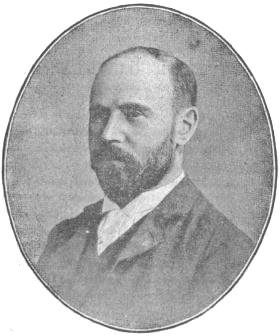 The match was played in a private room, where the players were at their ease. The members of the Manhattan Chess Club enjoyed all the excitement of the contest and were enabled to watch the game, move for move, on a giant chess-board 6 feet square, placed on chairs against the wall. A special messenger was detailed whose duty it was to convey each move as it was played by the players in their room to the club-room below, where the moves were shown on the big board. Besides this every spare board was occupied by eager analysts following the moves and discussing the probabilities. When Gunsberg played 9 P-K 4 it was very amusing to listen to the various opinions expressed thereon at different boards.
Meantime the game proceeded steadily upstairs. White had evidently preconceived a plan of action by which he intended to form a strong centre, but his active opponent gave him little chance to build up his game in accordance with his theoretical plan. A vigorous advance resulted in white’s Queen’s pawn being isolated and black having a little more freedom to move his pieces. The game was adjourned at 5, although play began half an hour later than usual.
At 7 o’clock the game was resumed. Black seemed to play with a good deal of confidence. He knew that if it came to an end game he would have the best chance. There were possibilities of attack for white, but as the latter seemed disinclined to venture on an advance, as indicated in Mr. Gunsberg’s notes to the game, a draw was agreed on shortly after the resumption of play on the twenty-sixth move of white. The game is appended. The second game will be played on Thursday next. The hours of play are from 1:30 to 5 and from 7 to 10:30 P.M. The umpires are Mr. A. Vorrath for Gunsberg and Mr. Waller Halliday [sic] for Steinitz, as well as Mr. Ford, who acted in Mr. Halliday’s [sic] absence.
The World, New York, 1890.12.10
Date: 1890.12.09
Site: USA New York, NY (Manhattan Chess Club)
Event: World Championship Match (Game 1)
White: Steinitz,W
Black: Gunsberg,IA
Opening: [D35] Queen’s Gambit Declined
Annotators: Gunsberg & Steinitz
Site: USA New York, NY (Manhattan Chess Club)
Event: World Championship Match (Game 1)
White: Steinitz,W
Black: Gunsberg,IA
Opening: [D35] Queen’s Gambit Declined
Annotators: Gunsberg & Steinitz
- 1.d4 d5 2.c4 e6 3.Nc3 Nf6 4.f3
- Gunsberg: Quite new at this stage of the game. Steinitz favors this move, whether as first or second player, to defend his center if the adverse dark square bishop is shut out from c5. As will be seen the text move also enables him to utilize his knight to fortify his center by bringing it to f2 via h3.
- Steinitz: Perfectly new in this opening, adopted with a view to forming a center and taking advantage of the confined position of the adverse light square bishop.
- 4...Nc6
- Gunsberg: Steinitz advises in close openings not to develop this knight to c6 before the c-pawn has been moved. I selected this move, however, in order to force White to play his pawn to e3, or else he would lose a pawn by 5...dxc4.
- Steinitz: Probably the best way to stop the advance in the center.
- 5.e3
- Steinitz: If 5.e4 dxe4 6.d5 exd5 7.cxd5 Ne5, with a good game.
- 5...Be7 6.Nh3
- Steinitz: A better outlet for the knight than at e2 later on, for the latter plan would have necessitated White’s moving his light square bishop to d3, where Black would have had an opportunity of attacking it by ...Nb4.
- 6...0-0 7.Nf2 Re8 [0:08-0:08] 8.Be2 Bb4 9.Bd2 e5 [0:24-0:31]
- Gunsberg: By this properly prepared move Black assumes the initiative, preventing his opponent from establishing a strong center, and finally breaking up his queen’s wing.
- 10.dxe5 Rxe5 [0:38-0:37] 11.cxd5
- Steinitz: 11.Nd3 Bxc3 (best) 12.bxc3 Re8 13.cxd5 Qxd5 (or 13...Nxd5) 14.e4 would have given White a more superior game still.
- 11...Nxd5 12.e4
- Gunsberg: 12.Nd3 instead would have been met by 12...Bxc3.
- 12...Nxc3 13.bxc3 Ba5
- Gunsberg: Black has now the better position for the endgame.
- 14.Qc2 Re8
- Gunsberg: The rook is here safer, and more useful.
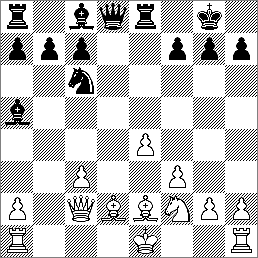
- 15.0-0 Bb6 [0:55-0:55] 16.Kh1 Qe7 17.Nd3 Ne5
- Gunsberg: 17...f5 looked very tempting, but would have been met with 18.Nf4. If then Black 18...fxe4, White retakes and obtains a very open game, for if 19...Qxe4 20.Bd3. There were also other moves, as Bc4+, by which White would obtain a formidable attack.
- Steinitz: If 17...f5 instead, White would answer 18.Nf4, and if then 18...fxe4 19.fxe4, and evidently Black dare not again capture on account of the reply 20.Bd3, and anyhow White gets a powerful attack.
- 18.Nxe5 Qxe5 19.Bd3
- Steinitz: White might, perhaps, have pressed the attack with more prospects of success by 19.f4 Qxe4 20.Bd3, followed by 21.Bxh7+.
- 19...Rd8
- Gunsberg: In anticipation of 20.f4, which now could be parried by 20...Qd6.
- 20.Rad1
- Steinitz: If 20.f4 Qd6 21.Rad1, and now Black dare not take the bishop on account of the reply 22.Bc1, but he wins, nevertheless, by 21...Bg4.
- 20...Be6 [1:11-1:11] 21.Bc1 Qa5 22.c4 Bd4
- Gunsberg: The bishop is here well posted, as it also prevents the adverse bishop from going to b2.
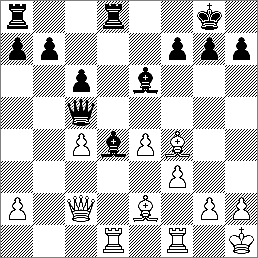
- 23.Bd2 (Adjourned) 23...Qh5 (Sealed) [1:24:30-1:37]
- Gunsberg: At this stage the game was adjourned for dinner at 5pm.
- 24.Bf4
- Gunsberg: White might have proceeded here more attackingly with 24.f4.
- 24...c6
- Gunsberg: Of course not 24...Be5, because of 25.g4, winning a piece.
- Steinitz: A very good move. It helps Black to obtain the drawn result, and is much stronger than 24...c5.
- 25.Be2
- Gunsberg: Here again 25.e5 would have been played by an attacking player.
- 25...Qc5 [1:34-1:50] ½-½
- Steinitz: Black threatens now ...b5, and the game is now well balanced that a draw is a fair result.
The Sun, New York, 1890.12.10
The World, New York, 1890.12.10
New-York Daily Tribune, 1890.12.10
Morgan's Chess Library, Book VIII, 1891, p43
STEINITZ SCORES A FINE GAME.
GUNSBERG BEATEN AT ALL POINTS - HIS OPPONENT SHOWS HIM HOW
TO DEFEND A RUY LOPEZ.
The result of Tuesday’s game in the match between Steinitz and Gusnberg, which is being played at the rooms of the Manhattan Chess Club, gives the contest at once an increased interest for chess players. The innovation introduced by Steinitz, coupled with the smart defence which Gunsberg set up, were also important factors in augmenting the interest of the encounter.
When Gunsberg yesterday, somewhat contrary to general anticipation, made a Ruy Lopez opening, curiosity to see the manner in which he would conduct it was added to the already aroused interest, and just before the adjournment of the afternoon session the moves were being closely followed by a large number of spectators in the club-room where they were being recorded on the big diagram board. At this time it was readily seen from the position that Gunsberg had a very bad game. Indeed, on all hands it was confidently declared to be a won game for Steinitz, and in some quarters surprise was expressed that Gunsberg did not resign, instead of allowing the game to be adjourned from 5 till 7 o’clock. Of course this latter was a prejudging of the case, for it was just possible, though by no means probable, that Gunsberg saw a way out of his difficulties.
As the result showed, however, it would appear as if he pursued the game in the hope of something good suggesting itself by which he could bring about a draw. On the resumption of play most of the moves were made rapidly, and almost every move of White that was sent down the bearer was asked if he had yet resigned.
Dr. F. Mintz, the president of the Tournament and Match Committee, who has control of the match arrangements, desires The Tribune to publish the appended statement which he makes on behalf of the club: “One of the city papers having severly commented upon the exclusion of reporters from the room of play, the officials of the Manhattan Chess Club desire to state that they have arranged for this match for the benefit of the members and the subscribers to the match fund and have granted to the players the sole right of publication of the games. It must be distinctly understood that neither we nor the members derive any monetary benefit whatever from the affair, and that we have arranged for the contest and subscribed $1,050 for the sole purpose of giving our members an interesting and instructive entertainment. The nature of the game is such that when played in a comparatively small room we are compelled to exclude reporters from the actual room of play, which in this case is a small one. We have, however, put up in our large club-room a giant diagram board on which the moves are recorded as they are made, and press representatives are at liberty to enter the club and watch the progress of the game on this board and to write whatever they choose for their respective papers so long as they do not print the scores of the games, which are the absolute property of the players.”
To deal more fully with the play. It will be seen that Steinitz played right away in due observance of the principles which he has laid down in his chess works, by defending this opening (the Ruy Lopez) by playing P-Q 3 as his third move. Gunsberg now followed by taking up one of the leading variations exemplified in Steinitz’s works, viz., 4 P-Q B 3, and anticipating the probability of Gunsberg’s having come prepared with something on this particular line of attack, the “great theorist” at once turned his attention to other tactics that have hitherto remained without analysis and are comparatively new to the chess world. He adopted a plan of development on his fifth move which was originally introduced in the Sixth American Chess Congress by Martinez. Gunsberg’s seventh move clearly showed that he was entering into a defence upon the blocking plan, which is frequently adopted by first-class masters, because it sometimes evolves a brilliant game. According to Steinitz’s theories, however, it compromises the ending.
The next few moves saw a development of the King’s side, on the part of Black, in preparation for castling, while an attempt was made by White to work his Kt in at K 3, with the ultimate idea of occupying a strong position at K B 5. On the tenth move Black entered on a counter demonstration, which may be said to resemble in some respects that of Gunsberg in the first game, attacking the adverse K P with his Kt. After defending here, White took an early opportunity to attack the Kt with his Q Kt P, but then Black’s piece gained strong entrance into the “hole” at Q R 5. Later Black effected a long prepared breach in the centre by advancing his K B P. After his seventeenth move, Black proceeded to force the exchange of Q’s, and by clever manipulation of the rooks on the open files he greatly improved his position, and at the adjournment threatened to occupy the strong post at Q 7 with one of his rooks. After a gallant fight to no purpose, on the part of Gunsberg, Steinitz captured the pawn, and being the exchange ahead, he easily forced a win after forty moves on each side. Gunsberg deliberated fifteen minutes before he decided to resign.
New-York Daily Tribune, 1890.12.12
STEINITZ DRAWS FIRST BLOOD IN AN EXCELLENT MANNER.
Gunsberg’s Attack Was Weak and to No Purpose, While the Champion
Made a Beautiful Defence in the Spanish Game.
When play was resumed yesterday in the championship chess match at the Manhattan Chess Club there was not so large an attendance of members as on the opening day, but as evening drew near the club room began to assume a more animated appearance, and the game provided a fund of interesting points for discussion and comment.
Despite the fact that Steinitz for several reasons did not begin the day in a settled frame of mind, it will be seen from the character of the game that this did not militate against his powers of play. Before the opening of the game he entered an opposition to the objection made by Gunsberg, which resulted in the total exclusion of reporters from the room, and ultimately, as the result of his efforts, Gunsberg assented to the admission of one or two special chess reporters, including the representative of THE SUN, on the understanding that they should not write out their reports in the room, which he considers too small for the purpose.
By many it was expected that Gunsberg would offer an Evans gambit to his opponent, who, it may be remembered, stated some time ago that he would undertake to play the defence in the Evans’ four times with Gunsberg from a certain position which at that time had been reached in his game with Tschigorin. Several persons expressed, with some confidence, the opinion that Gunsberg would take up this challenge, if challenge it may be called; but a few moves soon showed the spectators that he had selected the Ruy Lopez. It is only fair to say, however, that Gunsberg has never been known to play the Evans Gambit in match games. It is a pity that he did not offer Steinitz a chance to redeem his declared intention, for then we should have had a revival of the old interest which was evinced in the Evans cable game when it was adjourned. It would really have been like a continuation of the cable fight. As the game progressed it took little penetration to see that Gunsberg was making a weak development of his pieces and the climax of his bad play wa reached when, on his eighteenth move, he made a blunder which gave his antagonist the advantage of the exchange, and before the adjournment it was equally clear that nothing short of the intervention of a miracle would prevent Steinitz from winning easily.
Steinitz played in accordance with the theory laid down in his book - defending the Ruy Lopez by 3...P-Q 3 - whereupon Gunsberg started one of the leading variations from the same work, viz., 4 P-Q B 3, and Steinitz, not knowing whether his opponent had anything of a special nature prepared in that particular line of attack, immediately adopted other tactics which have not yet been analyzed. On the fifth move he adopted a plan of development for the K Kt at K 2, which, in a similar position, was first introduced by Martinez of Philadelphia in the sixth American Congress. On the seventh move Gunsberg’s plan of action was declared, and his defence of P-Q 5 showed that he was playing for the crowding and blocking system, which, according so Steinitz’s theories, somewhat compromised the ending, but us nevertheless often made use of by first-class masters, as it sometimes leads to brilliant games.
During the next few moves black simply developed the king’s side ready for castling, while white tried to manoeuvre his Kt into the centre at K 3 with a view to keeping the strong post at K B 5. Black on the tenth move entered upon a counter demonstartion in the centre, attacking the adverse K P with his Kt, and white, after defending, took the earliest opportunity to attack that Kt with his Q Kt P, but black’s pieces then gained strong entrance into the “hole” at Q R 5. White proceeded with the advance of pawns on the Q side, while black on the fourteenth move effected a long prepared breach in the centre with the advance of his K B P. After some moves for the development and preparation of an attack by black, who had evidently the pull on both wings, the crisis came on his seventeenth move, which threatened a dangerous exchange that would have allowed black’s Kt to jump in at the “hole” at white’s K B 4.
In trying to avoid that white lost the exchange. After this black proceeded to force the exchange of queens and then to get strong entrance with his rooks, first on the open K B file and afterwards in the Q file. At the time of adjournment, it being white’s twenty-seventh move, which he sealed, black threatened to occupy the strong post at Q 7 with one of his rooks, which seemed to win a pawn.
On play being resumed at 7 o’clock black succeeded in capturing the pawn, and being the exchange ahead, it only became a matter of time. Steinitz pressed the pace and Gunsberg resigned at his forty-first move after taking fifteen minute’s consideration.
The Sun, New York, 1890.12.12
THE ENGLISH CHESS-PLAYER RESIGNS AT FORTY-ONE MOVES.
He Adopted the Ruy Lopez at the Opening of the Second Game
at the Manhattan Chess Club Rooms - Remarkable Judgment Displayed
by Mr. Steinitz - Many Spectators.
The undecided result of Tuesday’s battle has apparently whetted the appetite of chess amateurs, as was plainly shown yesterday by the rooms of the Manhattan Chess Club being crowded. Gunsberg was credited with having achieved a moral victory in the last fray, and so the spectators looked eagerly forward to the events of the day. The Anglo-Hungarian player, having the move, cautiously adopted a Ruy Lopez, to which his antagonist replied with P-Q3 on his third move. Mr. Steinitz had this move first adopted against Senor Golmayo and other amateurs in Havana, and has recommended it, together with the continuation B-Q2, both in his books and in analytical notes. The first player might have transformed, now, the game into a well-known variation of the Philidor defense by playing his pawn to Q4, which is considered by all the authorities as in white’s favor. He, however, moved contrary to his usual agressive style - P-QB3. Later on he pushed his QP to Q5 and a position ensued similar to what is known as the Hungarian game. White temporarily was compelled to retire his QKt home but the advanced QP proved subsequently a source of weakness. In the tenth move Mr. Steinitz displayed his remarkable judgment of position by posting his Kt at QB4, which proved to be a thorn in the opponent’s side.
On the other hand Gunsberg, laboring under the disadvantage of a cramped position, made a few aimless moves which enabled black, by a brilliant stroke, to win the exchange. On the twenty-sixth move the game was adjourned and, after resumption, white continued the hopless struggle against numerical force up to the fortieth move, when he resigned after nearly four hours’ play.
The next game will be played next Saturday at 1:30 P.M.
An erroneous report has been circulated that Mr. Gunsberg objects to the presence of reporters during play. The representatives of the press are welcome to be at the Manhattan Chess Club all day and to do their work there. As to their entrance into the players room, Mr. Gunsberg is not only not opposed to it, but will be pleased to see them.
The World, New York, 1890.12.12
Date: 1890.12.11
Site: USA New York, NY (Manhattan Chess Club)
Event: World Championship Match (Game 2)
White: Gunsberg,IA
Black: Steinitz,W
Opening: [C62] Spanish
Annotators: Gunsberg & Steinitz
Site: USA New York, NY (Manhattan Chess Club)
Event: World Championship Match (Game 2)
White: Gunsberg,IA
Black: Steinitz,W
Opening: [C62] Spanish
Annotators: Gunsberg & Steinitz
- 1.e4 e5 2.Nf3 Nc6 3.Bb5 d6
- Gunsberg: Steinitz recommends this move as the safest defense to the Ruy Lopez.
- Steinitz: A defense that has been little thought of though occasionally tried by old masters. Recently I gave it as the best in my “Modern Chess Instructor,” but there is still some opposition to it.
- 4.c3
- Gunsberg: Very tame and not suited to White’s character of play. 4.d4, as remarked above, would have led into a variation of Philidor’s Knight game, which, with the sole exception of Steinitz, is considered in favor of the first player.
- Steinitz: A sort of Giuoco Piano attack which holds good in many variations in this opening.
- 4...Bd7
- Steinitz: 4...f5 is the answer given in the “Modern Chess Instructor,” but I considered the text move equally good.
- 5.0-0 Nge7 [0:05-0:05]
- Steinitz: If 5...Nf6 6.d3, etc.
- 6.d4 Ng6 7.d5
- Gunsberg: Although Black loses ground temporarily, the white queen’s wing is weakened by this advance.
- Steinitz: A question of style, in which I am opposed to many masters.
- 7...Nb8 [0:15-0:15] 8.Bxd7+ Nxd7 9.Na3
- Gunsberg: This and the next move of the knight are pure loss of time.
- Steinitz: 9.c4 followed by 10.Nc3, was, I believe, his best plan.
- 9...Be7 [0:19-0:19] 10.Nc2 Nc5 [0:19-0:26]
- Gunsberg: Black with tactical sagacity posts his knight where it does the most good. Although it is self-evident that the subsequent entrance of this piece at c3 via a4 could not be foreseen at the present stage the second player shows his master hand by selecting the best spot available for his avant garde.
- Steinitz: This knight is now strongly placed, for, as will be seen, it could not be dislodged without further disadvantage for White.
- 11.Qe2 Qd7
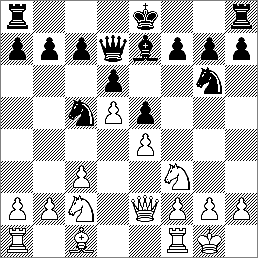
- 12.b4
- Gunsberg: This weakens his queen’s wing. He had, however, to guard against ...Nf4, which would have forced him to give up his bishop for the knight, as well as against ...Qg4.
- Steinitz: 12.b3 was, I think, much preferable.
- 12...Na4 13.Bd2 0-0 14.c4
- Gunsberg: Very weak. 14.g3 ought to have been played here. White’s play is far below his usual standard.
- 14...f5
- Gunsberg: Black presses the attack with his noted vigor and precision.
- Steinitz: Having arranged his pieces in battle order, Black proceeds with his attack against the obvious mark in the king’s center.
- 15.exf5 Qxf5 [0:54-0:36] 16.Rac1 Rae8 [0:54-0:58]
- Steinitz: I studied twenty minutes for this move because 16...Nb2 seemed to yield some promise, but on consideration I concluded to make another strong developing move, which was sure to be useful in the end.
- 17.Nfe1
- Gunsberg: 17.Kh1 was better.
- 17...Bg5
- Gunsberg: An excellent move. White cannot afford to take this bishop, as the adverse knight will finally enter at f4.
- Steinitz: There is hardly any escape from this that I can see.
- 18.g3
- Gunsberg: Too late now.
- Steinitz: If White had played 18.Bxg5 then 18...Qxg5, followed by 19...Nf4 or 19...e4, accordingly with an irresistible attack.
- 18...Nc3
- Gunsberg: A brilliant and suprising coup, which crushes White’s game entirely.
- 19.Bxc3
- Steinitz: Forced.
- 19...Bxc1 20.Ng2 Qf3 [1:24-1:29] 21.Qxf3 Rxf3 22.Nge3 Bxe3 23.Nxe3 Ref8 24.Kg2 c6
- Steinitz: This is the decisive move that breaks the pawns and gains entrance for Black’s rooks in the adverse camp.
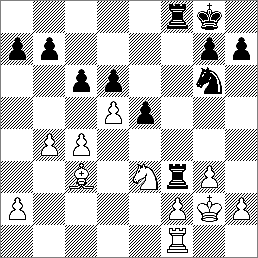
- 25.Bb2 cxd5 [1:34-1:34] 26.Nxd5 Rd3 (Adjourned)
- Gunsberg: Threatening to win a pawn by ...Rc8.
- 27.Bc1 (Sealed) 27...b5 28.Ne3 bxc4 29.Nxc4 Rd4 30.Ne3 Rxb4 [2:04-1:34] 31.Rd1 Rb1 32.Ba3 Rxd1 33.Nxd1 Rd8 34.f3 d5 35.Nc3 d4 36.Ne4 Rb8
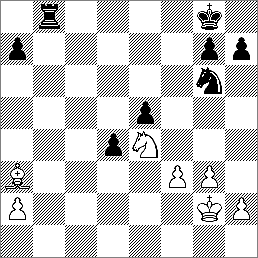
- 37.h4 h5 38.Kf2 Rb1 39.Bd6 Rb2+ 40.Ke1 Rxa2 [2:12-1:41] 0-1
The Sun, New York, 1890.12.12
The World, New York, 1890.12.12
New-York Daily Tribune, 1890.12.12
Morgan's Chess Library, Book VIII, 1891, p44-45
THE THIRD GAME IN THE SERIES A DRAW.
STEINITZ AGAIN OFFERS THE QUEEN’S GAMBIT AND MAKES AN
INTERESTING VARIATION.
By degrees the interest in the Steinitz-Gunsberg match steadily grows, and although, when the masters sat down to begin their third game at 1:30 p.m. yesterday, there was only a small attendance, during the afternoon and evening the club-rooms of the Manhattan Chess Club, where the match is being played, were well filled.
Steinitz, in offering again the Queen’s Gambit, at once put an additional interest into the encounter. The offer was just as promptly declined by Gunsberg as on Tuesday, and in exactly the same manner. Chess players who expected that after this Gunsberg would proceed with the same defence which he had previously adopted were doomed to disappointment, for the Hungarian on his third move deviated from the first game by playing P-Q B 3, instead of Kt-K B 3.
Naturally this change might be considered a desirable one by some followers of the game, the more so that this new variation promised much in the shape of instruction. It followed now as an obvious consequence that Steinitz’s proceedings had to be altered and fitted to the new tactics of his opponent. Eventually Gunsberg managed to isolate the pawn of his adversary on the queen’s file, which ought to have given him a considerable advantage. Several of his succeeding moves, however, which were described by the spectators as premature if not actually useless, enabled Steinintz to double his rooks on the queen’s file and to assume a consequently threatening attitude. Gunsberg thereupon found himself compelled to proceed with a rapid exchange of pieces, which not only brought to Steinitz’s isolated pawn, but gave Steinitz the opportunity of redeeming the time which he had lost in the early part of the game. This will be readily seen when it is stated that after twenty moves had been made Steinitz had consumed one hour and twenty-two minutes to his opponent’s fifty-six minutes, whereas at the time of the adjournment, after twenty-seven moves had been recorded on the score-sheet, Mr. Gunsberg’s time stood at one hour and forty-six minutes and his opponent’s at one hour and forty-five minutes.
Dealing in more minute detail with the game it will be seen that after the variation on the third move Steinitz proceeded with the same development as in the first game, by playing 5 P-K B 3. His opponent next gained a move by playing B-Kt 5, instead of first moving the Kt to B 2 and then to Kt 5 as he did in the first game. He then immediately entered upon an attempt to break the centre by Q Kt-Q 2, and Steinitz played K Kt to B 4 instead of to K B 2 as he did in the first game, and this he himself looks upon as an improvement upon his previous play. His eigth move, B-K 2, however, was hardly as good as B-Q 2. He might also have done better by retaking with the queen. Afterward White forced the withdrawal of his opponent’s K B. An exchange of minor pieces soon followed, and it then became apparent that Gunsberg was aiming at a draw, which was probably the best thing he could do, for although White’s queen’s pawn was isolated, it greatly hampered Black’s game and might ultimately become very strong. Later on White succeeded in concentrating his rooks on the open king’s file, and Black then altered his tactics with winning purposes in view. He directed his attack upon the isolated Q P, but soon recognizing that he could not make much impression in this direction, he returned again to the exchanging policy with the view of drawing.
At the adjournment, when Gunsberg sealed his twenty-seventh move, the pieces and pawns were even, each side having a queen and one rook on the board. Black’s king and bishop, however, were confined, while White had a greater freedom for those pieces. After the resumption of the play at 7 o’clock only one more move was made on the board, this being the twenty-seventh move of Gunsberg, which had been already sealed when the game was adjourned. It was certainly a very good one, as it offered the exchange of queens, which it would have been a very difficult matter for White to avoid, and it furthermore liberated the confined king. For the space of about twenty minutes deliberated upon a reply, and then he finally agreed upon a draw, which was suggested by Gunsberg.
New-York Daily Tribune, 1890.12.14
ANOTHER DRAWN BATTLE - BOTH MASTERS AT THEIR BEST.
At First Gunsberg Made a Good Stand, While the Champion Had to
Think - Later the Hungarian’s Position Became Difficult,
but Fine Play on His Part Secured for Him the Division of Honors.
When the third game in the championship chess match began yesterday morning at the Manhattan Chess Club in West Twenty-seventh street there was only a meagre attendance of members in the large club room; but as was the case on Thursday, as the afternoon progressed the number of spectators began to increase. What made matters more than ordinarily interesting from the start, was the fact that Steinitz again opened a Queen’s gambit, which, as on the first day, Gunsberg declined by playing P-K 3. The inference to be drawn from this proceeding on the part of Steinitz is that he had fully realized the mistake he made on the first day, and was satisfied that he could do better, if not actually win. He was evidently of the opinion that he could rectify the errors of judgment which marked his play in the first game, and presumably in this belief he entered for the second time upon the same opening.
It is frequently the case that when a master loses or draws a game in a certain opening he will take the earliest opportunity of playing the same opening again, provided he thinks he could improve on his previous play by substituting at times a different move or variation. From the point of view of the chess student yesterday’s game is a most valuable one when studied side by side with that of Tuesday, for from such a study the weaknesses of the earlier game will probably be exemplified in the second one. It will be seen, upon reference to the score, that Gunsberg thought it well not to pursue the same course which he adopted on Tuesday, for, as early as his third move, he entered upon a different course of defence. Instead of playing Kt-K B 3, as he did in the first game, he moved P-Q B 3. It is worthy of note that Steinitz took five minutes’ consideration on his fourth move and that he consumed twelve minutes upon his eighth move.
This careful deliberation indicated that Steinitz was once more treading new ground, while Gunsberg consumed much less time, probably because he had his course of action clearly planned in accordance with long-established principles.
It may be pointed out that when fifteen moves had been made by each player Steinitz had consumed an hour, and Gunsberg only 39 minutes. Attention may also be drawn to the fact that a clear advantage acerned [sic] to Gunsberg early in the game by his isolating his opponent’s Queen’s pawn.
Just before the time for the adjournment of the afternoon session many spectators declared that Gunsberg had thrown away the chances he had gained earlier in the game, and was obviously playing for a draw. And here it was, too, that Steinitz, on his twenty-seventh move, brought into operation one of his pet ideas by putting his king into play, with the idea of making use of him as a “fighting monarch.”
At the adjournment Gunsberg sealed his twenty-seventh move [...]
During the adjournment Steinitz was asked to give his opinion on the game as far as it had gone, and he said: “You are aware that though a Queen’s Gambit declined, this game differs very much from the one we played on Tuesday, in consequence of Gunsberg having adopted a different line of play on his third move. Although the position was thus at once altered, I still proceeded with the same line of development as in the first game, commencing with 5 P-K B 3. My opponent answered this time B-Kt 5, thereby gaining a move, for in the first game he had played B-K2 in a similar situation, and afterward B-Kt 5. He then proceeded immediately with an attempt to break the centre by Q Kt-Q 2, and I then played my K Kt-B 4, instead of K B 2, as in the first game, which, I believe, was some improvement. My eighth move, B-K 2, was probably not as good as B-Q 2. I think I should also have done better by retaking with the queen. Black’s twelfth move was, in my opinion, not a good one, and in his place I would have played B-Q 2, White then compelled a withdrawal of his adversary’s K B and proceeded. An exchange of minor pieces soon followed, and it became evident that black was playing for no more than a draw, and I think he could not do better than that, for white’s Q P, though isolated, greatly hampered his opponent’s game, and experts will recognize that in similar positions which arose in the game between Labourdonnais and McDonnell the Q P became ultimately very strong.
The further progress of the game was marked by the concentration of the rooks on the open king’s file on the [sic] white’s part, while black changed tactics and attempted an attack against the isolated Q P, evidently for winning purposes. He, however, soon recognized that he could not make much impression with his attempted attack, and again he entered on an exchange policy with a view of drawing. At the time of the adjournment, on the twenty-seventh move, the pieces and pawns were even, and there was this difference of position that black’s king and bishop were confined, while white had more freedom for those two pieces, each side having queen and one rook on the board.”
Some of the spectators were prepared to see the game proceed for fifteen or twenty moves more, and therefore it was a source of some little surprise when it was announced that a draw had been agreed upon, practically without any additional moves being made, for the only move recorded after the adjournment was the one which Gunsberg had sealed at 5 o’clock, when the two players arose for their two hours’ rest, viz.: 27. Q-Q 3, which on all hands was counted a good one. This movement made Steinitz think for about twenty minutes at the end of which time his opponent said: “It is nothing but a draw, Mr. Steinitz.” and the latter then assented to the proposal, saying: “Very well, all right.” This is what Steinitz has to say about the termination of the game: “Gunsberg’s twenty-seventh move, Q-Q3, was certainly a very good one, as it offered the exchange of queen’s, which white could hardly avoid, and it furthermore liberated the confined king. After I had looked a good while for my reply, Gunsberg interrupted by offering a draw, which was accepted.”
The Sun, New York, 1890.12.14
The Third Game in the Chess Contest a Draw.
GUNSBERG HAS NOT WON A VICTORY.
While the Veteran Player Has a Shade the Best of the Match Thus
Far Honors Are Rather Equally Divided - A Close Analysis of the
Important Moves Last Night - The Game in Detail.
The first week of the championship chess match has passed and while the younger player has not as yet a victory to his credit he has by no means reason to feel discouraged. He has twice succeeded in wresting the attack from his famous opponent, who had the advantage of the first move and who played an entirely novel variation, which, to all appearances, he had carefully prepared and analyzed. Although thrown upon wholly unknown ground Gunsberg came out both times with an advantage in position. Mr. Gunsberg failed to make good his advantage, but his friends assume that in the course of the match he will be able to do so despite the stubbornness of his opponent, for which he is so justly famous.
Mr. Steinitz having the move, again selected a Queen’s gambit, to which Gunsberg replied with P-QB3 on his third move. This move, recommended by Rosenthal, and adopted in his match against Zukertort, is a favorite defense of Gunsberg, who has played it successfully against Blackburne and others. Mr. Steinitz, too, chose this defense in the first part of his match against Zukertort, his QB, however, having been played previously to B4. In his analytical notes he disapproves of Black’s defending with P-QB3.
In yesterday’s game white pursued his plan of the first game, with the modification of playing his Kt-KB4 instead of B2. Black, as in the first game, rapidly developed his pieces, and, assuming the counter attack by P-K4, succeeded in isolating the hostile QP. On the fourteenth move, however, he impaired his chances of winning by allowing his KB to be exchanged, and, while the position was still in his favor, the road to victory was not clearly discernible.
After the adjournment, while Mr. Steinitz devoted twenty minutes to the consideration of the move by Gunsberg, the latter proposed a draw, which was accepted.
The score is now: Steinitz, 1; drawn, 2.
The World, New York, 1890.12.14
Date: 1890.12.13
Site: USA New York, NY (Manhattan Chess Club)
Event: World Championship Match (Game 3)
White: Steinitz,W
Black: Gunsberg,IA
Opening: [D31] Semi-Slav
Annotators: Gunsberg & Steinitz
Site: USA New York, NY (Manhattan Chess Club)
Event: World Championship Match (Game 3)
White: Steinitz,W
Black: Gunsberg,IA
Opening: [D31] Semi-Slav
Annotators: Gunsberg & Steinitz
- 1.d4 d5 2.c4 e6 3.Nc3 c6
- Gunsberg: Recommended by Rosenthal and invariably adopted by Gunsberg.
- Steinitz: With a view of playing ...dxc4 and then supporting the captured pawn by ...b5.
- 4.e3 Nf6 5.f3
- Steinitz: Black’s third move does in no way counteract White’s tactics, which are still quite feasible, and it also gives the first player a slight pull.
- 5...Bb4 [0:06-0:03]
- Steinitz: Certainly superior to 5...Be7 as played in a similar position in the first game of this match.
- 6.Nh3 Nbd7
- Gunsberg: While White moves by carrying out his plans of development, Black brings his pieces rapidly into play with a view of assuming the attack.
- Steinitz: Also better than 6...0-0 and 7...Re8; he gains his point of breaking in the center much sooner.
- 7.Nf4 0-0
- Gunsberg: Better than 7...e5 at once.
- 8.Be2
- Steinitz: This was probably not as good as 8.Bd2.
- 8...dxc4 [0:29-0:18]
- Gunsberg: In order to avert the danger of his d-pawn becoming isolated he ought to have exchanged pawns.
- 9.Bxc4 e5 10.Nfe2
- Gunsberg: After 10.dxe5 Nxe5 11.Qxd8 Rxd8, the position would be in Black’s favor.
- 10...exd4 [0:40-0:21]
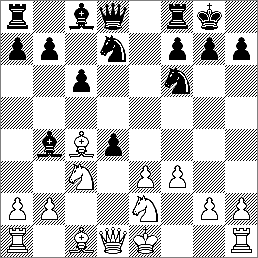
- 11.exd4
- Steinitz: Here 11.Qxd4 was undoubtedly stronger.
- 11...Nb6 12.Bb3 Bf5
- Steinitz: The bishop here is exposed to attacks and to being shut in; 12...Bd7 was much preferable.
- 13.Bg5 Be7 14.0-0 Nfd5
- Gunsberg: He would have done better to preserve his dark-square bishop, which would have rendered powerful assistance in keeping up the pressure on White’s weak d-pawn.
- 15.Bxe7 Nxe7 [1:00-0:39] 16.Ng3 Bg6 17.Nce4 Nbd5 18.Qd2 b6
- Gunsberg: To prevent the adverse knight from entering at c5.
- Steinitz: Black conducts his defense in an extremely difficult position with very good judgment.
- 19.Rae1 Qd7 20.Re2 Rad8 [1:22-0:56] 21.Rfe1 Nf5 22.Nc3 Nxg3 [1:30-1:20]
- Gunsberg: Perhaps 22...Nde7 would have been preferable.
- 23.hxg3 Nxc3
- Gunsberg: Not having adopted the line of play indicated above he had nothing better, for instance, 23...Nf6 24.Re7 Qxd4+ 25.Qxd4 Rxd4 26.Rxa7, with a slight pull.
- 24.bxc3 Rfe8 25.Qf4 Rxe2 [1:40-1:30]
- Gunsberg: Rather forced, for White would exchange rooks, followed by 28.Qc7.
- 26.Rxe2 Kf8 [1:40-1:30]
- Steinitz: For, if 26...Re8 at once, then 27.Qc7 Qd8 (best) 28.Qxd8, followed by Re7, with an excellent game.
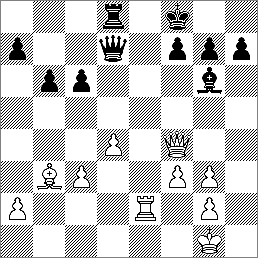
- 27.Kf2 (Adjourned) [1:45-1:46] 27...Qd6 (Sealed) [2:06-1:46] ½-½
The Sun, New York, 1890.12.14
The World, New York, 1890.12.14
New-York Daily Tribune, 1890.12.14
Morgan's Chess Library, Book VIII, 1891, p45-46
GUNSBERG COMPELS HIM TO RESIGN.
THE FOURTH GAME IN THE GREAT CHESS MATCH - THE
WINNER PLAYS A GIUOCO GAME.
The fourth game in the chess match now in progress between Steinitz, of New-York, and Gunsberg, of London, was begun punctually at 1:30 p.m. yesterday. As in the previous days of play, there was a small attendance at the beginning, but by and by the numbers increased, and those who were present during the latter part of the afternoon were well repaid for their visit by seeing an exceedingly interesting game in one of its most interesting phases.
Gunsberg had the move, and when he had played the first three familiar moves and Steinitz had replied, it was on all sides expected that now he was going to gratify a desire strongly felt in chess circles that he would offer Steinitz an Evans Gambit; but no, it was not to be. The fourth move declared his intention, which was to play a Giuoco Piano. The disappointment which was at first felt at his adoption of this course, however, soon gave place to a new interest which was kindled as the game went on. Steinitz, not satisfied with introducing a distinct novelty in each of last week’s games, now brings one forward which is perhaps even more interesting than any of those which went before. He acts in direct opposition, on his fifth move, to the universal recommendation of book writers, by taking off the bishop from K 3, instead of retreating his own bishop to Kt 3.
The game assumed an entirely different aspect upon the introduction of this novel variation, and was now watched with close interest. On his tenth move Gunsberg was threatening to capture one of his opponent’s pieces, and here Steinitz pondered long and deeply before he made his move, and then it was one which was pronounced by some to give Gunsberg the chance of putting into operation the move which would threaten to capture a piece. Gunsberg, however, did not pursue that course. He soon afterward massed his forces in an attack on the King’s side, and matters soon became more and more exciting, when Steinitz made a sortie on the opposite side of the board with his Queen, leaving his King well protected by several strong pieces.
The effect of this movement on the part of Black on the Queen’s side was to call away the attention of White from his meditated attack on the King’s side. At the time of adjournment it was unanimously agreed that the postion was a very interesting one. It was still in the middle game stage, and from its nature seemed to promise for the first time an evening’s entertainment. It is peculiar coincidence that for the fourth time Gunsberg was the player who had to seal his move when the time for adjourning arrived.
The expectation of a longer evening session than usual was realized, but after about and hour’s play it was agreed that Steinitz was getting the worst of it, and as further moves were made the opinion became unanimous among the spectators that Steinitz had a lost game. At an early stage of the evening session Steinitz greatly handicapped himself for his subsequent play by consuming twenty-five minutes upon his twenty-ninth move. This obliged him to play hurriedly at a later stage. Just about as the clock struck 9 Steinitz resigned on the fifty-seventh move, and the Hungarian player drew up alongside of his veteran opponent.
New-York Daily Tribune, 1890.12.16
GUNSBERG DEFEATS STEINITZ IN GRAND STYLE.
The Veteran Took the Youngster “Out of the Book”
- The Latter Did Not Mind it -
He Pressed On Early in the Game and Scored Beautifully
After 57 Moves.
For the first time since the beginning of the Steinitz-Gunsberg match in this city peace marked the opening of the proceedings yesterday afternoon at the rooms of the Manhattan Chess Club, where the two masters are playing. On each of the three prededing days of play there has occured some sort of unpleasantness. Yesterday, however, such occurrences were conspicuous by their absence.
It was Gunsberg’s turn to open, and when the first three moves on either side had been recorded on the big show board in the club room, the few spectators who were assembled there were at once filled with the anticipation that at last Gunsberg was going to give them an opportunity of seeing a highly interesting continuation or variation of one of the cable games, by opening an Evans Gambit. Such an opening at this juncture, as has already been pointed out, would for many reasons prove eminently interesting to chess players all over the world. But the fourth move of white brought disappointment in its train, and showed the spectators that instead of an Evans Gambit they were going to be treated by the Hungarian to a Giuoco Piano.
Steinitz proceeded to play against all the usually adopted methods of defence in this opening; instead of playing on his fifth move B-Kt 3, which is recommended as the best by the German Handbook, by Staunton, and in fact, by all other works on theory, he chopped down the B in K 3, thereby giving over the open bishop’s file to white’s rook. Of course this move altered the whole prospect of the continuation. After a few more moves some surprise was felt at the length of time taken by Steinitz to consider his tenth move, and when the amateurs set up the position and began to examine and analyze it they found an explanation in the fact that Gunsberg was threatening to win a piece.
Steinitz, of course, saw the difficulties of the position, and it took him twenty-one minutes’ deliberation before he was sufficiently satisfied in what way to try and obviate them. Finally he made a move which seemingly did not prevent the loss of the piece. What could not be elucidated at the moment by the majority of spectators was, however, pointed out by Major Hanham, who showed how white could not capture the piece. Next came Gunsberg’s time for thinking, and at the fifteenth move the time consumed by each player had been equalized, and stood at 45 minutes.
After white’s thirteenth move there was some talk about the difficulties, if not weaknesses, of Steinitz’s position. A believer in Steinitz declared his willingness to bet $10 that no member of the club could beat Steinitz in that position. If no other characters are to be found in chess circles, there are always some players who have any amount of confidence in themselves and their powers, and at this moment a “champion” came forward and declared that he could beat the great theorist in that position. The bet was registered.
As the game progressed it grew very interesting. White gathered his pieces in readiness of an attack on the king’s side, and it is deserving of mention that black never castled, being content to allow his king to remain surrounded by a number of trusty officers, while the queen was sent out on an exploring expidition. This introduced a welcome variety into the contest, for black’s trip with the queen necessitated white’s advancing with his queen’s pawn, and also forced him to abandon for the time his attack on the king’s side and turn his attention to the other side of the board, where a little side fight was going on independent of the main issue. When each player had made twenty-five moves there was a difference of ten minutes in favor of the younger player.
It is a noteworthy fact that on every occasion so far Gunsberg has been the one to seal his move on the adjournment of the afternoon sitting. This was the case yesterday.
When the game was resumed at 7 o’clock there was every prospect of an evening of interesting play. The previous games had all been finished soon after the commencement of the evening session, but yesterday’s was an exception. Steinitz too 25 minutes’ consideration on his twenty-ninth move, and then a number of rapid moves on both sides followed. It now became evident that Gunsberg was quickly getting the advantage. This superiority the Anglo-Hungarian maintained, until at length the spectators began to declare that Steinitz’s game was a lost one. Still he fought on to the Fifty-seventh move, when he struck his colors as the clock struck 9.
The Sun, New York, 1890.12.16
STEINITZ FORCED TO RESIGN ON THE FIFTY-SEVENTH MOVE.
The English Expert Chooses a Giuoco Piano, with Which He Has Won
Many Battles Against the Masters - The Record is Now One Victory
for Either Player; Two Games Drawn.
The second week of the chess match found both players in excellent health and spirits. It was Gunsberg’s move yesterday and he selected a Giuoco piano, a pet opening of his, with which he achieved some of his greatest triumphs over such formidable opponents as Blackburne, Mackenzie and Zukertort. Steinitz, in accordance with his theories, doubled white’s pawns on the king side by exchanging B, and threatened to create another double pawn by taking the adverse K B, which he attacked by Kt-Q R 4. White, however, counteracted his intentions. Black brought his queen early into play, which subjected him to a well-directed attack. On the twenty-ninth move he had to lose a pawn and on the thirty-third move Gunsberg won a piece. Steinitz fought gallantly against odds, but resigned after fifty-seven moves. The score is now: Steinitz, 1; Gunsberg, 1; drawn, 2.
After the conclusion of the game Gunsberg was congratulated all around. By this victory the match is now more interesting.
The World, New York, 1890.12.16
Date: 1890.12.15
Site: USA New York, NY (Manhattan Chess Club)
Event: World Championship Match (Game 4)
White: Gunsberg,IA
Black: Steinitz,W
Opening: [C50] Italian
Annotators: Gunsberg & Steinitz
Site: USA New York, NY (Manhattan Chess Club)
Event: World Championship Match (Game 4)
White: Gunsberg,IA
Black: Steinitz,W
Opening: [C50] Italian
Annotators: Gunsberg & Steinitz
- 1.e4 e5 2.Nf3 Nc6 3.Bc4 Bc5 4.d3 Nf6 5.Be3 Bxe3 [0:02-0:03]
- Steinitz: The Giuoco Piano has not yet come within the province of an analysis in my work, but it is generally known to first-class masters that I hold different views as regards the treatment for the defense to those which have been long established, and it may be assumed that Gunsberg either really discovered a flaw in my demonstrations, or merely thought so. One if the main points of my divergence from the accepted notions occurred as early as the fifth move, where my line of play in capturing the bishop and opening the adverse f-file for the opponent’s rook has generally been condemned hitherto. This variation I played first against Mason in Vienna in 1882.
- 6.fxe3 d6 7.0-0 Na5 8.Bb5+
- Steinitz: Another feature of my defense in this opening came out on my seventh move, and then my opponent entered on a line of attack that is already known to experts in similar positions, viz., to check with the bishop at b5, with a view of drawing on the adverse pawns on the queenside and thereby weakening them.
- 8...c6
- Gunsberg: Black intends to take the bishop, after which White would remain with doubled pawns on b-file and e-file. White’s mode of playing this opening always been to develop his pieces rapidly and to castle either on the queenside, or when the f-file is open, as in the present game, on the kingside.
- 9.Ba4 Qb6
- Gunsberg: Had Black played 9...b5 10.Bb3 Nxb3 the command of the open a-file and the weakness of Black’s a-pawn would fully compensate White for the inferior position of his pawns. Black’s move in the text is not favorable. It is contrary to established principles to bring out the queen so early in the game.
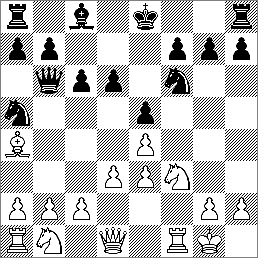
- 10.Qd2
- Gunsberg: An important developing move.
- Steinitz: My counter attack against the b-pawn on the ninth move was apparently hazardous, for my opponent, in his answer, threatened to confine and ultimately win my queen in case I took the b-pawn, and otherwise he threatened to win a piece.
- 10...Ng4 [0:09-0:32]
- Gunsberg: If 10...Qxb2 11.Qxa5 Qxa1 12.Nbd2 Qb2 13.Rb1 would win the queen, as Black can neither take the a-pawn nor play 13...Qa3, because of 14.Bxc6+.
- 11.Re1
- Gunsberg: He might here have won two minor pieces for the rook by 11.b4 Nxe3 12.bxa5 Nxf1+ 13.axb6 or 13.Kxf1. But Black would remain with an unbroken phalanx of eight pawns and White should ultimately lose his far advanced pawn.
- Steinitz: On my tenth move it was evident that I intended to sacrifice two minor pieces for the rook and at least one pawn (in some variations I would have got two) with a strong game for the ending, the exchange of queens being forced. But Gunsberg avoided that contingency, and I think very wisely, and then I had to direct my attention to the release of my confined a-knight, which was fully accomplished on my thirteenth move.
- 11...Qa6 [0:29-0:33] 12.c3 f6 13.Bc2
- Gunsberg: White has succeeded in preserving his bishop. Had he played 13.b4, Black would have replied with 13...b5.
- 13...c5
- Steinitz: At this point I believe I would have done better by playing 13...b6 and then retreating ...Nb7 and ...Nd8, which would have made both wings inaccessible to the adverse pieces. The move actually left a “hole” at d5, which, however, was much compensated for by the adverse double pawn in the center. My opponent then turned his attention to that “hole” at d5 which he tried to occupy with one of his minor pieces, and a lively struggle followed pro and contra. As it was, White had the opportunity of instituting an attack in the center, and on the kingside alternately, and though by best play it should not have amounted to much, yet it caused heavy work which might have been avoided.
- 14.b4 cxb4
- Steinitz: Inferior to 14...Nc6 at once, which would have made it very difficult for the adverse b-knight to get into good play.
- 15.cxb4 Nc6 [0:45-0:45] 16.Bb3
- Gunsberg: Better than 16.a4.
- 16...Qb6 17.a3 Bd7
- Gunsberg: If 17...a5, then 18.Nc3.
- 18.Nc3 Ne7 19.h3 Nh6 20.d4 Rd8 [1:00-1:13]
- Gunsberg: Perhaps 20...Rc8 at once would have been better.
- 21.Rf1 Rf8
- Gunsberg: A very useful move; if Black now plays 21...Nf7, with the object of castling, then 22.Bxf7+, followed by 23.dxe5, winning a pawn through the presence of the rook on f1.
- 22.Qf2
- Gunsberg: Threatening dxe5 and Nxe5 and also Ng5.
- 22...Rc8 23.Rac1 Qa6 24.a4 Qb6 25.b5 Qa5 [1:27-1:37] 26.Qb2 Nf7 (Adjourned) [1:41-1:39] 27.Nd2 (Sealed)
- Gunsberg: White now changes his plans, as he wants to attack the weak d-pawn by Nc4.
- Steinitz: At the adjournment White made a very fine move, the sealed one, which threatened Bxf7+, followed by Nc4. Matters became here very difficult for Black, who, as usual in such cases, consumed much of his time, and then had to play very hurriedly when the crisis came.
- 27...exd4 [1:53-2:00]
- Gunsberg: He has to guard against the loss of a pawn by Nc4.
- 28.exd4 Qb6 29.Ne2 d5 [1:54-2:25]
- Gunsberg: Making a strong effort to gain room for his knight and reckoning upon recovering the pawn later on.
- 30.exd5 Nd6 31.Qa3
- Gunsberg: Best.
- 31...Kd8
- Gunsberg: A mistake which loses a piece. 31...Nef5 was the proper move.
- Steinitz: Black first of all sacrificed the d-pawn in order to free his knight on the twenty-ninth move, and this was seemingly good enough, but in reply to a cleverly laid trap, Black played hastily his king, and committed one of those blunders which perhaps more often in proportion occur in heavy match games among masters in consequence of the great mental strain to which contestants are subjected than in light skittles among inferior players. Such captious critics are apt to deride the players when such a thing occurs, and I can only point out in anticipation of any such remarks that a donkey will always go his trot without stumbling while a race-horse may break neck or limbs in a run of a few seconds. After that I might have perhaps improved my defense and made a harder fight of it, but naturally I got demoralized.
- 32.a5 Nxb5
- Gunsberg: His only alternative would have been 32...Qxb5 33.Qxd6 Qxe2 34.Rxc8+ Kxc8 35.Rc1+ Kd8 36.Ba4, and wins.
- 33.Qxe7+ Kxe7 34.axb6 axb6 35.Nc4 Ra8 [2:12-2:38] 36.Ra1 Nd6 37.Nxb6 Rxa1
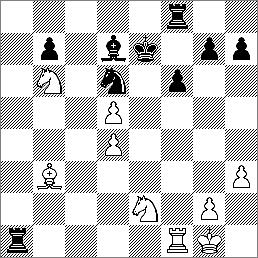
- 38.Rxa1 Bb5 39.Nf4 Kf7 40.Ne6 Re8 [2:15-2:45]
- Steinitz: Up to my forty-first move, and having very little time at my disposal by the stop-clock, I merely went on in order to pass that point and then to resign if I thought my game absolutely hopeless. There seemed to me some little chance for a draw in case my opponent made some weak moves, and it was legitimate for me to speculate upon that considering that I myself had committed a regular blunder. Some players will in such a position try to weary out their antagonist, not alone by the number of moves, but also by taking a long time for consideration. The former is more justifiable than the latter, but it is altogether a matter of discretion, and I think I may state that though I had plenty of time on my hands, I made my moves rapidly . My opponent as an experienced master did not hurry himself and played steadily and carefully. He avoided the exchange of rooks I was playing for, as then I hade some chance to enter with my king in the center and stop the doubled pawn or perhaps gain one or both of them, whereupon my passed b-pawn and the extra pawn on the kingside could have made an excellent fight for a draw. It came finally to a mating position from which there was no escape.
- 41.Ba4 Bxa4 42.Rxa4 g6 43.Nc4 Nf5 44.Rb4
- Gunsberg: Safer than 44.g4.
- 44...Re7 45.g4 Ng3 46.Nd6+ Kg8 47.Nxb7 Rd7 48.Nbc5 Rxd5 49.Kf2
- Gunsberg: Caught him.
- 49...Nf5 50.gxf5 Rxf5+ 51.Kg3 h5 52.Rb7 g5 53.Ne4 Kh8 [2:27-3:00] 54.Rg7 h4+ 55.Kg2 Ra5
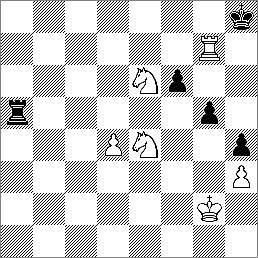
- 56.Nxf6 Ra2+ 57.Kf1 [2:27-3:08] 1-0
The Sun, New York, 1890.12.16
The World, New York, 1890.12.16
New-York Daily Tribune, 1890.12.16 & 1890.12.17
Morgan's Chess Library, Book VIII, 1891, p46-47
THE FIFTH GAME OF THE CHESS MATCH.
STEINITZ FOR THE THIRD TIME PLAYED THE
QUEEN’S GAMBIT - AN INTERESTING CONTEST.
Play in the Steinitz-Gunsberg chess match, which is taking place in this city under the auspices of the Manhattan Chess Club, was temporarily suspended on Wednesday at the request of the New-York player, who telegraphed from his home early that morning, stating that he was suffering from a severe cold. He did not appear to be completely recovered when play in the fifth game began at the usual hour yesterday afternoon.
It was Steinitz’s turn to play, and there was no little astonishment when for the third time he offered a Queen’s Gambit, which Gunsberg this time did not decline. The persistency of Steinitz in making this opening, after he had twice tried it and only been so far successful as to bring about a draw in each occasion, cannot but be admired by chess-players. Whether he expected Gunsberg, however, to accept the proffered gambit or to reject it as he had previously done, is a matter for speculation. Be that as it may, the Anglo-Hungarian showed himself a formidable antagonist on this occasion, and he succeeded in producing in the course of his play some exciting specimens of his powers of position judgment which cannot fail to prove attractive to the student.
The spectators at an early stage were aroused from a comparatively passive interest into one of unusual keenness, and a disciple of the principle of playing an open game at an early stage in defending predicted on the third or fourth move a victory for Gunsberg. As it happened, this premature prediction did finally meet with a fulfilment.
Gunsberg’s defence was based on the principles of the old masters in this opening, particularly so with reference to his third move, P-K 4. Instead of proceeding in the customary way by 4 B x P, Steinitz wiped out the opposing K P with his Q P, thus enabling his antagonist to effect an exchange of Queens and neutralize the advantage of the opening move. By the time the 10th move was completed on both sides, Gunsberg had a slight advantage of postion, to which he soon afterward managed to add the extra advantage of winning a Pawn by a very well wrought-out idea. Steinitz’s eleventh move was a weak one, and shortly after this Gunsberg managed to effect such a distinct improvement in his game that it was seen that all he required to do to become the master of the situation was to play with care. This he did by repelling in an admirable manner the repeated onslaughts of his opponent on the sixteenth, eighteenth and twentieth moves, and after clever play he announced “mate in five” on his twenty-fifth move, Steinitz resigning at his twenty-ninth turn.
It will be seen by chess-players who study the game that Steinitz again played in opposition to his own clearly defined principles by allowing his rival to obtain the majority of Pawns on the Queen’s side.
New-York Daily Tribune, 1890.12.19
GUNSBERG LEADS STEINITZ BY THE ODD GAME.
The Hungarian Added Another Masterpiece to the
Record - His “Mate in Five” Was Brilliant - Steinitz was Nowhere.
Any one entering the Manhattan Chess Club just before 1 o’clock yesterday afternoon would have found the two chess masters, Steinitz and Gunsberg, seated in friendly communion over a chess board in the club room, examining the position in the Evans game which Steinitz is playing in his cable match with the Russian champion Tschigorin. Steinitz did not, by any means, look bright; there were distinct traces remaining of the indisposition which prevented his playing on Wednesday.
The opening of yesterday’s game was another surprise to few early arrivals who were watching the movements on the big club room board. In the first place Steinitz for the third time offered a Queen’s Gambit, which this time, by the way of a change, Gunsberg accepted. A pleasant variety was thus introduced, which was augmented by Gunsberg’s promptly hewing down the pawn. After the two previous games in which he made a Q P opening had been drawn, Steinitz showed yesterday, in again making the same opening, a perseverance which would suggest either that he thought he had discovered really this time a solution which would enable him to win instead of drawing, or that he was determined to play the same opening until he does win.
Gunsberg, however, with a wisdom which is very commendable, declined to give his antagonist the opportunity of again testing the Queen’s Gambit declined, by accepting the proffered gambit. The new turn which was thus given to affairs rapidly developed new and interesting features. Upon the third move of black a strong amateur player who was present said that this playing an open game by Gunsberg was an excellent policy, and he would predict right off that the Hungarian would win. This, of course, was rather a premature prophecy, but immediately afterward queens were exchanged. Then Gunsberg once again put into practice the principles of his opponent by acquiring a majority of pawns on the Queen’s side, and he was soon generally pronounced to have by far the best position.
It will be seen on reference to the score of the game that Steinitz used twenty-three minutes in considering his eleventh move, and it was decidedly entertaining to watch him while he pondered over the board. At the beginning he complacently puffed his cigar and toyed with the smoke as it curled upward from his lips, but after a while he didn’t seem quite so easy. Meanwhile Gunsberg gazed on with that appearance of comfortable equinimity which one can always enjoy when witnessing the difficulties of an adversary. At last, when twenty-three minutes had been remorselessly ticked off by the eloquent little clock on his left, Steinitz pushed forward his K Kt and relighted his cigar.
When the fourteenth move of white had been made his position was declared to be an extremely bad one, and it was confidently predicted that Gunsberg had a win clearly before him. A member, who is not considered by any means a strong player, after consulting the board at this position said, “I think I shall have to finish this match for Steinitz. He cannot play any more.” Matters went on in the same way for some time longer, Steinitz’s position becoming more and more hopeless as the game proceeded. The excitement of the spectators grew with the increasing difficulties of the great theorist and the corresponding improvement in the Hungarian’s prospects until at last the climax came on Gunsberg’s twenty-ninth move, which was accompanied by the announcement that he had declared his intention of mating in five moves. Suffice it to say that Steinitz resigned on his twenty-ninth move, with a mate pending in two moves.
After the conclusion of the game, which was brought about after 2 hours and 5 minutes play, Steinitz was heard to declare his intention of playing the same opening again on Monday when his turn comes, and in fact again and again until he wins it.
A more particular description of the play is as follows: Steinitz opened again the Queen’s Gambit, which was accepted by Gunsberg, who defended in accordance with the theories laid down by the old masters, principally so by advancing on his third move P-K 4. Steintiz instead of proceeding in the usual way by 4 B x P, chopped off the opponent’s K P at K 5, thereby enabling Gunsberg to exchange queens and neutralize the advantage which a player, as a rule, possesses by having the opening move. On his fourth move Gunsberg castled on the Q side with a check, and his opponent then found a retreat for his king on B 2. After this the Hungarian proceeded discreetly to the development of his pieces Steinitz’s eleventh move, Kt-B 3, over which he spent a great deal of time, was rather weak one, and on the twelfth move Gunsberg had a little the better position of the two. Soon after this the latter, by a very well conceived move, succeeded in winning a pawn, and he soon improved his game so as to get a very good grip on his opponent. He never relaxed after once he had gained the material advantage. He retailiated in a beautiful manner to the repeated sorties of Steinitz - 16. Kt-R 4, 18. P-K B 4, 19. P-B 5, 20. P-K Kt 4. All these aggressive movements were of no avail for the great theorist; they were first quietly conteracted, and then assuming a powerful attack, Gunsberg reached the culminating point of his clever play by announcing at his twenty-fifth turn ‘mate in five.’ His play for the mate proved as sound and brilliant as his whole game, and Steinitz resigned when there was a mate in two moves.
The Sun, New York, 1890.12.19
NOW LEADING IN HIS MATCH WITH MR. STEINITZ
Brilliant Contest, in Which the English Player Announced a
Mate in Five Moves - The Score Now Is: Gunsberg, Two; Steinitz,
One - The Next Game Saturday.
Mr. Steinitz put in an appearance yesterday in good time at the Manhattan Chess Club. He explained that, having a slight cold, he did not care to venture out of the house yesterday on account of the severe weather which raged in Upper Montclair, N.J., the place of his residence. He seemed, however, to be in good form and in his usual tenaciously combative mood. In spite if the fact that in the first and third game, wherein he adopted the Q gambit, he could not make much headway, he nevertheless persisted in playing this opening to-day, which, to tell the truth, was generally expected by those who know him well. As on previous occasions, Gunsberg has shown that he is entirely independent of any particular line of play or studied analysis of the opening by again varying his line of defense as he accepted the proffered gambit pawn. In consequence of the line of play pursued by Steinitz, Gunsberg, with good judgment, effected advantageous exchange of queens, thereby forcing white to move his king, while black himself castled on the ninth move.
The position that resulted from the opening manoeuvres brought white’s king to QB2 on the tenth move. From that point, with every succeeding move, black developed his pieces in a telling way and brought increased and menacing pressure to bear upon the exposed adverse king.
On the fifteenth move, by a combination of his minor pieces and probably also by an error of judgment on the part of his opponent, black won a pawn. White did not obtain the relief which he expected. On the contrary black directed his forces against the exposed king with such effect that after twenty moves the coming catastrophe could be foretold.
On the twenty-fourth move black saw winning chances, which he grasped, and playing with great precision he obtained a position on the twenty-sixth move where, by a brilliant coup, he was enabled to announce a mate in five moves.
Needless to say there was great pleasure and rejoicing among the chess connoisseurs of the Manhattan Chess Club who had the privilege of witnessing this fine game. The prophets, both on this and the other side of the Atlantic, will have to find a new occupation. They ventured to predict - and Mr. Steinitz’s reputation and great achievements certainly warranted the forecast - that the veteran, as in past matches, would have matters all his own way with the English player, but the result shows that Gunsberg was too lightly reckoned and that once more he is following up his former brilliant achievements by making such a bold stand against the undefeated hero of twenty-five years’ battle. Whatever the final result now may be the brave fight will reflect honor on the younger player.
The sixth game will be played on Saturday. Gunsberg will have the move and great anxiety prevails among the chess community whether now, with the score in his favor, he will play an Evans gambit.
The World, New York, 1890.12.19
Date: 1890.12.18
Site: USA New York, NY (Manhattan Chess Club)
Event: World Championship Match (Game 5)
White: Steinitz,W
Black: Gunsberg,IA
Opening: [D20] Queen’s Gambit Accepted
Annotators: Gunsberg & Steinitz
Site: USA New York, NY (Manhattan Chess Club)
Event: World Championship Match (Game 5)
White: Steinitz,W
Black: Gunsberg,IA
Opening: [D20] Queen’s Gambit Accepted
Annotators: Gunsberg & Steinitz
- 1.d4 d5 2.c4 dxc4
- Gunsberg: In the two former games played at this opening I declined the Queen’s Gambit by 2...e6. This defense, in my opinion, leads to a close and often more interesting game than can be obtained by accepting the gambit.
- 3.e3
- Gunsberg: Usually prefered to 3.e4. White may, however, simplify matters by 3.Qa4+.
- 3...e5
- Gunsberg: The best continuation at Black’s disposal.
- Steinitz: Quit in the old style as played already by Labourdonnais and McDonnell.
- 4.dxe5
- Gunsberg: If now 4.Qa4+ Bd7 5.Qxc4 exd4 and Black obtains a speedier development for his pieces.
- Steinitz: The above masters invariably played here 4.Bxc4 instead.
- 4...Qxd1+
- Gunsberg: This exchange gives Black a slight superiority.
- 5.Kxd1 Nc6 [0:04-0:02]
- Gunsberg: 6.f4 may be played but the white pawns in the center would be clumsily situated.
- 6.Bxc4 Nxe5 7.Bb5+
- Steinitz: This I already played against Chigorin in a consultation game; the object is not to allow the knight to go back to c6, but it is probably better to retreat the bishop to e2 at once.
- 7...c6 8.Be2 Be6 9.Nc3 0-0-0+ 10.Kc2
- Gunsberg: In hope of playing out his dark-square bishop and a-rook and retire his king to b1.
- 10...Nf6 [0:11-0:05]
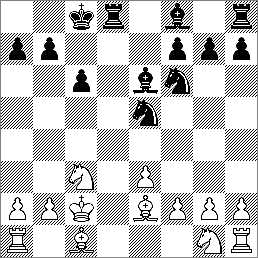
- 11.Nf3
- Gunsberg: 11.f3 instead seems preferable, although it would retard the development of his g-knight.
- Steinitz: 11.e4 or 11.f3 were the right moves at this juncture; and, in fact, the move made loses the game by letting too many of the adverse pieces in against the king.
- 11...Neg4 [0:34-0:09] 12.Rf1 Bf5+ 13.Kb3
- Gunsberg: It is already plainly evident that White will not be able to place his king in safety, as he imagined when playing 10.Kc2.
- 13...Nd7
- Gunsberg: The most forcible way to threaten with punishment the recklessly bold monarch.
- Steinitz: A very fine move which forces the gain of a pawn.
- 14.e4
- Gunsberg: The result of a miscalculation. White was of course bound to seek some opening for his pieces, but he must been under the delusion also that Black subsequently could not capture the pawn on account of the rejoinder 15.Nh4.
- 14...Nc5+ 15.Kc2 Nxe4 [0:38-0:19] 16.Nh4 Nxc3+ 17.Kxc3
- Gunsberg: White’s idea was probably to get rid of the troublesome adverse bishop, even at the cost of a pawn, but he probably overlooked the fact that if he now would take the bishop, Black would win a piece by 17...Nxe2.
- 17...Be6 18.f4 Nf6 19.f5 Bd5 20.g4
- Steinitz: This is a bad move, and 20.Nf3 at once was undoubtedly the proper play.
- 20...Be7 [0:46-0:29]
- Gunsberg: Threatening ...Ne4+, which would win a piece.
- Steinitz: Also a very fine move.
- 21.Kc2
- Steinitz: Forced as Black threatened to win a piece by ...Ne4+; nor could the g-pawn advance, as it would be lost by the same sally.
- 21...Be4+ 22.Kb3 Nd7
- Gunsberg: Once more the self-same move comes in very forcibly.
- 23.g5 f6
- Gunsberg: Effectively stopping the desperate though harmless rush of these pawns.
- Steinitz: Very fine play, as White cannot advance the pawn without creating an opening for the adverse rook that would be disastrous for him, and otherwise the whole of White’s attack on the kingside is completely stopped.
- 24.Bg4
- Gunsberg: A move wholly without effect in preventing the speedy dissolution of the game contemplated by Black.
- Steinitz: 24.Be3 was now the only defense. The text move draws White into the “mate” net.
- 24...Nc5+ 25.Ka3 Rd3+ [1:12-0:44] 26.b3
- Gunsberg: Black here announced mate in five moves.
- Steinitz: As will be seen the mate is accomplished in a most ingenious manner.
- 26...Na4+
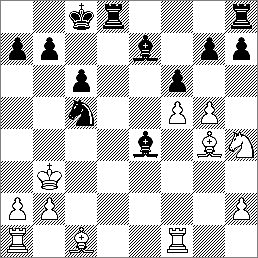
- 27.Kxa4 Rd4+ 28.b4 Rxb4+ [1:15-0:50] 0-1
- Gunsberg: If 29.Ka3, mate follows by 29...Rb5+ 30.Ka4 Bc2#. Or if 29.Ka5 b6+ 30.Ka6 Ra4#.
The Sun, New York, 1890.12.19
The World, New York, 1890.12.19
New-York Daily Tribune, 1890.12.19
Morgan's Chess Library, Book VIII, 1891, p48
THE CHESS MATCH MADE A TIE.
REFUSING TO TAKE ADVANTAGE OF THE TIME LIMIT - THE GAME.
The sixth game in the match between Steinitz and Gunsberg, which was played yesterday, proved more interesting to the spectators in some respects than any of its predecessors. There was a better attendance than usual in the Manhattan Chess Club’s rooms. When play began and for some time before the adjournment of the afternoon session there was an excited crowd gathered round the show-board in the big club-room, discussing in an unusually animated manner each move as it was made and the position of the game generally.
Steinitz was undoubtedly ill after spending one of his bad nights, while Gunsberg began the fight under the auspicious and encouraging circumstances of being a game ahead of his antagonist. The younger player brought a surprised look to the face of the veteran when he opened the game by P-Q 4, this time putting Steinitz in the position of defending a Q P opening, instead of carrying on the attack.
When about fifteen moves had been made Steinitz was considered to have achieved the advantage of position, and his game was declared to be in a great measure superior to that of his rival. Gunsberg, however, fought gallantly and managed to rid himself of many of the difficulties which beset his forces, and then Steinitz lost a pawn, which somewhat changed the aspect of what had hitherto been looked upon as a fine game for the “theorist.” A few more moves, however, and matters began to look much more promising for Steinitz.
It is a peculiar coincidence and one deserving mention, that Gunsberg again was the one of [sic] seal his move at the adjournment, which has been the case on every previous occasion. On all hands it was considered that the position as the contestants left it for the intermission was a very difficult one, and nobody ventured to declare that either one or the other of the players had the advantage. Playing under heavy pressure of time and in an extremely difficult and almost hopeless position, Gunsberg managed by a clever effort to bring into play his two Bishops, which had previously been lying in a useless and blocked position. Finally, however, after Steinitz had declined to claim a win because of his opponent’s having exceeded the time limit, he announced on his forty-first move “Mate in three,” and brought the game to an admirable and beautiful conclusion accordingly.
Taking the game from the beginning and dealing more particularly with the play, it will bee seen that Black was the first to advance Q B P, which is out of the usual groove. After White had castled, Black seemed in no hurry to place his King in security, but proceeded first to develop the Queen’s side. White’s eigth move, sometimes favored by Bird and Gunsberg, is one of which Steinitz disapproves. Black made his eigth and ninth moves with the intention of opening a centre and King’s side attack, which is scarecly in accordance with Steinitz’s style. On his thirteenth move Steinitz began to press his pawns on the Queen’s side, and was thereby successful in blocking both the adverse Bishops. Complications here seemed to arise and sacrificing tactics were expected by the onlookers. Steinitz, however, says that such a proceeding was not justified by analysis. Black lost a pawn on his twenty-second move, and as a matter of fact Steinitz himself admits that this was the result of an oversight, but fortunately for him, as the result proved, it led to a strong attack which caused White ultimately to spend thirty-four minutes in deliberation upon his twenty-seventh move, which was the one he sealed.
After the adjournment Black’s attention was directed to the concentration of his pieces against the King, and also to the prevention as far as possible of the exchanges which his adversary was evidently contemplating. His Rooks also became harassing to the adverse Queen, and White was finally obliged to give up the extra pawn, which had yielded him some hope of fighting effectually for a draw. Furthermore, Gunsberg’s King’s side was altogether compromised, but he made a sturdy defence. For a long time he warded off the disaster which loomed inevitably before him, but finally was obliged to succumb after the thirty-ninth move of his opponent which brought inevitably in its train a mate in a few more moves.
New-York Daily Tribune, 1890.12.21
HONORS DIVIDED SO FAR IN A SPLENDID FIGHT.
The Veteran Gave a Magnificent Display of Playing
Chess - True, He Blundered Once, but this Gave Him an Attack
Which Gunsberg Could Not Defend.
The sixth game in the Steinitz-Gunsberg chess match began yesterday morning, at the Manhattan Chess Club, under the most favorable conditions for the player from England, and he seemed perfectly at ease with himself and on good terms with the rest of the world. There must have been a great deal of satisfaction to him in the reflection that he was already leading, with two wins to his opponent’s one. Then, again, another thing greatly in his favor was the fact that undeniably Steinitz was unwell. In fact, in answer to a question on this point, Steinitz said he had scarcely had a wink of sleep all through the preceeding night and, furthermore, he had been obliged to leave home without his breakfast. It could be easily seen from his appearance that he was far from well, but if anything was required to make assurance on his head doubly sure, it is only necessary to add that the ever-constant Steinitzian cigar was absent during yesterday’s play. He had no heart for it, and those who know him will understand from this that his indisposition was not a trifling one.
The opening of the game was perhaps its most amusing feature. Gunsberg had the start, and he played P Q 4! Steinitz looked and looked at the board, and at last he smiled a faint smile.
“What, is it Q P you play?”
“Yes, I am going to try your game,” replied the Hungarian.
His next move, however, proclaimed it to be his intention to introduce a fresh variety of the Q P opening. During the early part of play Gunsberg rather handicapped himself by attending to the keeping of a double score of the game. After making his twelfth move his attention was so far distracted from the board that he got up from the table and left his clock still going. After the lapse of about a minute his attention was drawn to the fact, and for the moment he seemed to be under the impression that his opponent had replied. A glance at the board, however, showed him what was the matter, and he pressed down his clock and started that of his adversary, explaining, as he quickly looked up, “It was my own fault.” When Steinitz realized the position of things, of which he had hitherto remained oblivious, he said he thought the mistake should be rectified by Gunsberg putting back his clock; but the latter decided not to take advantage of the permission which had been given him to retrieve the lost time.
As the play progressed from the twelfth to the nineteenth move the opinion of the majority of the spectators quickly developed in favor of Steinitz, and it was declared that with equally careful play to that which he had already shown, he would be certain to win. It was a noticeable fact here, too, that he had the majority of pawns on the Q side, and with a superior game it might be said that his theory thus received a further proof of its soundness.
Almost from the beginning of play there was a large attendance of members and visitors in the club room, and they were soon rewarded by something interesting. Indeed, by the time white had made his twentieth move there was more than the usual excitement, and black’s reply was awaited with a considerable degree of interest and anxiety. Steinitz deliberated twenty-five minutes on this move.
The clever and astute defence of Gunsberg, however, was such as to minimize the evils which surrounded his positionand the tables were somewhat by what was pronounced to be a blunder on the part of Steinitz in the twenty-second move, which resulted in his losing a pawn. Some rather weak play by Gunsberg, however, neutralized the advantage of the pawn ahead [...]
For the fifth time Gunsberg was the player to seal his move at the adjournment, and so grave did he evidently consider his position at this point that he consumed thirty-four minutes in considering the move. Just before 5 o’clock Steinitz accidentally touched Gunsberg’s foot beneath the table. In his abstraction, instead of uttering the customary form of apology, he exclaimed, “J’doube,” which is the prescribed formula when a player touches a piece for the purpose of adjusting it simply, and without the intention of playing it. When play was resumed none of the spectators were sufficiently venturesome to say that either player had the best of the game. Later, Gunsberg’s position grew worse, and, as he was laboring under great time pressure on account of the thirty-four minutes he had consumed on his twenty-seventh turn, his position was declared to be almost without hope. He had at this stage only six minutes in which to make eight moves, while Steinitz, having plenty of time in accumulation, played with great deliberation, evidently forgetting that by so doing he was allowing his opponent to utilize the time so spent in studying a way of escape. Ultimately Gunsberg exceeded the time limit, and although Steinitz could have claimed the game as a win on this account, he refused to do so. A move or two later Steinitz, on his forty-first turn, announced mate in three, which he accomplished in a brilliant and ingenious manner. All through the day the veteran had eschewed the friendly cigar, but when he had finished play in this satisfactory manner he lighted one with evident enjoyment.
Steinitz supplies the following description of the game: “Black was the first to advance the Q B P which is a proceeding out of the usual groove. After white had castled, black proceeded to develop the Q side first, and did not hurry to get his K into security. White’s eigth move was one which is sometimes favored by Bird and Gunsberg, but the modern school disapproves of it. Black’s eighth and ninth moves were made with a view of opening a centre and king’s side attack, which is very rarely in my style. On the thirteenth move black began to press his pawns on the Q side and thereby succeeded in blocking the two adverse bishops. Complications seemed to arise and sacrificing tactics were probably expected, but they were hardly justifiable in analysis. At his twenty-second move black lost a pawn. To tell the truth, this was nothing but an oversight at the time, but nevertheless it led to a very strong attack, which it was so difficult for white to repel that he took thirty-four minutes to consider his twenty-seventh move, which he sealed for the adjournment.
On the resumption of play black directed his attention to the concentration of his pieces against the king and at the same time to preventing, as much as possible, the exchanges which his opponent was aiming at. His rooks became very harassing to the adverse Q, and white had ultimately to give the extra pawn, which, under the circumstances - his position being altogether inferior - had yielded him some hope of fighting effectually for a draw. His king’s side was altogether compromised, but he made a sturdy defence, and staved off for a long time the inevitable disaster. He was also very much pressed for time, and had to make nine moves in eight minutes. Black’s thirty-ninth move was a coup which virtually settled the matter by forcing mate in a few moves.”
The Sun, New York, 1890.12.21
He Is Tied with Mr. Gunsberg in the Chess Match.
A numerous and illustrious crowd packed the handsome rooms of the Manhattan Chess Club to witness the sixth game of the great chess match. The President, Prof. Isaac Rice, and the Vice-President, Col. Betts, of the Club, were early on hand in the players’ room, while the masters of the New York chess community, E. Delmar, S. Lipschutz, J. Hanham, A. Hodges and numerous others watched the progress of yesterday’s contest.
The opening moves were wuite a disappointment to the spectators, as they hoped for an “Evans Gambit,” or at least a repetition of Gunsberg’s aggressive tactics in the Giuoco Piano.
The English player, however, started with P-Q4, and proceeded thereafter to develop his forces without offering the gambit usually connected with that opening. The line of play adopted by the English champion, though leading to a dull game, is theoretically perfectly safe, but the first player was not always at his best and was soon compelled to move his Q B P, which gave him an inferiority of the position, besides condemning his Q B to inactivity. Black instituted an attack with his pawns on the queen’s wing and a difficult and complicated position arose. The second player made a few feeble queen moves and gave his opponent, unnecessarily, an opportunity to win a pawn on his twenty-third move.
The game was now in white’s favor, but the latter, too eager to fortify the position of his pawns on the queen side, lost two valuable moves by advancing his Q R P, and, moreover, allowed black a wide range for his two bishops. At the time of the adjournment Mr. Gunsberg, realizing the dangerous state of his game, was so excited that he twice left the playing-room before sealing his move, for which to decide he consumed fully thirty-five minutes. After the adjournment, at 7 o’clock, white had but half an hour in which to make fourteen moves. A well-directed sacrifice of a pawn gave him considerable relief, but in spite of intense concentration, time slipped by and amid great excitement it was noticed that Gunsberg’s clock stood at five minutes to the hour and he had yet six moves to make. Those present in the room could not but admire the coolness with which up to that point white resisted the attack, but the last five minutes proved too much for him, and his opponent, taking forcible advantage of the position, managed by a clever sacrifice of his B to bring about a mating position on the forty-third move. Score - Gunsberg, 2; Steinitz, 2; drawn, 2.
The World, New York, 1890.12.21
Date: 1890.12.20
Site: USA New York, NY (Manhattan Chess Club)
Event: World Championship Match (Game 6)
White: Gunsberg,IA
Black: Steinitz,W
Opening: [D05] Queen’s Pawn
Annotators: Gunsberg & Steinitz
Site: USA New York, NY (Manhattan Chess Club)
Event: World Championship Match (Game 6)
White: Gunsberg,IA
Black: Steinitz,W
Opening: [D05] Queen’s Pawn
Annotators: Gunsberg & Steinitz
- 1.d4 d5 2.e3 e6 3.Bd3 c5
- Steinitz: It is a curious feature of this game that, while White retains the c-pawn, Black, although second player, is the first to advance that pawn. As will be seen, White intends to turn the game into an ordinary Fianchetto di Donna.
- 4.b3 Nc6 5.Nf3 Nf6 [0:02:30-0:04:00] 6.0-0 Bd7 7.Bb2 Rc8
- Gunsberg: A good move played with the object of continuing with ...Nb4.
- Steinitz: This threatens, after exchanging pawns, ...Nb4, with a good game.
- 8.c3
- Gunsberg: A very disagreeable alternative.
- Steinitz: Hardly advisable in this and similar situations.
- 8...Bd6
- Steinitz: Usually the defense plays ...Be7 in this opening, but, as White has blocked his own dark-square bishop, Black is justified in altering his tactics.
- 9.Nbd2 e5
- Gunsberg: Always a forcible move in similar positions.
- Steinitz: As in a similar position in the match between Steinitz and Chigorin at Havana.
- 10.dxe5 Nxe5 [0:16-0:15] 11.Nxe5 Bxe5 12.Nf3 Bb8
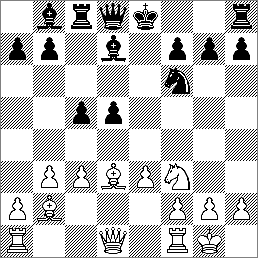
- 13.h3
- Steinitz: There was hardly any necessity for this move, which is generally disadvantageous.
- 13...c4 14.Bc2 0-0 15.Qd4 Re8 [0:33-0:24] 16.Rad1 b5 17.b4
- Gunsberg: White already has a serious disadvantage by having his dark-sqaure bishop blocked in.
- 17...Qc7 18.Rfe1
- Gunsberg: An unnecessary move. White ought to have proceeded at once with 18.Qh4.
- 18...Re7 19.Kf1
- Gunsberg: If 19.e4 Black plays 19...dxe4 20.Bxe4 Rd8 which makes it uncomfortable for White. The text move was played to gain time if necessary to be able to play his knight.
- Steinitz: He might have better utilized his time by playing first 19.Rd2, with a view of bringing the bishop back to d1.
- 19...Rce8 20.Qh4 Qd6 [0:53-1:09]
- Steinitz: If 20...Re4 21.Bxe4 Rxe4 22.g4 h5 23.Ng5 and Black gets nothing for the loss of the exchange. But anyhow the text move was a waste of time, and Black should have played 20...Qc6 at once.
- 21.Rd4 Qc6
- Gunsberg: These are aimless moves which lose time.
- 22.Red1 Be5
- Gunsberg: A curious oversight by which he loses a valuable pawn.
- Steinitz: An oversight which loses a pawn. Black as it happens obtains a strong attack by the loss of the pawn, as he liberates his light-square bishop.
- 23.Rxd5 Bb8
- Gunsberg: He would be mated if he took the rook with his knight.
- 24.a4
- Gunsberg: The best play for White would have been to retire the rook at once to d2.
- 24...a6
- Steinitz: Black could not take the pawn without getting the disadvantage by the reply 25.b5, followed by 26.Ba3.
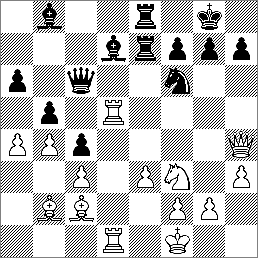
- 25.a5
- Gunsberg: This move gives Black a wide range for his pieces.
- 25...h6 [1:37-1:25]
- Steinitz: A little too late.
- 26.R5d4 Qb7 (Adjourned) [1:40-1:26] 27.Ne1 (Sealed)
- Gunsberg: This move was sealed. White was afraid of Black playing ...Bc6, followed by ...Qc7 etc.
- 27...Be5 [2:15-1:26] 28.R4d2 Bc7
- Steinitz: Black has gained an important move by this maneuver, whereby he prevents the exchanging of rooks at later stages.
- 29.Re2 Re5
- Gunsberg: A strong move. He threatens ...Rh5, followed by ...Bxh3 or ...Rxh3.
- Steinitz: Threatening ...Rh5.
- 30.f3
- Gunsberg: The only move to counteract Black’s powerful stroke. Although he gives up a pawn White gains considerable relief for a time.
- Steinitz: About the only move.
- 30...Rxe3 [2:28-1:53] 31.Rxe3
- Gunsberg: 31.Be4 would not have been good on account of 31...Nxe4 32.Rxe3 Ng3+ 33.Kf2 Rxe3 34.Rxd7 Re2+ and mates in two more moves.
- Steinitz: If 31.Be4, which White probably speculated upon, then 31...R8xe4 32.fxe4 Bg3 and wins.
- 31...Rxe3 32.Bc1
- Gunsberg: A very useful move if Black now plays 32...Rxc3, White gets pull by 33.Bb2.
- 32...Re5
- Gunsberg: If White now plays 33.Bf4 and Black replies with 33...Rh5 34.Qg3 Rxh3 35.gxh3 Nh5 36.Qh4, White gets the best of it. But an interesting variation arises if, after White playing 33.Bf4, Black should continue with 33...Rh5 34.Qg3 Rg5 35.Qh2 Bxf4 36.Qxf4 Nd5 37.Rxd5 Rxd5 (he cannot take with the queen because of 38.Qb8+.) 38.Be4, etc.
- Steinitz: White threatened Bxh6, which is now prevented, as Black would answer ...Rh5. The text move was also better than 32...Rxc3, as White would answer 33.Bb2, with an excellent attack.
- 33.Qf2 Qc6 34.Be3
- Gunsberg: 34.g4 might perhaps have been played here.
- 34...Re8 35.Qd2 Qe6 [2:42-2:11] 36.Bd4
- Gunsberg: If 36.Bf4, Black plays 36...Bxf4 37.Qxf4 Qe2+ 38.Kg1 Qe3+ 39.Qxe3 Rxe3 40.Kf2 Rxc3 41.Rd6, with a good game.
- 36...Nh5
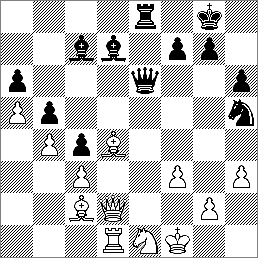
- 37.Bf2
- Steinitz: If 37.Bxg7 Ng3+ 38.Kg1 Kxg7, and obviously White dare not take the bishop as mate would follow in a few moves, beginning with 39...Qe3+.
- 37...Bc6 38.Bb1 Qe5 39.Nc2 Bxf3
- Gunsberg: All these moves were made under great time pressure. Black now seizes a chance for a pretty mating combination.
- Steinitz: This is decisive.
- 40.gxf3
- Gunsberg: If 40.Re1 Bxg2+ 41.Kxg2 Qh2+ 42.Kf1 Qh1+ 43.Bg1 etc., the same as in the text.
- 40...Qh2 41.Qd7 Qh1+ 42.Bg1 Qxf3+ 43.Bf2 Ng3+ [2:47-2:29] 0-1
- Gunsberg: Mate follows next move.
The Sun, New York, 1890.12.21
The World, New York, 1890.12.21
New-York Daily Tribune, 1890.12.21
Morgan's Chess Library, Book VIII, 1891, p49-50
A DECISIVE VICTORY OVER GUNSBERG.
THE GAME MARKED BY SOME OF THE FINEST
PLAY OF THE MATCH
The seventh game in the chess match which is being played in this city between Messrs. Steinitz, of New-York, and Gunsberg, of London, was contested yesterday, and ended in a decisive victory for Steinitz. Reference to the score will show the reader that this game contains some finer plays than have yet been witnessed in the course of the match.
Steinitz fulfilled his openly declared intention of again playing a Queen’s Gambit, which Gunsberg accepted. The first player, however, introduced at his third move a variation which he did not adopt in the fifth game, and by this move he prevented Gunsberg from pursuing the tactics in which he was so successful on the former occasion. Both masters castled on the King’s side on the sixth and seventh moves respectively, and at that time the game presented a compact appearance.
With his fifth move Steinitz began a fine combination, and was materially assisted in the execution of his strategical project by the mediocre play of his adversary. First the Hungarian exchanged his bishop for a knight, whereby Steinitz succeeded in getting an entrance for his Q B on R 3. Then Black compromised his position still further by offering the exchange of bishops, which, according to Steinitz’s views, lost him the game. Then, again, Gunsberg’s fourteenth move was an unsound one, and all these circumstances combined ultimately enabled the veteran player to give some brilliant specimens of chess, which, at the same time, were entirely sound.
On his seventeenth move, P x P, the eminent theorist left a knight “en prise”; on his twenty-second turn, by playing R x Kt, he sacrificed the exchange, and then he showed the finest bit of play in the entire contest by sacrificing the queen afterward regaining it, and finally establishing two passed pawns on the queen’s and king’s seventh squares. After a series of brilliant finishing moves on the part of Steinitz, Gunsberg was finally compelled to resign on his twenty-eighth move. The play occupied only about three hours. On account of the approaching holidays, no further game will be played until Saturday.
The score now stands: Steinitz, 3; Gunsberg, 2; drawn, 2.
New-York Daily Tribune, 1890.12.23
STEINITZ AGAIN LEADS HIS OPPONENT
IN THE GREAT MATCH.
The Veteran Played in His Old Form - He Gave A Most
Beautiful Specimen of Brilliant and Sound Play - Gunsberg
Was Outplayed at Every Stage of the Game - A Masterpiece of the
Royal Sport.
A few days ago, after he had lost his second game, Steinitz declared his intention of playing the same opening - the Queen’s Gambit - until he succeeded in winning it. Yesterday it was his turn to open, and when he offered a Queen’s Gambit the almost universal feeling of the chess players who were watching the encounter was expressed by a spectator, who said: “Well, Steinitz tires me by this.” Notwithstanding, the game soon opened up some interesting features for the delectation of the spectators, of whom a goodly number had assembled in the rooms of the Manhattan Chess Club, where the match is being fought.
Gunsberg accepted the proffered gambit, and then on his third turn Steinitz played Kt-K B 3, and thereby prevented his adversary from pursuing similar tactics to those which he adopted in the fifth game by replying 3...P-K 4, and which on the former occasion brought about the exchange of queens at a very early stage, and almost secured for the Hungarian a winning position.
Yesterday’s game was quickly developed after the first few moves. It presented a very solid appearance when both players had castled on the king’s side. Evidently the movements of Steinitz brought considerable difficulty to his opponent, who had to think very long and very deeply. On his fifteenth move he consumed thirty minutes and at this time the older player had the advantage of thirty-two minutes saved, with the superior position. Gunsberg’s thirteenth move was described by a strong amateur as a “stunner,” but another controverted this statement by saying that Kt to R 3 was far better for purposes of development, and a little later the first man was bound to admit that the Hungarian had been entirely outmanoeuvred by the veteran player.
As the game progressed Steinitz gradually assumed a distinct superiority of position, and ultimately brought about a brilliant combination by the sacrifice of a knight on his seventeenth move, and later on the exchange, which was declared to give him a certain win. With the excellent combination he had achieved he pressed forward his attack in a manner which Gunsberg found it impossible to resist, although at times he made some good defensive moves, and on the whole fought well. The brilliant consummation of Steinitz’s scheme, however, was as irresistible as it was pretty, and this game may claim to rank first among the seven which have been played in this encounter as affording really fine specimens of chess play. On his twenty-eighth move Gunsberg bowed to the inevitable and resigned.
The score now stands: Steinitz, 3; Gunsberg, 2; drawn, 2.
In regard to his having offered the Queen’s Gambit so many times in succession Steinitz says he knows there are some people who object to this repetition of the same opening. “My answer is,” he says, “that Morphy always played a Ruy Lopez in a match. It was only in skittle games that he varied his openings. Zukertort almost invariably played P-Q 4 as first player. In former days I used to play a variety of openings but latterly I have taken to playing one with which I am familiar.”
“My memory,” he proceeded to explain, “is not so good as it was, and I cannot always, in a complicated position, rely on book knowledge. Nevertheless, I always try to introduce something original or new, even in the openings, as I play them. I have done so in the match with Tschigorin, and I also think I introduced some fair novelties in my match with Zukertort.”
The Sun, New York, 1890.12.23
OPENING WITH THE QUEEN’S GAMBIT HE WINS EASILY.
Constant and Merciless Attack Mark
His Play in the Seventh Game of the Series-Gunsberg,
Apparently in Poor Form, an Easy Prey for the
Onslaught-A Short Game as to Moves.
One third of the games in the chess contest have been played and Mr. Steinitz leads by one game. His opponent, who was evidently not himself on Saturday, failed sadly to recover his form. Mr. Steinitz tenaciously adhered to his Queen’s Gambit and scored for the first time as leading player. Indeed, the Queen’s Pawn opening needed a rehabilitation.
Mr. Gunsberg committed an error of judgment early in the opening by pinning the adverse Kt with his K B. In the course of events he had to exchange it, and he labored from this point under serious disadvantage. His fourteenth move compromised his position still more, while his sixteenth move rendered his game untenable.
Mr. Steinitz, whose play recalled the winner of the Vienna tournament, 1873, pressed the attack with merciless precision, and finished off by a crushing sacrifice of the exchange. For six more moves Gunsberg struggled bravely, then he surrendered, after not quite three hours’ play.
The score now stands: Steinitz, 3; Gunsberg, 2; drawn, 2.
A recess will be taken during the holidays. The next game, the eighth, will be played at the usual place and hour on Saturday.
The World, New York, 1890.12.23
Date: 1890.12.22
Site: USA New York, NY (Manhattan Chess Club)
Event: World Championship Match (Game 7)
White: Steinitz,W
Black: Gunsberg,IA
Opening: [D26] Queen’s Gambit Accepted:
Annotators: Gunsberg & Steinitz
Site: USA New York, NY (Manhattan Chess Club)
Event: World Championship Match (Game 7)
White: Steinitz,W
Black: Gunsberg,IA
Opening: [D26] Queen’s Gambit Accepted:
Annotators: Gunsberg & Steinitz
- 1.d4 d5 2.c4 dxc4 3.Nf3
- Gunsberg: Better than 3.e3 as played in the fifth game, as it prevents the strong rejoinder 3...e5.
- Steinitz: Certainly a very strong move; introduced by Blackburne in the Vienna tournament of 1873.
- 3...Nf6
- Steinitz: If 3...b5 4.a4 c6 5.axb5 cxb5 6.b3 recovering the pawn with a superior game.
- 4.e3 e6
- Gunsberg: An attempt to defend the gambit pawn by 4...b5 would be bad, as White would continue by 5.a4, followed eventually by pawn to b3, etc. Black’s later trouble may be ascribed to this move, as afterwards he will be compelled to give up the bishop for the adverse b-knight which is disadvantageous to him, as White gets control of an important diagonal by Ba3. Black’s reply should have been 5...Be7.
- 5.Bxc4 Bb4+ [0:04-0:06]
- Steinitz: Not to be approved of, though twice before in this contest Gunsberg adopted it in a similar position, and the games were finally drawn.
- 6.Nc3 0-0 7.0-0 b6
- Gunsberg: Here 7...Nbd7 seems preferable.
- Steinitz: This move makes it a sort of Fianchetto di Donna.
- 8.Ne5
- Steinitz: Chiefly with a view of playing pawn to f3, thus counteracting the bearing of the adverse light-square bishop on the long diagonal against the queenside.
- 8...Bb7 9.Qb3 Bxc3
- Steinitz: Although White threatened Bxe6 and then to come out with a rook and two strong center pawns against two minor pieces, it would have been somewhat better to face that combination, as the white pawns could not be made available for some time, than to strengthen White’s center with the text move.
- 10.bxc3 Bd5 [0:11-0:25]
- Gunsberg: A necessary precaution, as White threatened to win a rook and two pawns for two minor pieces by either Nxf7 or Bxe6, which would have been all the more dangerous if he had been given time to play Ba3 and pawn to f4 first.
- Steinitz: A weak move, though no doubt made with the intention of effecting exchanges and simplifying matters. The drawback was that the bishop protected the “hole” at c6.
- 11.Bxd5 exd5 12.Ba3 Re8 13.c4 c5
- Gunsberg: This seems the right move, as White threatened pawn to c5.
- Steinitz: A very fine defensive move.
- 14.Rac1
- Steinitz: As the sequel shows, the rook was very well placed here.
- 14...Ne4
- Gunsberg: A move which virtually loses the game, as it enables White to gain important time for bringing his f-rook into a commanding position on d1. The correct play was 14...dxc4, followed by ...Qd5, but even then the utmost caution was necessary.
- Steinitz: Black’s game was extremely difficult, but he facilitates matters here for the opponent. Still the manner in which White afterward took advantage of this move was not easily to be foreseen, and it seemed to be a feasible to try to drive off the adverse knight.
- 15.Rfd1 cxd4 [0:29-1:01] 16.exd4 f6
- Gunsberg: Which compromises his game even more. 16...Nf6 was his best defense.
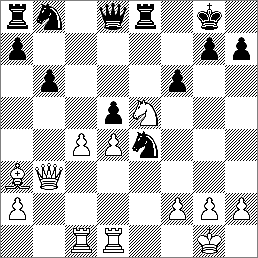
- 17.cxd5
- Gunsberg: White seizes the opportunity and presses the attack in brilliant and vigorous style.
- Steinitz: The beginning of a series of sacrificing tactics.
- 17...fxe5 18.d6+ Kh8 19.Qd5 Nxf2
- Steinitz: Black makes an excellent defense, which renders it very difficult for the opponent to maintain his advantage of position. If 19...exd4 20.Rxd4 (not 20.Qxa8, on account of 20...Nc3, followed by ...Ne2+, which would give Black drawing chances).
- 20.Rd2
- Gunsberg: With his usual precision White chooses the strongest continuation.
- 20...Nd7 [1:00-1:21]
- Gunsberg: Hopeless as his game is there were still more chances in 20...Nh3+ instead of the move in the text, for if then 21.gxh3 Qg5+ 22.Rg2 Qe3+ 23.Kh1 Qxa3 with much better chances.
- Steinitz: The position is now extremely interesting, and at first sight it might look as if Black would have done better by proceeding with 20...Nh3+; but then might have followed 21.gxh3 Qg5+ 22.Rg2 Qe3+ 23.Kh1 Qxa3 24.Rcg1, with a winning game.
- 21.Rxf2 Nf6 22.Rxf6
- Gunsberg: Finishing off in high style.
- Steinitz: A decisive combination of rare interest.
- 22...gxf6
- Gunsberg: No better would have been 22...Qxf6, as White would continue with 23.d7 Rf8 (best) 24.Bxf8 Rxf8 25.Qf3, and whether Black exchanges queens or not, White’s passed d-pawn will ultimately win the game.
- Steinitz: No better was 22...Qxf6 23.d7 Rf8 (or 23...Red8 24.dxe5, followed mostly by Qxa1) 24.Bxf8 Rxf8 25.Qf3, and wherever the queen may move to White takes the rook with a “check,” followed by Rc8 and wins.
- 23.d7 Rg8 24.dxe5 Rg5
- Gunsberg: He has nothing else, as the advance of the e-pawn would decide the game in a few strokes.
- Steinitz: He had no good defense. If 24...fxe5 25.Bb2, and wins in a few moves.
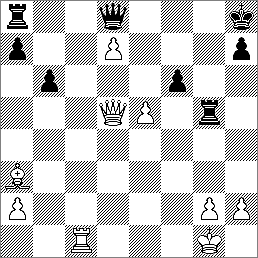
- 25.Qxa8
- Steinitz: Quite a little surprise.
- 25...Qxa8 [1:05-1:35] 26.Rc8+ Rg8 27.Rxa8 Rxa8 28.e6 [1:05-1:36] 1-0
The Sun, New York, 1890.12.23
The World, New York, 1890.12.23
New-York Daily Tribune, 1890.12.23
Morgan's Chess Library, Book VIII, 1891, p50-51
CONTINUATION OF THE CHESS MATCH.
GUNSBERG PLAYED THE GIUOCO PIANO OPENING
-STEINITZ STILL LEADS BY ONE GAME.
After a few days’ rest, which ought to have had a salutary effect upon both players, Messrs. Steinitz and Gunsberg resumed their match for the chess championship yesterday at the rooms of the Manhattan Chess Club in this city. In opening the eighth game of the contest Gunsberg, who had the move, played for the second time a Giuoco Piano, which, however, was this time varied on the fifth move by his playing P-Q B 3, the move generally recognized and adopted as the best, instead of castling, as he did on the former occasion.
As the game proceeded it failed to awaken the interest of the spectators, who would idly glance over the game now and again, but who in the main found more interest in playing games among themselves, in studying problems, or in analyzing positions. On the whole, the conclusion of yesterday’s game points to a fair degree of equality in the masters’ play, for at no point did either appear to possess a distinct advantage over his antagonist; and yet this very fact was perhaps what divested the game of those brilliancies which are best seen when one player gets very much the better of the other.
However that may be, yesterday’s game, from the spectators’ point of view, was the least interesting of the eight which have been played in this match.
At the best there is little of an adventurous character about a Giuoco Piano opening, and usually the issue is a draw. Gunsberg’s fifth move, already alluded to, may be said to have been a little more advantageous to him than his move in the former game as this point. Steinitz was compelled to change his tactics two moves later, for it would not have been wise for him to pursue his former policy by playing Kt-Q R 4, inasmuch as White’s B had a convenient point of retreating at Q B 2, and Black’s Kt would at the same time have been put in danger.
A new line of play was instituted by Steinitz at his eighth turn, when he drew back his Kt-Q sq. with the idea of defending with his Q Kt an almost certain attack on the K side. As was anticipated, Gunsberg instituted this attack. Steinitz missed an opportunity at this point and his opponent was enabled to undouble his pawns, while the Black King was compelled to seek shelter on the Q side without being allowed a chance to castle. There are really no other points deserving of particular mention, except that Gunsberg offered a draw on the thirty-first move, which Steinitz declined. On the thirty-sixth move, however, the “great theorist” himself appeared to think this was the only expedient, so he proposed a draw which was accepted. The position of affairs now stands at three wins for Steinitz, two for Gunsberg and three drawn games.
New-York Daily Tribune, 1890.12.28
THE EIGHTH GAME OF THE MATCH ENDS IN A DRAW.
Gunsberg Again Opened a Giuoco Piano, but the
Veteran Plays a Sterling Defence-The Game was Fought
Evenly Throughout-No “Fireworks” in It.
Christmas Day, with its festivities is past, and the reaction which as a rule follows upon a season of merriment was apparent on every hand yesterday at the Manhattan Chess Club just before the time for the resumption of play in the match between Steinitz and Gunsberg. The two masters appeared to be equally under the influence of retrospective reflections upon joys that were no more, while one of the most constant followers of the play in this match, a well-known amateur player, was in such a quiet, grave mood that one could hardly get rid of the notion that he was still ruminating over his Christmas turkey and plum pudding.
After play had been going on for a while, members and visitors began to increase in number in the club room, but there was a sort of languid indifference in the manner of most of them as the entered - an appearance which seemed to tell of a surfeit of good things, the mere recollection of which was sufficient for the time to deprive even the great chess encounter of the interest and attractiveness which is has hitherto possessed for them.
There was nothing in the opening if the eighth game to banish the general languor. Gunsberg, whose turn it was to move first, played a sort of Sponziani [sic] variation of the Giuoco Piano opening. A similar opening was played by Tschigorin in his first game against Gunsberg in Havana a year ago, and on that occasion the Russian vanquished his opponent. Yesterday when the Hungarian played 6. B-K 3, Steinitz, as he did in a former game in the present match, replied by clearing off the bishop, a move which is in opposition to the long-established and adopted principles of most of the leading masters.
It is a noteworthy fact that after nineteen moves had been made not a single pawn had been taken. Another thing which is charged with some interest is made apparent when one looks back upon the game already played. Gunsberg, in almost every instance, has effected a considerable saving of time in the opening, but just as consistently has Steinitz given him something to think about in the middle game, and here the younger player has spent so much time in thought that he has more than once hampered his end play by being compelled to move rapidly under heavy time pressure.
The first twenty moves in yesterday’s game were made very quickly by both players, who had each nearly an hour in which to make the last three moves prior to the adjournment of the afternoon sitting.
In regard to the character of the game, it was one which was so safely played on both sides that it admitted of no display of brilliancy whatever. As a matter of fact, it has now come to be accepted almost as an axiom that any well-played game, in which neither player makes a grave or material mistake, will naturally conclude in a draw, although such a game, as a rule, is far less interesting than one which results in victory or defeat. In the last mentioned category are to be found the games which have made a stir in the chess world. Yesterday’s game, belongs, as it does, to the evenly fought class, was pronounced by many of the spectators present as a very “tame” one. No single feature in it seemed to arouse anything more than a mere ordinary interest. Indeed, if there was any interest at all manifested, it was rather of the passive that the active order. Gunsberg offered a draw on his thirty-first move, but Steinitz seemingly thought he could do something better with his game, for he declined the proposal. It could not be seen by the onlooker, however, that he had any advantage which would be likely to prove valuable to him, and after a few more moves he evidently changed his mind; he in turn proposed a draw, which Gunsberg accepted. It was 4:45 when the game was thus terminated, and at that time the position was one in which neither player seemed to have the slightest advantage. The score now stands: Steinitz, 3; Gunsberg, 2; drawn, 3.
The Sun, New York, 1890.12.28
Steinitz and Gunsberg Renew Their
Chess Battle.
Steinitz Has Won Three and the Londoner Two
of the Contest-A Stubborn Fight in the Rooms of the
Manhattan Chess Club-The Next Game Will Be Played To-morrow.
The recess since Monday last in the play of the chess match has increased the curiosity of chess-players to know which of the two combatants now wrestling for the world’s championship will gain a decided lead over his opponent. It was generally felt yesterday that the time has now arrived for the match to take a turn. Mr. Steinitz, starting with a game ahead, was expected to make an effort to secure another victory, which would have given him sufficient advantage to make sure of not losing the match, while his opponent would have been correspondingly depressed.
Under these circumstances it was not to be wondered at that a good many chess enthusiasts flocked to the rooms of the Manhattan Chess Club to witness what they expected to be a game having a critical influence on the result of the match. At the call of time when Messrs. Steinitz and Gunsberg faced each other, they seemed to be in a most happy mood. The game itself fully reflects the state of affairs. Mr. Gunsberg, having the first move, felt too seriously the importance of that game to risk any other opening than his trusted friend, the Giuoco piano.
After the opening moves, varied from the fourth game by Gunsberg playing 5 P-Q B 3, Black did not castle, and gave White an opportunity to develop his forces with considerable vigor and rush into a seemingly promising attack by 16 Q-R 4, which subsequently compelled Black to move his king. White showed a very keen scent for the attack, and in pursuing it perhaps too hotly by playing his R-K Kt 3 he lost somewhat of the advantage which his superior development might have given him. As usual in such cases, Black then had a chance of assuming offensive tactics.
Mr. Steinitz did not, however, seem inclined to follow the example of his opponent by instituting an attack, but confined himself to making matters secure through the advance of P-K Kt 4, which gave White liberty to devote his attention to the queen’s side, as he had nothing to fear on the king’s wing. Again Black apparently thought of his own safety only, and as soon as White prepared to mass his forces on the queen’s side Black did the same, the result being an exchange of pieces, which brought about a position wherein neither player saw a chance to win. On the thirty-seventh move the game was abandoned as drawn.
Although a draw is only a negative result it was generally conceded that the outcome of this game proves that there is not much difference in strength between these renowned players, and the members of the Manhattan Chess Club recognize that whichever player wins the match will have to do so by hard fighting and good chess. The score: Steinitz, 3; Gunsberg, 2; drawn, 3. The next game will be played on Monday.
The World, New York, 1890.12.28
Date: 1890.12.27
Site: USA New York, NY (Manhattan Chess Club)
Event: World Championship Match (Game 8)
White: Gunsberg,IA
Black: Steinitz,W
Opening: [C54] Italian
Annotators: Gunsberg & Steinitz
Site: USA New York, NY (Manhattan Chess Club)
Event: World Championship Match (Game 8)
White: Gunsberg,IA
Black: Steinitz,W
Opening: [C54] Italian
Annotators: Gunsberg & Steinitz
- 1.e4 e5 2.Nf3 Nc6 3.Bc4 Bc5 4.d3 Nf6 5.c3
- Gunsberg: A deviation from his line of play in the fourth game.
- 5...d6 [0:02:30-0:02:30] 6.Be3 Bxe3
- Gunsberg: Steinitz considers the double pawn on the e-file resulting from this exchange a disadvantage for the first player. The usual move is 6...Bb6 instead.
- Steinitz: Chopped in a similar way as in game four. The fact that White has played 5.c3 makes no difference in the situation.
- 7.fxe3 Qe7 8.0-0 Nd8
- Gunsberg: This knight is made extensive use of.
- Steinitz: Quite new and its object will soon be seen.
- 9.Nbd2 Ne6
- Steinitz: This knight is now in communication with both wings and White cannot afford to exchange it for the bishop without strengthening Black’s position.
- 10.d4 Ng4 [0:06-0:10]
- Steinitz: Not so much with the object of attacking White’s e-pawn, but in order to make room for the advance of the f-pawn.
- 11.Qe1 f6 12.Nh4 Nh6
- Gunsberg: 12...g6 instead of the last move would have prevented White from dissolving his double pawns.
- Steinitz: Probably 12...g6 would have been better, because it would not have allowed White to undouble his pawns. Still there was some object in it as White’s e3-pawn formed a marked attack.
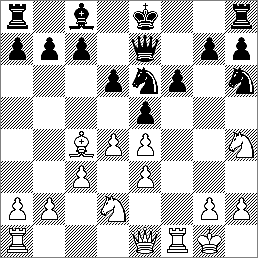
- 13.Nf5 Nxf5 14.exf5 Nf8 15.e4 Nd7 [0:15-0:25] 16.Qh4 Nb6 17.Qh5+ Kd8 18.Bb3 Bd7 19.Rae1 c6 20.Re3 Kc7 [0:17-0:43] 21.Rg3
- Gunsberg: It would have been better to double rooks at once on the d-file.
- Steinitz: White has conducted the attack with great spirit, but, though Black’s king is now in safety, his kingside is somewhat weak.
- 21...Raf8
- Gunsberg: To prevent White from 22.Qf7.
- Steinitz: In order to prevent 22.Qf7, which would have gained a pawn for White.
- 22.dxe5 dxe5 23.Qe2
- Gunsberg: A well timed retreat. He changes his attack to the queenside, as he has no prospects of accomplishing anything on the kingside, while on the other hand Black might gain ground 23...Be8.
- 23...g5
- Gunsberg: Black could have assumed the attack against the adverse king by playing this pawn only one square. The move actually made renders White safe, as he could calmly await an advance of Black’s g-pawn or h-pawn and then block the kingside by moving the g-pawn in reply to ...h3 or the h-pawn if Black pushes the g-pawn to g3.
- Steinitz: Gunsberg expressed the opinion that 23...g6 was better. It is a difficult question to decide for the object of that move could only be to exchange the f-pawn, and then White’s knight obtains a favorable square at e4.
- 24.Rd3
- Steinitz: If 24.fxg6 hxg6, and obviously White there will not take the g-pawn with the rook on account of the rejoinder 25...Qh7.
- 24...Bc8
- Gunsberg: 24...Be8 instead, with a view of posting it after due preparation at h5, seems to be more promising.
- 25.Rd1 Rd8 [0:53-1:10] 26.Nf1
- Steinitz: An excellent move.
- 26...Nd7 27.Bc2 Nc5 28.Rxd8 Rxd8 29.Rxd8 Kxd8 30.b4 Nd7 [1:00-1:20]
- Gunsberg: This knight has now moved eight times in thirty moves.
- 31.Bb3
- Steinitz: At this point Gunsberg offered a draw, but Black decided to go on.
- 31...a5
- Steinitz: Of course, if 32.bxa5 Qc5+ and recovers the pawn with advantage.
- 32.a3 axb4 33.axb4 Qd6
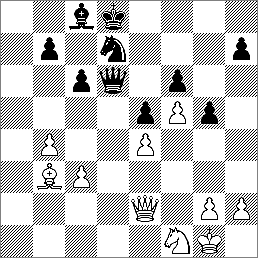
- 34.Ne3 b5 35.Kf2 Kc7 [1:04-2:08]
- Steinitz: Black at first contemplated 35...c5, but, as Gunsberg pointed out, he would have answered just the same 36.Qd1, and there was hardly anything more in it than a draw.
- 36.Qd1 [1:05-2:08] ½-½
- Gunsberg: After the exchange of queens the slight superiority of the position of White’s pawn is sufficiently counterbalanced by the presence of Black’s king on the queenside. The game was here abandoned as drawn.
The Sun, New York, 1890.12.28
The World, New York, 1890.12.28
New-York Daily Tribune, 1890.12.28
Morgan's Chess Library, Book VIII, 1891, p51-52
A GREAT CONTEST OVER THE CHESS BOARD.
STEINITZ AND GUNSBERG EXCITED OVER A
GAME WHICH NEITHER COULD WIN.
The match for the chess championship was resumed at 1:30 p.m. yesterday in the rooms of the Manhattan Chess Club, and the game was far more interesting than that of Saturday. Steinitz, having the move, played a Kt to K B 3 opening, which was a favorite with his old antagonist, the late Dr. Zukertort. Steinitz is apparently satisfied with the Queen’s gambit after his decisive victory of a week ago. The game developed rapidly and after ten moves the position seemed to be pretty even.
Both players castled respectively on the eighth and ninth moves on the K side, and at this stage neither of them had a majority of pawns on either wing, while the attitude of both armies gave the board a very symmetrical appearance. The play was very slow for some six or seven moves, both masters evidently playing for position only. At length Steinitz began aggressive operations on the Queen’s side, but on his twentieth move he gave up a pawn which was declared to be a blunder on his part. After this he proceeded with an attack on the enemy’s Q Kt pawn. The immediately succeeding moves made it evident that the sacrifice of the pawn was a mistake. Gunsberg assumed a superiority of position, and securing the whip he prosecuted his advantage with vigor and ability. First of all he carefully protected his Q Kt P, and then took up the aggressive by playing his Queen on the enemy’s Q R file, and at the same time threatening to gain another pawn with an additional improvement of position.
When Gunsberg sealed his twenty-ninth move at the adjournment he had by far the best of the direction of playing for a draw. This he proceeded to do when play was resumed. Gunsberg was obliged to give up the exchange he had just won, and thereupon followed a further exchange of pieces, the Hungarian coming out of the general slaughter still a pawn to the good. This advantage, however, did not suffice to win the game. Play was continued up to the eightieth move, which shows that the veteran made a tremendous fight before he could effect a draw.
Some rapid moves were made toward the close, and both players were in a state of great excitement, which in a smaller measure was shared by the crowd of spectators assembled in the room. The game was declared a draw just upon the time for adjourning the evening sitting. The score now stands: Steinitz 3, Gunsberg 2, drawn 4.
New-York Daily Tribune, 1890.12.30
THE NINTH GAME ENDS IN A DRAWN
BATTLE AFTER EIGHTY MOVES.
Steinitz Blundered and Gunzberg [sic] Ought to
Have Won at Once - Still the Veteran
Struggled Hard and Got on Even Terms
After the Toughest Fight of the Series.
The ninth game in the championship chess contest between Steinitz and Gunsberg, which has now been going on for about three weeks in this city, was opened yesterday afternoon, and it was not long before the members and visitors at the Manhattan Chess Club were provided with something entertaining as well as instructive. It will be remembered that Steinitz, on each of four the previous occasions when he has had the opening move, has offered a Queen’s Gambit. The first two were drawn, the third was cleverly won by Gunsberg, and the fourth counted as a brilliant victory for Steinitz.
At an early stage in the match Steinitz had said he would play the same opening until he won it. This he succeeded in doing. In yesterday’s game he gave a welcome variety, “Nothing so common as a Queen’s Gambit,” said an interested onlooker when the “great theorist” started out with an opening which the late Dr. Zukertort repeatedly played, and which commenced with Kt-K B 3. Pawns were exchanged on the fifth move and the game was very quickly developed.
In the early part of the game the play was apparently conducted by both masters with a view of securing a good position, but ultimately Steinitz initiated an aggressive movement on the queen’s side. After making what subsequently proved to be a blunder by sacrificing a pawn on his twentieth turn, he proceeded with an attack on the opposing pawn on the Q Kt’s file. This pawn the Hungarian first put beyond the reach of danger, and then quickly assumed a distinct superiority of position, threatening at the same time to capture another pawn. After twenty-six moves had been recorded on both sides the spectators all agreed that Gunsberg had by far the best of it, and some ventured the opinion that he had a won game.
For the sixth time Gunsberg was the player to seal his move on the adjournment of the afternoon sitting [...]
On the resumption of play at 7 o’clock it soon became manifest that Steinitz was playing hard for a draw, and his efforts in this direction were pronounced, after four or five moves, to be tending with some little chance of success. At the same time it was declared that if he were to succeed in bringing about a draw he would be a “good one.” He fought on and on, though his efforts were generally thought to be useless. Ultimately, however, affairs took a favorable turn for the “great theorist.”
Meantime the number of spectators in the club room had increased until the scene was one of great animation, while a profound interest was evinced in the progress of the play. Finally it was seen that Steinitz was gradually but surely extricating himself from the difficulties which surrounded him, and a few minutes after 10:30 o’clock, the time for adjourning for the day, the announcement came down that a draw had been agreed upon. It will be seen that Steinitz consumed nearly double the time occupied by Gunsberg.
The Sun, New York, 1890.12.30
MR. STEINITZ SURPRISES HIS LONDON
OPPONENT AT CHESS.
Over Six Hours at the Board and at
the Adjournment Mr. Gunsberg Had
the Advantage, but Mr. Steinitz
Finally Fought the Contest to a
Draw - Notes of the Sporting World.
The ninth game, the longest and most stubbornly contested in the chess match, caused by its changes and vicissitudes no end of excitement. The well-conducted game was only marred by an oversight or miscalculation on the part of the first player in the twentieth move. The numerous and illustrious crowd which thronged the Manhattan Chess Club-rooms, among them such expert players as Mr. Phil Richardson and Mr. E. Delmar, discounted black’s win befor [sic] the adjournment. Then to the general surprise, Mr. Steinitz prolonged the struggle, and by 10 o’clock seemed to have achieved a drawing position.
Mr. Steinitz, who had the move, slightly altered his previous course by beginning with (1) Kt to K B 3, which, however, results but in a modification of the Queen’s gambit. The reader will find sufficient comment on this move, which the Austro-American champion invariably adopted in his match with Tschigorin in the notes to the appended game. Mr. Gunsberg emerged out of this opening with a slight superiority of position, as he could first take possession of the open Q R file with his rook. On the twentieth move the veteran left a pawn en prise under the impression to win afterwards the Q Kt P with his rook, which would have given him a decided advantage. His scheme was, however, frustrated by Black’s correct defense. Just before the adjournment Mr. Steinitz brought a highly ingenious sacrifice at the exchange which he recovered on the 33d move. But he was still a pawn behind, and had to submit to the exchange of queens. The remainder of the game was fought by Mr. Steinitz with his persistent tenacity, wherein he was somewhat aided by Black’s line of play, which did not make the most of the position, enabling White to obtain chances for a draw.
On the sixty-third move Black, who saw a well-deserved and valuable victory slip from his grasp, made a bold and determined effort to carry the day by abandoning his K P, thus giving his opponent a formidable passed pawn on the K file. Mr. Steinitz with great glee captured the pawn and smilingly asked his opponent whether it was worth while to carry on the battle, to which Gunsberg responded with a grim and determined, “I think so.” Steinitz, after a series of checks, had to give up his R for the adverse passed R P, but his own pawn became so strong that Gunsberg had to submit to a draw.
The game lasted nearly six hours, of which four hours and twenty minutes were consumed by the first player.
The World, New York, 1890.12.30
Date: 1890.12.29
Site: USA New York, NY (Manhattan Chess Club)
Event: World Championship Match (Game 9)
White: Steinitz,W
Black: Gunsberg,IA
Opening: [D30] Queen’s Gambit Declined
Annotators: Gunsberg & Steinitz
Site: USA New York, NY (Manhattan Chess Club)
Event: World Championship Match (Game 9)
White: Steinitz,W
Black: Gunsberg,IA
Opening: [D30] Queen’s Gambit Declined
Annotators: Gunsberg & Steinitz
- 1.Nf3
- Gunsberg: This move has been introduced and frequently played by the late Dr. Zukertort, after whom it is sometimes called Zukertort opening. In the correspondence match between the British Chess Club of London and the Chess Club of St. Petersburg the English players adopted it in the game wherein they had the move. Steinitz, in his match against Chigorin, in Havana, 1889, limited himself solely to that opening, although he had declared it on previous occasions to be an indifferent move which leads to a variation of the Queen’s gambit declined by mere transposition of moves. The course of the present game seems to corroborate that statement, for, as will be seen, after the fifth, eighth, ninth and tenth move, the game presents the exact position which arises from that variation of the Queen’s gambit declined, wherein the best recognized moves are made on both sides.
- 1...Nf6
- Gunsberg: This or 1...d5 is the best move for Black.
- 2.d4 e6 3.e3 c5
- Steinitz: New, but is does not make much difference in the development of the game.
- 4.c4 d5 5.dxc5
- Steinitz: White obtains a slight advantage after this, as he threatens with his next move to isolate the d-pawn, which gains time in the development.
- 5...Bxc5 [0:10-0:04] 6.Nc3 Bb4
- Gunsberg: In order to avoid the isolating of his pawn at d5.
- Steinitz: This move is now forced, as he cannot well capture the pawn and allow the exchange of queens.
- 7.Bd2
- Steinitz: Here, and later on at the tenth move, 7.Qb3 was probably better.
- 7...dxc4 8.Bxc4 0-0 9.0-0 Nc6 10.Qe2
- Steinitz: Initiating a kingside attack, whereas his strength was on the other wing, as indicated above.
- 10...Qe7 [0:19-0:14] 11.e4 Bxc3 12.Bxc3 e5
- Gunsberg: A very good move, which frees his game considerable and prevents the advance of White’s pawn to e5, which would have confined his position.
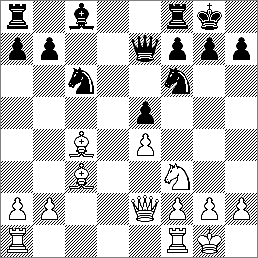
- 13.Qe3
- Steinitz: Any attempt to pursue the kingside attack would probably have been a failure, if, for instance 13.Bb3 Bg4 14.Qe3 Rad8 with a very good game.
- 13...Be6 14.Be2
- Gunsberg: 14.Bxe6 Qxe6 15.Ng5 would only lead to an even game. A very tempting continuation, instead of the move in the text, would have been 14.Bb5 Bd7 15.Bxc6 Bxc6, and White could not take the e-pawn without losing his own e-pawn.
- Steinitz: A concentration on the kingside, with a view afterward of attacking on the other wing.
- 14...Ng4 15.Qc1 Rac8 [0:52-0:42]
- Gunsberg: Black’s game is now well developed.
- 16.h3 Nh6 17.Qe3 f6
- Gunsberg: An excellent move, which not only gives additional support to his e-pawn, but also opens an important square for his knight, which enables him afterwards to use it in time for the defense of his b-pawn.
- 18.a3
- Steinitz: For defensive purposes, as Black threatened ...Nb4, and also with the object of supporting the advance of the b-pawn.
- 18...Nf7 19.b4 a6 20.a4
- Gunsberg: This move was made probably under the impression that he could afterwards recover the b-pawn with his rook, which would have given him the advantage of position.
- Steinitz: Simply an oversight.
- 20...Nxb4 [1:07-0:51] 21.Bxb4 Qxb4 22.Rfb1 Qe7 23.Rb6 Rc7 24.Rab1 Rfc8
- Gunsberg: Of course not 24...Rb8, because of 25.Rxa6.
- 25.Ne1 Nd8 [1:15-1:05]26.Nd3 Qa3
- Gunsberg: Again correctly played.
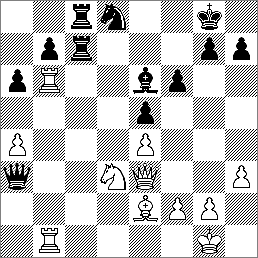
- 27.Kh2
- Gunsberg: In order to avoid an eventual check.
- Steinitz: This was necessary in order to enable him to remove the knight without being subjected to exchanges by ...Rc1+.
- 27...Rd7
- Steinitz: Threatening ...Rc3, but 27...Bc4 was stronger.
- 28.Rxe6
- Gunsberg: An ingenious combination, which, however, is parried by Black’s correct defense.
- Steinitz: The only way to release himself and giving White good attacking chances.
- 28...Nxe6 29.Bg4 (Adjourned) [2:06-1:27] 29...Re8 (Sealed)
- Gunsberg: This move was sealed by Gunsberg. It is worthy of note that so far Steinitz has not sealed a move.
- 30.Bxe6+ Rxe6 [2:10-1:21] 31.Nc5
- Gunsberg: This regains the exchange, but White is still a pawn behind.
- 31...Qxe3 32.fxe3 Ree7 33.Nxd7 Rxd7 34.Kg3 Kf7 35.a5 Kg6 [2:17-1:46] 36.Kf3 Rc7 37.Rb2 Rc5 38.Ra2 Rb5 39.Ke2 Kf7 40.Kf3 Ke6 [2:28-1:33]
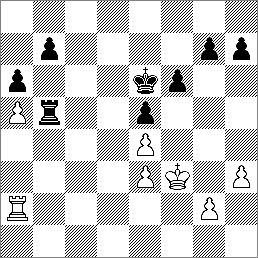
- 41.h4 h5 42.Ra1 g6 43.g4 hxg4+ 44.Kxg4 Rb4 45.Kf3 f5 [3:01-1:35] 46.exf5+ Kxf5 47.Rh1 Rb5 48.e4+ Kf6 49.Rd1 Rxa5 50.Rd6+ Kg7 [3:23-1:37] 51.Rd7+ Kh6 52.Rxb7 Ra3+ 53.Kf2 Ra5 54.Rb6 Kh5 55.Rf6
- 55...Ra4 [3:38-1:46]
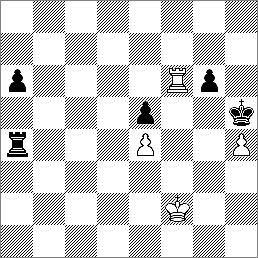
- 56.Kf3 Ra3+ 57.Kf2 Kh6 58.Re6 Ra5 59.Kg3 Kg7 60.Kg4 Kf7 [4:02-1:55] 61.Rb6 Ra1 62.Rb7+ Kf6 63.Rb6+ Kg7 64.Re6 a5 65.Rxe5 a4 [4:10-2:14] 66.Ra5 a3 67.Kg5 a2 68.Ra7+ Kf8 69.Ra8+ Kf7 70.Ra7+ Ke6 71.Ra6+ Ke5 72.Ra5+ Kxe4 73.Ra4+ Kf3 74.Ra3+ Kf2 75.Kxg6 Rg1+ 76.Kf7 a1Q 77.Rxa1 Rxa1 78.h5 Rh1
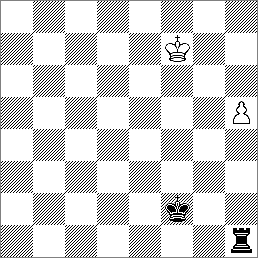
- 79.Kg6 Rg1+ 80.Kf6 [4:24-2:34] ½-½
The Sun, New York, 1890.12.30
The World, New York, 1890.12.30
New-York Daily Tribune, 1890.12.30
Morgan's Chess Library, Book VIII, 1891, p52-54
HE LEADS BY TWO GAMES IN THE GREAT
CHESS MATCH.
THE TENTH CONTEST AN INTERESTING ONE, BUT
GUNSBERG WAS COMPELLED TO RESIGN.
There was a good attendance at the rooms of the Manhattan Chess Club yesterday when the tenth game was fought between Steinitz and Gunsberg in their contest for the championship of the world. As will bee seen from the score of the game, Gunsberg, who had the move, selected the safe Giuoco Piano, which opening he has frequently played, and which he now adopted for the third time in the match. While the Giuoco Piano is in many respects highly interesting, it is an opening which gives Black an opportunity of developing his pieces at the same that White is doing so.
In this case Steinitz took full advantage of the opportunity thus afforded him. He castled after seven moves, and Gunsberg seemingly made several moves to very little purpose, with the result that he was prevented from castling, having finally to bring his king into safe quarters b a sort of artifical castling, which left the monarch on K R 2. Steinitz meanwhile had not been idle. He succeeded in doubling his Rooks on the open Q file, and advancing his K R P to the sixth square with a check. After twenty-seven moves had been recorded he appeared to be threatening in all directions, and a few moves later the afternoon sitting was adjourned, Steinitz this time, being the player to seal his move.
The development of the game after the adjournment proved highly interesting, Gunsberg withstanding in a clever manner for some time the attacks of his opponent on the King’s side. Ultimately, however, he was compelled to succumb. He resigned on his forty-fourth move, which now makes the score: Steinitz, 4; Gunsberg, 2; drawn 4. This game, and in particular the conclusion, was pronounced to be a fine one.
New-York Daily Tribune, 1891.01.03
STEINITZ NOW LEADS GUNSBERG BY
TWO GAMES.
The Anglo-Hungarian Opened an Italian
Game, but He Soon Had to Defend the
Repeated Attacks of His Opponent--The
Veteran Thought at First that He
Could Not Win the Game, but He
Finally Scored in Grand Style.
The tenth game in the contest for the chess championship between Steinitz and Gunsberg was played yesterday at the Manhattan Chess Club in West Twenty-seventh street. Gunsberg again opened a Giuoco Piano - which, along with most masters, he considers to be a very safe and sound opening, and for which he appears to have more than an ordinary fondness.
As in every other case, during the match Steinitz consumed much more time than his opponent in the opening. In fact, as early as the sixth move he began to fall behind. While Steinitz castled on the eighth move, Gunsberg went in for a series of moves, the evident intention of which was to further the development of his pieces, but ultimately his position became such as to make it dangerous for him to castle, and furthermore he hesitated in putting his king into safety. After apparently wasting several moves he decided upon bringing his king via B sq. to K R 2.
Meantime Steinitz got a stron attack on his opponent’s K P, eventually doubled his rooks on the king’s file, having previously made an aggressive movement with his K R P, and after 28 moves had been recorded Gunsberg was considered to have a little the worse position of the two.
For the first time Steinitz was the player to seal his move when an adjournment was made [...]
At this point Steinitz expressed the belief that, at the best, the game would only end in a draw, while, on the other hand, many strong amateur players who were present were of opinion that he had a distinctly winning position.
After the resumption of play at 7 o’clock, the game developed some interesting complications. Steinitz tried hard to break through the defence on the king’s side, but Gunsberg showed himself equal to each successive emergency, defending the position in a remarkably skilful manner.
Some fine play followed, but ultimately Gunsberg, seeing that his efforts were going to be of no avail, saved time by gracefully resigning before he was positively compelled to do so. The score now stands: Steinitz 4, Gunsberg 2, drawn 4.
The Sun, New York, 1891.01.03
HE WINS THE TENTH CHESS GAME
FROM THE LONDONER.
The Score Now Stands: Steinitz, 4;
Gunsberg, 2; Draws, 4 - Dame Fortune
Appeared to Be Against the
Englishman - Interested Spectators at the
Manhattan Chess Club Rooms.
When the chess players assembled on Wednesday last to play the tenth game of the match, they found a number wo workmen busy at the Manhattan Chess Club, carpeting the stairs leading to the second floor, where the playing room is situated. The noise caused by the incessant hammering rendered it impossible to for the champions to go on with their game, and as there was no chance that the work would be finished before 4 o’clock P.M. the game was postponed until yesterday.
With the tenth game the first half of the contest is concluded, for, as the readers of THE WORLD will remember, the stipulations of the match contain the clause that if none of the players have scored the necessary ten “wins” the match shall be terminated after twenty games played, and the winner of the majority shall be declared the victor. An eager assembly of chess connoisseurs crowded the rooms of the Club and watched the run of the game with unabated excitement.
The London expert conducted the white men, and he stuck to his K Kt opening, followed by B-B 4. On the fourth move he hesitated a little, but soon turned the game into a Giuoco Piano. On the sixth move he altered his line of play which he had adopted twice before, namely, opposing his Q B at K 3 by bringing his Q Kt to Q 2. The earlier part of the game was not well conducted by White, who, by some aimless moves, lost time and soon had the inferior position. Afterwards he improved his play and succeeded in ameliorating his position, when Mr. Steinitz, for the first time in the match, had to seal his move.
After resumption of play, Dame Fortune seemed to turn against the Englishman, for, laboring under pressure of time limit, he had not sufficient time to examine 31 Kt to K3, which would have got rid of Black’s troublesome rook. Mr. Gunsberg stated, after conclusion of the game, that he feared the consequences of Black’s sacrificing the Kt after the exchange of rooks. But, as will be seen by the comments to the appended game, Black could achieve nothing more than a draw. From this point the remainder of the moves were all forced. Black played with his usual precision, and on the 43d move he was bound to win a pawns. White preferred a quick surrender to the continuation of a hopeless struggle, thus giving the veteran for the first time a lead of two games. The score is now: Steinitz, 4; Gunsberg, 2; drawn, 4. This gives to the Austro-American champion an immense advantage, as he has only to make even games in the second half of the match. The eleventh game will be played to-day at the usual place and hour.
The World, New York, 1891.01.03
Date: 1891.01.02
Site: USA New York, NY (Manhattan Chess Club)
Event: World Championship Match (Game 10)
White: Gunsberg,IA
Black: Steinitz,W
Opening: [C54] Italian
Annotators: Gunsberg & Steinitz
Site: USA New York, NY (Manhattan Chess Club)
Event: World Championship Match (Game 10)
White: Gunsberg,IA
Black: Steinitz,W
Opening: [C54] Italian
Annotators: Gunsberg & Steinitz
- 1.e4 e5 2.Nf3 Nc6 3.Bc4 Bc5 4.d3 Nf6 5.c3 d6 6.Nbd2
- Gunsberg: White again varies his line of play, as on former occasions. The present maneuver of bringing the b-knight over to the kingside via d2 and f1 was first introduced by Paul Morphy, who, however, had previously developed his light-square bishop. Although the present line of play has been repeatedly adopted with success (among others by Steinitz vs. Blackburne and Gunsberg vs. Blackburne), it is still an open question whether that maneuvre should not be deferred until the light-square bishop has been developed.
- Steinitz: The idea to bring this knight out to d2 and then to f1, was first brought out by myself, against Blackburne, in a Ruy Lopez, and it has since been adopted in various openings.
- 6...Ne7 7.Nf1 c6
- Steinitz: A counter-demonstration of the same sort as that of the opponent.
- 8.Qe2
- Steinitz: 8.Ne3 or 8.Be3 was preferable.
- 8...0-0 9.h3
- Gunsberg: With a view of instituting a kingside attack, but White loses valuable time in making his preparations.
- Steinitz: This weakens the kingside somewhat.
- 9...d5 10.Bb3 Ng6 11.g3
- Steinitz: Necessary but not auspicious for his game.
- 11...dxe4
- Gunsberg: There was no necessity for this exchange 11...d4, as played by Chigorin, seems to be superior.
- Steinitz: Premature; 11...Re8 instead was stronger.
- 12.dxe4 Be6
- Steinitz: Black can well afford the double pawn which White can create condsidering the open f-file which he would gain and that White would find it difficult to castle on either side.
- 13.Ng5
- Gunsberg: Should White exchanges bishops here the open f-file would be more than an equivalent for Black’s doubled e-pawns.
- 13...Bxb3 14.axb3 Qd7 15.Be3 Bxe3 16.Qxe3 b6
- Steinitz: Probably better than either 16...a6 or 16...Rad8, as the pawns will have to be protected sooner or later.
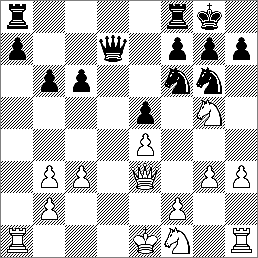
- 17.Nd2
- Gunsberg: He would have done much better by playing 17.Rd1 instead.
- 17...c5 18.Ngf3 Rad8 19.Nc4
- Gunsberg: Not good, as he only loses time thereby.
- Steinitz: This move was wasted, and only helped Black to consolidate his forces.
- 19...Rfe8
- Gunsberg: Perhaps it would have been better to leave that rook on its place in order to push, after due preparation, ...f5, which would have been very dangerous for White.
- 20.Ncd2
- Gunsberg: This retreat is now necessary, as Black threatened ...Nf4, which White could not take with impunity.
- 20...Re7 21.Kf1
- Gunsberg: Castling on the queenside instead would have submitted him to a vehement attack.
- 21... h5
- Gunsberg: 21...Nh5, with a view of sacrificing one of the knights on f4, was to be considered here.
- 22.Kg2 h4 23.Kh2
- Gunsberg: White defends himself very carefully. This move makes the h-rook available for his defense.
- 23...Qb5
- Gunsberg: Finely played. The object is to reduce the activity of the adverse knight, as White is compelled to occupy the square at c4 with his pawn.
- 24.c4 Qc6 25.Rac1
- Gunsberg: White now brings this rook into active and useful service.
- Steinitz: His best defense undoubtedly, as Black threatened a terrible ...R7d3, after doubling the rooks.
- 25...Red7 [1:01-1:23] 26.Rc3 Nh5 27.Rg1 Qf6 28.Nf1 Rd1
- Gunsberg: White has considerably improved his position. The position is very interesting and complicated. It would require a very close examination to determine whether Black’s last move was really the best at his disposal.
- 29.Qe2
- Gunsberg: A very good move, which threatens N3d2.
- Steinitz: An excellent move, as it threatens to bring out his knight to e3, and into the center at d5.
- 29...hxg3+
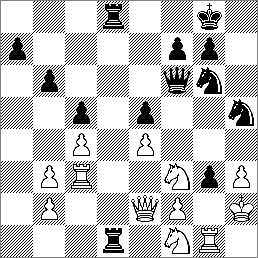
- 30.fxg3 (Adjourned) 30...Ra1 (Sealed)
- Gunsberg: This move was sealed by Steinitz.
- Steinitz: Of all the continuations at Black’s disposal this was probably the best.
- 31.N3d2
- Gunsberg: 31.Ne3 would be much better as it would compel Black to exchange rooks and allow White to play subsequently Nd5. The tempting sacrifice of the knight on the part of Black would lead to a draw; at least, it is difficult to see how Black could improve on the following line of play: 31.Ne3 Rxg1 32.Nxg1 Nxg3 33.Kxg3 Qf4+ 34.Kg2 Nh4+ 35.Kh1 Qxe4+, etc. Also, 33...Qh4+ or 33...Nf4 would not give him a winning attack.
- Steinitz: Much better was 31.Ne3, whereupon the game would probably have proceeded 31...Ngf4 32. Qf2 best, (if 32.gxf4 Qxf4+ 33.Kg2 best, 33...Qg3+ followed by 34...Qxh3+, winning in a few moves) 32...Rxg1 33.Nxg1 Nd3 and though Black will win a pawn, White can make an excellent fight of it by exchanging queens and playing Nd5.
- 31...Qg5 32.Rf3
- Gunsberg: 32.Rd3 at once were better.
- 32...Nf6 33.Rd3
- Gunsberg: If 33.Rf5 Qh6, but it still seems preferable to the move actually made.
- 33...Rxd3 34.Qxd3 Nf8
- Gunsberg: A very good move. He intends to post his knight on d4, which means practically a won game.
- Steinitz: As will be seen this was done with a view of occupying a strong position in the center spot at d4.
- 35.Qe3
- Gunsberg: If 35.Nf3 Black replies by 35...Qc1.
- 35...Qg6 [1:50-2:22] 36.Rg2 Ne6 37.Re2
- Gunsberg: This is forced, as Black threatened ...Ng5, followed by ...Qh5.
- Steinitz: Forced; because Black threatened to take the e-pawn and ultimately the other knight with the rook.
- 37...Nd4
- Steinitz: Black has achieved his object of forming a powerful attack in the centre, which places the adverse isolated pawns at his mercy.
- 38.Rf2 Ra2 39.Nf3
- Gunsberg: White has no good reply. If 39.Qc3 then the e-pawn falls.
- 39...Nxf3+ 40.Qxf3 Qxe4 [2:12-2:41] 41.Qxe4 Nxe4 42.Re2 Ng5
- Steinitz: Indirectly protecting the e-pawn, as Black threatens check at f3.
- 43.Kg2 Ne6 [2:15-2:43] 0-1
- Gunsberg: His position is hopeless. If he takes the e-pawn he loses both his b-pawns, and if 44.Ne3 Black replies with 44...Nd4, winning a second pawn.
- Steinitz: It is only a question of time. His pawns on the queenside must fall and he can hardly steer his king, while Black has free hands.
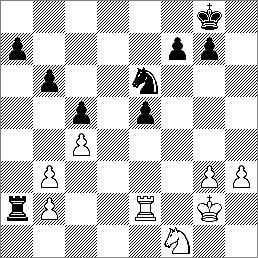
The Sun, New York, 1891.01.03
The World, New York, 1891.01.03
New-York Daily Tribune, 1891.01.03
Morgan's Chess Library, Book VIII, 1891, p54-56
A DRAWN GAME IN THE CHESS MATCH.
THE SCORE NOW: STEINITZ, 4; GUNSBERG, 2;
DRAWN, 5.
Steinitz and Gunsberg yesterday played the eleventh game in their contest for the chess championship of the world at the rooms of the Manhattan Chess Club in this city. After three hours’ play the game was abandoned as a draw on the proposition of Steinitz, and although one or two good features are to be found in it, taken as a whole this game will perhaps rank as one of the tamest which these two masters have yet fought.
Steinitz made what is commonly known as a Zukertort opening, by playing Kt-K B 3, and Gunsberg responded in the most approved style. In fact after the game had been turned into a Queen’s Gambit Declined Gunsberg’s defence was on lines similar to those which Steinitz himself adopted some years ago against the late Dr. Zukertort, and consisted in pushing forward his B to K 2, and then proceeding with an attempt to get rid of the centre pawns.
This led to a quick development of pieces and likewise to a rapid exchange of both knights. Gunsberg castled on his fifth turn, but White continued to develop his minor pieces before castling, which he did on his tenth move. Exchanging still remained a feature of the game, being freely indulged in by both players. After the fifteenth move even the Queens had disappeared from the field, and on the following move exchanges were once more the order of the day.
An even position, devoid of complications of any serious nature, was arrived at after seventeen moves had been recorded, and the subsequent play still more simplified matters and rendered anything but a draw practically impossible. This was proposed by Steinitz after his twenty-eighth move, and eventually accepted. The score now is: Steinitz 4, Gunsberg 2, drawn 5.
New-York Daily Tribune, 1891.01.04
THE ELEVENTH GAME ENDS IN A
DRAW.
The Experts Discussed a Zukertort
Opening - Neither Player Could Get an
Advantage, and Honors Were Divided.
The rival chess masters entered upon the second half of their contest yesterday at the Manhattan Chess Club. The first ten games, which, from present appearances, will form exactly half of the number which will be played in this match, have resulted distinctly in favor of Steinitz. The result of yesterday’s game points still more clearly to the probability that before either player scores ten wins, the maximum of twenty will have been played, unless, of course, the unexpected happens and Steinitz makes a clear break and wins a sufficient number of games consecutively to bring him up to the much-desired point. Judging from the nature of the play in the earlier games, such an eventuality may be looked upon as improbable, and yet taking a brief glance backward, it will be seen that in most of his match encounters Steinitz has made out badly in the beginning, but has almost invariably improved as the fight progressed. It remains to be seen whether the same thing will occur in this instance.
Steinitz opened yesterday’s game with Kt-K B 3, which is popularly known as the Zukertort opening. Gunsberg retorted in the most approved fashion, and the position of a Queen’s Gambit declined was evolved out of the original opening. The game quickly developed, and pawns and pieces were exchanged at a very early stage. So soon in the play as the tenth move a “knowing one” predicted that the issue would be a draw. A few moves later this prophet found an adherent who expressed himself with even greater confidence in the same direction. After the exchange of Queens on the fifteenth move another spectator exclaimed: “Steinitz has no advantage at all now. It is a draw from Alpha to Omega.”
The early exchanges which had marked the previous part of the game were continued on the sixteenth and seventeenth moves by an exchange of bishops. Indeed this rapid slaughter on both sides formed quite a prominent feature in the game, and had the effect of very much shortening it. A very simple position was now arrived at, and subsequent play was of a more or less dull and uninteresting character, although white succeeded in somewhat improving his position by later exchanges. This improvement, however, was of so unimportant a nature that it failed to lift the game from the “drawing” region, and ultimately Gunsberg accepted the proposal of his opponent on the twenty-ninth move, and the fifth draw was duly recorded. The score now stands at 4 wins for Steinitz, 2 for Gunsberg, and 4 drawn games.
Here is a more minute description of the play: Another Zukertort opening was started by Steinitz, and when the game turned into a queen’s gambit declined, his opponent defended virtually in the same manner as Steinitz had himself done against Zukertort viz. by bringing his B to K 2, and then trying to get rid of the two centre pawns on each side. The difference in Steinitz’s treatment was that he did not allow his queen’s centre pawns to be isolated as Zukertort had done.
The opening moves were marked by the exchange of the two Kts on each side, and then the struggle for position commenced on the queen’s wing. White seemed to have a little the pull, but black defended excellently, and especially his thirteenth and fourteenth moves were very fine ones for defensive purposes. On his seventeenth move Gunsberg remarked to his opponent: “Do you play to win this?” to which Steinitz answered: “I think I have slightly the best of it.”
The game proceeded, and white tried to break into the adverse game by advancing the pawns in the queen’s wing. He had to make preparations, and as his king was also far off he could not sufficiently support his attack in the face of the sturdy defence which his opponent made. Black posted his rooks well and entered on a march with his king toward the centre, after protecting his K R P. It came to the exchange of one of the rooks and of the bishops, and white maintained the passed Q R P, while black had a passed pawn on the Q Kt file.
In view of the proximity of black’s king, which threatened to cross over and protect his own Kt’s P, while white’s king was too far off from his passed R P, Steinitz offered a draw. Gunsberg then remarked, “I should like to make one or two moves.” Thereupon Steinitz played P-R 6, and Gunsberg immediately consented to a draw, which was the obvious result of white’s last move, for black’s rook had to intercept white’s passed pawn, and then an exchange of white’s Q R P for black’s Q Kt P was sure to follow, after which either side could easily make his position unapproachable.
The Sun, New York, 1891.01.04
Chess-Player Gunsberg Is Not Yet
Dismayed by Steinitz.
The American Began His Play with an
Irregular Opening Again Yesterday
- The Londoner Not Influenced by
Theoretical Doctrines - The Next
Game Will Be Played To-Morrow.
The chess game yesterday, although it resulted in a draw, demonstrated that the younger player has not been dismayed by the unfavorable turn for him which the match has taken, and that he is resolved to make as hard a fight as ever.
Mr. Steinitz, in all the games wherein he was first player, had failed to make an impression upon his opponent, who always managed to equalize matters if not to obtain the better position. Mr. Gunsberg’s play is never influenced by what other chess-players have played before, much less by theoretical doctrines. In playing he follows the inspiration of the moment. It has been amply proved by the games in the pending contest that he does not limit himself to one line of defense. For an instance, he met Steinitz’s Queen’s Gambits and (what is practically the same) irregular openings every time in a different way. The eleventh game was irregularly opened by Mr. Steinitz with 1 Kt-KB 3 and gradually drifted into a Queen’s Gambit Declined. After the thirteenth move of White Q-Kt 3 it appeared as though White had the best of it, as Black’s queen was seemingly subjected to an attack of both white rooks; but Black, by a well-conceived plan, not only averted all danger but forced White to exchange queens. After this episode the game drifted into shallow channels, and, although Mr. Steinitz prolonged the fight up to the twenty-eighth move, he could not alter the legitimate result. As Mr. Gunsberg remarked after the end of the game: “The time for miracles is over, and a win in an end game with even pieces cannot be forced.” The game lasted three hours and forty-five minutes, of which Black consumed one hour. The score is now: Steinitz, 4; Gunsberg, 2; drawn, 5.
The World, New York, 1891.01.04
Date: 1891.01.03
Site: USA New York, NY (Manhattan Chess Club)
Event: World Championship Match (Game 11)
White: Steinitz,W
Black: Gunsberg,IA
Opening: [D40] Queen’s Gambit Declined
Annotators: Gunsberg & Steinitz
Site: USA New York, NY (Manhattan Chess Club)
Event: World Championship Match (Game 11)
White: Steinitz,W
Black: Gunsberg,IA
Opening: [D40] Queen’s Gambit Declined
Annotators: Gunsberg & Steinitz
- 1.Nf3 d5 2.d4 Nf6 3.e3 e6 4.c4 Be7
- Gunsberg: In all close openings the king’s bishop is posted best at e7 for the second player, as well as e2 for the first.
- Steinitz: In conformity with the authorities and certainly superior to the experiments made by Gunsberg with his bishop in previous games of the match.
- 5.Nc3 0-0 [0:02-0:06] 6.Bd3 c5
- Steinitz: The defense, in its chief features, is altogether of the same description as was played by Steinitz against Zukertort in the match of 1886. It is an important point for Black to get rid of the two middle pawns.
- 7.cxd5 cxd4
- Steinitz: Best; for if 7...Nxd5 8.Nxd5 Qxd5 9.e4, gaining important time.
- 8.Nxd4 Nxd5 9.Nxd5
- Steinitz: White could not well allow the adversary to exchange and separate the pawns on the queen’s wing, nor could he afford to lose time to by either of the knights to e2.
- 9...Qxd5 10.0-0 Nc6 [0:10-0:17]
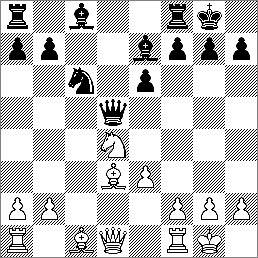
- 11.Nxc6
- Steinitz: As Black always threatened ...Bf6, which confined White’s queenside, it was again of no use to waste time by retreating that knight.
- 11...Qxc6 12.Bd2 Bf6 13.Qb3 Bd7
- Gunsberg: A very good move, which frees Black of all difficulties his queen might get involved in.
- Steinitz: A very good move and the key to his best defense.
- 14.Rfc1 Qa4
- Steinitz: Undoubtedly the best way of offering the exchange which was unavoidable.
- 15.Qxa4
- Gunsberg: If 15.Qxb7 then 15...Rb8, and if 15.Rc7, instead of the text move, then 15...Qxb3, followed by 16...Bc6 and the rook is imprisoned.
- 15...Bxa4 [0:34-0:39] 16.Bc3
- Steinitz: White gradually improves his position by these exchanges.
- 16...Bxc3 17.Rxc3 Bc6 18.b4 a6 19.a4 Rfd8
- Steinitz: 19...Rfc8, which he had to adopt subsequently, was undoubtedly much better at this juncture.
- 20.f3
- Steinitz: It was necessary to give the king freedom. If, for instance, 20.Raa3 Kf8 21.b5 axb5 22.axb5 Be4 with a good game, for obviously White dare not take the bishop on account of the impending mate on his first row.
- 20...Kf8 [0:56-0:46] 21.Raa3 h6
- Steinitz: As Black intended to bring his king into the center, he could not afford long to leave that pawn unprotected, for, though he could confine the bishop afterward by ...g6, White might have had an opportunity of releasing himself with advantage by the advance of the h-pawn to h5, either before or after, supporting it by pushing pawn to g4 according to circumstances.
- 22.Kf2 Rdc8 23.b5 Bd7 24.Rxc8+
- Steinitz: Instead of the exchanges that follow White ought to have played 24.Ke2.
- 24...Rxc8 25.bxa6 bxa6 [1:27-1:02] 26.a5
- Gunsberg: If 26.Bxa6 Black recovers the pawn by 26...Ra8, as White cannot defend his pawn with 27.Bb5.
- Steinitz: Obviously, if 26.Bxa6, Black recovers the pawn by 26...Ra8.
- 26...Bb5
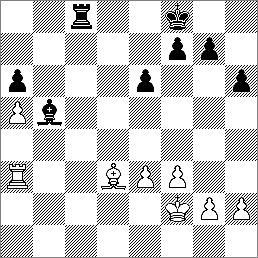
- 27.Bxb5 axb5 28.Rb3 Rb8 [2:00-1:40]
- Gunsberg: A draw was here agreed upon.
- Steinitz: A long struggle would only ensue if White allowed Black’s king to come near the b-pawn; in fact it would be rather dangerous for the former. The draw is now easily effected by White advancing the pawn to a6, which will lead to an exchange of White’s a-pawn for Black’s b-pawn, and the passed pawns being out of the way each party can easily protect his own line with the rook and king.
- 29.a6 ½-½
- From the description in The Sun it appears that Steinitz did play 29.a6 before the draw was agreed, although the gamescores from all three sources end with Black’s 28th move.-[Pope]
The Sun, New York, 1891.01.04
The World, New York, 1891.01.04
New-York Daily Tribune, 1891.01.04
Morgan's Chess Library, Book VIII, 1891, p56-57
GUNSBERG WINS WITH AN EVANS GAMBIT.
AN ILL-CONSIDERED MOVE PROVES FATAL TO
THE CHAMPION.
The fact that Gunsberg yesterday, by playing an Evans Gambit, took up a challenge thrown out by his opponent before the present match began, gave an unusual interest to the twelfth game in the contest for the chess championship of the world, now in progress between Steinitz and Gunsberg in this city. The challenge, made by Steinitz, it will be remembered, was to the effect that he would undertake to play the defence four times in an Evans Gambit in his match with Gunsberg, from a certain point which had at that time been reached in his game against Tschigorin.
The members and visitors at the Manhattan Chess Club who yesterday afternoon watched the giant board in the club-room were more than a little excited as they saw the moves coming down one by one in exact agreement with those made in the Evans cable game between Steinitz and Tschigorin. The whole play was quite familiar to everybody, and the game was accordingly welcomed by many as an old friend, for it is one which has perhaps been subjected to more scrutiny and criticism, comment and analysis, than any game previously recorded in the annals of chess.
Both masters played pretty rapidly, Gunsberg more so than Steinitz. The first fifteen moves were made in about fifty-eight minutes, of which Steinitz had consumed forty-three minutes, although he made precisely the moves which he had studied and analyzed over and over again before playing them against Tschigorin. After Gunsberg’s sixteenth move was recorded there was an unusually long pause, and when Steinitz’s reply finally came down Kt-Kt 5, as compared with 16 Kt-K 3 in the cable game, naturally it gave additional material for analysis and discussion among the spectators, who throughout the play were keps [sic] in a state of considerable animation.
Soon this move was declared to be a bad one, and so it quickly proved. Gunsberg got a chance to mass his minor pieces into attacking order against the adverse King, and by a series of clever moves he forced Steinitz to resign after twenty-four moves. The score now stands: Steinitz 4, Gunsberg 3, drawn 5.
New-York Daily Tribune, 1891.01.06
GUNSBERG ACCEPTS STEINITZ’S CHALLENGE
AND WINS.
Twenty-four Moves Finished Steinitz - He
Varied the Defence from the Cable Game
Against Tschigorin - This was Bad, and
Gunsberg Scored in a Brilliant Way.
The twelfth game in the Steinitz-Gunsberg chess match, which was played yesterday, will be no doubt seized upon and examined with avidity by chess enthusiasts all the world over, and will at the same time be found unusually interesting to every student and amateur players of the game. Had the habitues of the Manhattan Chess Club known what was coming they would have assembled in much larger numbers than was the case yesterday afternoon. As it was, the few who were fortunate enough to have dropped in casually to witness the probably expected Giuoco Piano or Ruy Lopez were thrown into a state of great animation and excitement.
“I wish Gunsberg would play an Evans Gambit.” said a spectator for perhaps the twentieth time, but from the tone in which he uttered it he evidently considered it a hopeless and forlorn wish. The two masters had just then ascended to the room of play on the floor above. The first three moves on either side were sent down rapidly, and the despondent one began, figuratively speaking, to prick up his ears. When the fourth move came down he uttered an exclamation of delight, for at last the desire of many was realized, and an Evans Gambit formed the subject of battle.
After Gunsberg had made his fifth move Steinitz said: “If you expect me to go on with my defence, I’ll do it.” Gunsberg’s reply was to the effect that if he had not expected that Steinitz would play the defence he had adopted against Tschigorin in the cable match he would never have ventured upon the Evans, and thereupon Steinitz said, “Very well then, I play Q-B 3.” This is the incident as it was described by an onlooker, but a somewhat different version is given by Steinitz himself. However it may have been, most of the spectators in the large club room below were confidently predicting that the veteran would vary his defence from that which he adopted in the cable match, and ultimately this proved to be the case, but not until it had almost reached the stage when the Steinitz-Tschigorin game was adjourned.
One of the most remarkable things about the early part of the game was the fact that Steinitz again consumed much more time than his opponent, although he made exactly the same moves as he did in his game against Tschigorin, over which he had already spent a great deal of time in consideration and analysis. For example, he deliberated fifteen minutes on his twelfth move, and then played as he had done before. After fifteen moves on each side had been recorded Steinitz’s clock stood at forty-three minutes, while Gunsberg had only consumed ten minutes. It was only a natural astonishment which prompted a spectator at this point to say: “I cannot understand why Steinitz should have used all this time upon exactly the same moves as he made in the cable match.”
Up to this time there had been no departure from the cable game, and Gunsberg’s next move was the same as that of the Russian master. But now came a deviation. Instead of replying 16...Kt-K 3, as he did in the cable match, Steinitz’s sixteenth move was Kt-Kt 5, which, by the way, is one that does not seem to have been tried in any of the numerous analyses of the game which have been made in New York chess circles.
The game was no longer “Steinitz vs. Tschigorin,” it became once more an encounter between the Hungarian and his Bohemian rival, and in the end the young master conquered, in a manner which will be readily seen by a glance at the score of moves. The whole game was finished in two hours.
This is what Steinitz had to say about the game: “In the opening of the game, before I played 6...Q-B 3, I asked Gunsberg whether he thought I was morally bound, after what I had published, to play exactly the same defence as I played against Tschigorin. My object in asking this question was so that I could not be charged with any deception, as what I had published might have misled Gunsberg into playing an attack which perhaps he would not otherwise have attempted. He answered: "You are not exactly bound, but the public will expect you to defend your own theories." or words to that effect.
After that intimation I remembered I had pledged myself up to a certain point, but could not exactly recollect up to which move, and I decided to play exactly the same moves as in the match with Tschigorin up to and including black’s fifteenth move. Knowing that all the stages of that opening had been well analyzed up to this point, I essayed a new sixteenth move by Kt-Kt 5, which had not even been suggested before; but no sooner had I made it than I saw that I had run, by a mere transposition of moves, into one of the most dangerous variations for my side.
Gunsberg took advantage of it in a masterly manner by answering Kt-R 4, and from that point, as the analysis shows, he had it all his own way.”
At first sight one may be apt to think that the fact of Gunsberg having beaten Steinitz in an Evans’s [sic] Gambit, pursued up to a certain point in the same manner as the cable game, is equivalent to the smashing up of Steinitz’s theories. But a few moments’ consideration will at once alter that view. In the first place it must be remembered that in actual play upon the board the player has not that opportunity for deliberation and analysis which he possesses in a correspondence match like the one between Steinitz and Tschigorin, and this was very pertinently pointed out after the close of yesterday’s game by a spectator, who said that Steinitz would never have played Kt-Kt 5 if he had more time to consider it. Upon this question Steinitz had this to say last night:
“There is a great deal of difference,” he began, “between a correspondence match with a time limit of three days, and a match over the board, and I shall look into the game and perhaps give Gunsberg notice, so as not to mislead him, that I shall alter the defence at an earlier stage than I did to-day, for undoubtedly at the position which was reached at the turning point the heavier burden is thrown upon the defence, and, in a match over the board, I am not justified in handicapping myself to such an extent.”
“It is quite possible,” he continued, “that the move 16...Kt-K 3 which I made in my match with Tschigorin was, after all, the best, for as far as I have been able to reckon, I think I ought to get out with a drawn game, but it would be unwise to adopt it in a match over the board with Gunsberg, for I would show my hand, and up to the present nobody has found out the variation which I intend to play. When I said I would play it four times it did not strike me that this would be the case, and under the circumstances I think my best plan will be to give Gunsberg notice as I have already suggested, as I have no right to compromise the interest of my backers in the match with Tschigorin by playing that variation over the board at present, but I shall be glad to do so after my match with Tschigorin is over.”
“However,” said Steinitz in conclusion, “before it is Gunsberg’s turn to play, I shall decide finally upon the matter.”
The score now stands: Steinitz, 4; Gunsberg, 3; drawn 5.
The Sun, New York, 1891.01.06
HE WINS A BRILLIANT EVANS GAMBIT
FROM STEINITZ.
The Score In the Chess Match Now
Stands: Steinitz, 4; Gunsberg, 3;
Drawn, 5 - Steinitz’s Challenge
Accepted by the Londoner, who
Succeeds in Winning the Contest.
Ever since the beginning of the match between Messrs. Steinitz and Gunsberg, chess players have eagerly expected the event which came off yesterday. Everybody thought it would be a most interesting thing if Gunsberg were to play the Evans gambit against Steinitz to enable the latter to adopt the same defense as in the adjourned cable game against Tschigorin, which he maintains he should win even against the best play. The press also joined in that appeal, and last but not least Mr. Steinitz himself has on several occasions specifically stated by a way of a challenge in the chess reports of various daily prints, and also in his own publication, the International Chess Magazine, that he would undertake to adopt this defense should Mr. Gunsberg offer an Evans gambit. At the time of writing access to the precise wording of all of Mr. Steinitz’s challenges, issued on several distinct occasioes [sic], is not to be had, but the International Chess Magazine contains the following statement by Mr. Steinitz. Speaking of his seventh move, Kt-R3, he said, some time in the early part of November:
“I offer to play that move against Mr. Gunsberg himself as often as he likes in our forthcoming match over the board.”
Subsequently, when discussing his sixteen [sic] move of Kt-K3, Mr. Steinitz was understood to say that with the substitution of Kt-Kt sq he would play four times against Gunsberg from this position. Again, on Dec. 12, Mr. Steinitz further confirms this by a statement in a daily newspaper to the following effect: “By many it was expected that Gunsberg would offer an Evans-gambit to his opponent, who, it may be remembered, stated some time ago that he would undertake to play the defense in the Evans four times with Gunsberg from a certain position which at that time had been reached in this game with Tschigorin.”
The reason Gunsberg deferred till yesterday an acceptance of this challenge was not because he ever doubted that the line of the play adopted by Mr. Steinitz offered splendid opportunities for attack, for Gunsberg has all along stated that in due time he would play the Evans-Gambit. His only object was to defer playing this opening until the match should have reached a more advanced and interesting stage.
With eleven games played and the score standing four to two against him, Mr. Gunsberg felt that it was high time to make an effort to check his opponent’s victorious progress by taking whatever risk there was in playing against that particular variation which Mr. Steinitz has made the subject of special study and exhaustive analysis for the last two years.
Gunsberg gave apt expression to this train of thought when on his fourth move he played P-QKt 4. He remarked to his opponent with an apologetic smile on his countenance: “A sick man may do anything.” Great was his astonishment when he perceived that playing the Evansgambit [sic] seemed to cause considerable mental perturbation to his opponent.
Mr. Steinitz met Gunsberg’s remark by another query, the gist of which was a question of ethics, namely, whether his challenge was binding on him, and whether he was compelled to adopt his own defense. Mr. Gunsberg, of course, declined to give a definite answer to that delicate problem, and merely contented himself with remarking in a general way: “All the world expects you to play your defense, but of course you can do as you please about it.” Dr. Mintz, who up to the present has faithfully watched the interests of both players as representative of the Club here, kindly interposed by reminding Steinitz that he declared his intention to play this defense four times in this match, upon which Mr. Steinitz, but not without reluctance, proceeded with the well-known moves of the Cable games.
On his twelfth move Mr. Steinitz was again taken with some doubts as to his way of proceeding, for he devoted half an hour to the consideration of his move, which, after all, he did not alter. On the sixteenth move, however, Mr. Steinitz varied his move. Instead of Kt-K s [sic] as played against Tschigorin he played Kt-K x 5 [sic]. This move is in accordance with formerly expressed views of Mr. Steinitz who had signified his intention to modify his defense at that stage of the game. The remainder of the story is amply told by the notes to the game below. Suffice it to say that from this point, the sixteenth move, a sharp wrestle for the attack resulted, after only eight moves, in the complete overthrow of the defense and the resignation of Mr. Steinitz on the twenty-fourth move. The final collapse was brought about by a finely considered and effective sacrifice of the White’s rook on the twenty-fourth move.
The scene in the club-room was most animated. Everybody expected that when the Evans gambit was played a lively and interesting fight would result, but it was little thought that the struggle would be so short, sharp and decisive, and everybody present gave expression to their appreciation of the victor’s play by offering him their hearty congratulations.
The World, New York, 1891.01.06
Date: 1891.01.05
Site: USA New York, NY (Manhattan Chess Club)
Event: World Championship Match (Game 12)
White: Gunsberg,IA
Black: Steinitz,W
Opening: [C52] Evans
Annotators: Gunsberg & Steinitz
Site: USA New York, NY (Manhattan Chess Club)
Event: World Championship Match (Game 12)
White: Gunsberg,IA
Black: Steinitz,W
Opening: [C52] Evans
Annotators: Gunsberg & Steinitz
- 1.e4 e5 2.Nf3 Nc6 3.Bc4 Bc5 4.b4 Bxb4 5.c3 Ba5 [0:02-0:02] 6.0-0 Qf6
- Gunsberg: The normal defense is here 6...d6 7.d4 exd4 8.cxd4 Bb6. The move above, with its subsequent line of play, is the invention of Steinitz, who first introduced it in his match against the Russian champion, Chigorin, which was played in Havana in the early part of 1889. Not less than ten games were played at that opening, including one consultation game, of which the Russian master won five to four and one draw. Steinitz has since improved his defense and an elaborate and careful analysis thereof can be found in his “Modern Chess Instructor.” As will be remembered, his new defense is put to a test in one of the two games played by cable between him and Chigorin, which were both postponed during the duration of the pending championship match.
- 7.d4 Nh6
- Gunsberg: In the first part of his Havana match Black played here 7...Nge7 and retired afterwards ...Ncd8, but he now considers the move in the text a decided improvement. The position arising of Black’s seventh move was the object of Chigorin’s challenge, and from this point the game was played by cable.
- 8.Bg5 Qd6 9.d5 Nd8
- Gunsberg: In his book Steinitz recommends 9...Ne7 instead.
- 10.Qa4 Bb6 [0:04-0:09] 11.Na3 c6 12.Be2
- Gunsberg: Threatening Nc4, followed by pawn to d6 and Nb6, which would win the exchange.
- 12...Bc7 13.Nc4 Qf8 14.d6 Bxd6 15.Nb6 Rb8 [0:10-0:43] 16.Qxa7
- Gunsberg: Up to this point the game is identical with the cable match mentioned above.
- 16...Ng4
- Gunsberg: In the cable game Black played here 16...Ne6, but Steinitz subsequently stated that 16...Ng8 was preferable. The move actually made should enable White to win.
- Steinitz: Up to this point the game was conducted in the same way exactly by both parties as in the cable match between Steinitz and Chigorin. In the cable match Steinitz played here 16...Ne6 and then remarked that 16...Ng8 was his best move at this juncture. The text move was an ill-conceived deviation, which gives White at once a strong attack and allows him to bring his minor pieces to bear against the adverse kingside.
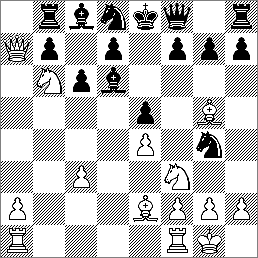
- 17.Nh4
- Steinitz: An excellent move.
- 17...Ne6
- Gunsberg: If 17...f6, then 18.Bc1. He might have, however, played 17...Nf6.
- Steinitz: Under the circumstances the best. If 17...Nf6 18.Bxf6 gxf6 19.Nf5 Ne6 20.Rfd1 Bc7 21.Na8, and the position is similar to that which actually occurred.
- 8.Bxg4 Nxg5 19.Nf5
- Gunsberg: It was difficult to fix upon this move. A promising line of play appeared to be, instead of this move, 19.Nxc8 Rxc8 20.Qxb7 Rd8 21.Rd1 or 21.Nf5, with fair prospects of success.
- 19...Ne6
- Gunsberg: Necessary, as White threatens 20.Nxd6+ Qxd6 21.Rad1, followed by Nxc8 and Bxd7+, etc. Had he, however, played 19...Nxe4 instead, White would likewise continue with 20.Nxd6+ Qxd6 (if 20...Nxd6 then 21.Qxb8) 21.Rd1.
- Steinitz: White threatened Nxd6+, followed by taking the other bishop with the knight, and either of the rooks to d1 with a winning game, and Black had hardly anything better than the text move, for if 19...Nxe4 20.Rfd1 Bc7 21.Nxc8 Rxc8 22.Qxb7 Kd8 23.Qxc6 and wins.
- 20.Rfd1
- Gunsberg: It is important to play the f-rook and not the a-rook, as will be shown on the next move.
- 20...Bc7 [0:37-1:10] 21.Na8
- Gunsberg: Best.
- 21...Rxa8
- Gunsberg: If, instead of this move, Black should attempt to defend his bishop otherwise than by giving up the exchange - namely, by playing 21...Kd8 then White would take the bishop and continue the attack later on by means of Nd6 and Rab1.
- Steinitz: If 21...Kd8 22.Nxc7 Kxc7 23.Nd6, followed by Rab1 and wins.
- 22.Qxa8 Kd8
- Gunsberg: Forced.
- 23.Rxd7+
- Gunsberg: An irresistible move.
- Steinitz: A fine and powerful move which settles the game.
- 23...Kxd7 24.Rd1+ [0:40-1:15] 1-0
- Gunsberg: A singularly disastrous position, from which Black must emerge with a lost game. If he attempts to defend by 24...Nd4 White plays 25.cxd4. If, then, 25...Bb6 26.Qb8 wins; or if 25...Ke6 26.Nd6+ Kf6 (if 26...Kxd6, then 27.Qa3+ mates) 27.Nxc8 and wins. Then again if 24...Bd6 25.Qb8 Nd4 26.Nxd4+ Ke7 27.Nxc6+ and wins.
- Steinitz: For after 24...Bd6, which was the only defense, White would proceed with 25.Qb8, winning easily. If 24...Nd4 25.cxd4 Ke6 26.Nd6+, and wins; for if 26...Kxd6, White answers 27.Qa3+, and mates next move.
The Sun, New York, 1891.01.06
The World, New York, 1891.01.06
New-York Daily Tribune, 1891.01.06
Morgan's Chess Library, Book VIII, 1891, p57
GUNSBERG SUFFERS ANOTHER DEFEAT.
SCORE IN THE CHESS MATCH NOW STANDS:
STEINITZ 5, GUNSBERG 3, DRAWN 5.
In the chess match for the championship of the world now in progress between Messrs. Steinitz and Gunsberg the thirteenth game was played yesterday at the Manhattan Chess Club, in West Twenty-seventh-st. Steinitz had the move and again selected the Zuckertort [sic] opening, Kt-K B 3. His opponent adopted a defence different from the one he played in the eleventh game, and after eight or ten moves had been made it seemed as though Gunsberg had not quite so good a position as on the former occasion, because of the fact that his pieces could not be so readily developed as before, while Steinitz had more freedom.
On both sides the game was conducted pretty rapidly. After a few more moves Steinitz threatened an attack on the opposing Q B P, but Gunsberg was successful in neutralizing the effect of this movement. Not only did he manage to develop his pieces, but he appeared to avert all danger for the present. Meanwhile, however, Steinitz prepared a strong attack on the King’s side by doubling his Rooks on the K B file in readiness for an onslaught when the proper moment arrived. This was the state of affairs after twenty-one moves had been registered.
Now the battle began to rage in earnest, for Steinitz began to threaten on both wings-on the Queen’s side with his Q, and on the King’s side with his R and Kt. His opponent’s play became difficult to manage, but just when he seemed to have got into a bad position, at his twenty-fifth move, he played B-Kt 4 which at once seemed to alter the state of affairs. At the adjournment, however, Steinitz was considered to have the better of the fight.
On the resumption of play at 7 o’clock the pace was forced by the move which Steinitz had sealed upon the adjournment of the afternoon sitting. Still Steinitz had to meet with great care a counter attack which Gunsberg managed to obtain by giving up his centre pawns. When the 37th move had been reached, however, Gunsberg’s play became greatly hampered by the attack which he had to contend with from several quarters. The deciding point seemed to be attained on White’s 38th turn, when Black could no longer hold his citadel, and he had to resign after making one more move.
New-York Daily Tribune, 1891.01.08
STEINITZ AGAIN IN THE LEAD BY TWO
GAMES.
The Veteran Played a Beautiful “Zukertort”
Opening Against the Youngster-
The Latter Fought Bravely, but in Vain.
The incident of last Monday in the match between Steinitz and Gunsberg, has given a lively turn to affairs, and has brought into existence the neucleus of what may ultimately grow to be the subject of a warm controversy between the two masters. Before the commencement of yesterday’s game, they had quite a lively, though not unfriendly argument upon the matter.
The turn to open the game yesterday belonged to Steinitz, and he showed his pertinacity of purpose by again playing Kt-K B 3, known as the Zukertort opening, which, practically speaking, after a few moves became a Queen’s Gambit. In effect every one of his openings so far has been virtually the same, and the frequent repetition of similar openings cannot fail to have an instructive value to students, still a greater variety would be more edifying to the general spectator. The early moves on both sides were made very quickly. Gunsberg varied the defence somewhat, and Steinitz also altered slightly his opening moves. The former castled on his fifth move, and Steinitz adopted the same proceeding on the sixth.
Steinitz then proceeded with a very carefully directed attack on his opponent’s Q B pawn, and almost at the same time he strengthened his K side by taking up a threatening attitude with his rooks on the open K B file. Gunsberg got into a very difficult position, but his defence was a clever one, and his twenty-fifth move, B-Kt 4, seemed to turn things a little in his favor, although Steinitz was altogether of a different opinion. However, after four more moves on either side, the game was adjourned [...]
The move which Steinitz sealed on the adjournment proved to be a very fine one when it was made known on the resumption of play in the evening. By it the pace was accelerated. Gunsberg made a gallant but ineffective struggle, and after ten more moves his position became so hopeless that he was finally obliged to resign, which he did on his fortieth turn. The score now stands: Steinitz, 5; Gunsberg, 3; drawn, 5.
The Sun, New York, 1891.01.08
Steinitz Again Defeats the Londoner in
the Chess Match.
The short and brilliant victory scored by Gunsberg in the Evans gambit has infused a renewed interest to the chess contest, for even the home champion’s most ardent admirers have to admit that the match will be by no means a one-sided affair. In consequence thereof the rooms of the Club were crowded at an early hour yesterday, and much speculation was indulged in whether the veteran would deem it advisable to abandon his hitherto favored close openings, and if so whether he would resort to the variation of the Ruy Lopez, which he had favored almost to the exclusion of any other attack throughout the greater part of the London tournament in 1883, as well as in his second match against the late J. H. Zukertort. A few Hotspurs, with whom the wish fathered the thought, gave expression to their expectation that Mr. Steinitz would venture that variation of the Vienna opening which bears his name.
As is generally the case with prophecies, none of the predicted events happened, but Mr. Steinitz adhered for the third time to what is known as the “Zukertort opening,” namely, beginning with 1.Kt-K B 3. Mr. Gunsberg succeeded in finding out a novel and original defense, which seems also to be quite sound, but unfortunately he lost time on several occasions by indifferent moves, while his opponent, who was in excellent form, gained ground steadily.
After the seventeenth move he had the better position for the ending, according to the doctrines expounded by the modern school, as he had four connected and well-protected pawns on the Queen side, while the pawns of his opponent were dissolved into groups of two. But he omitted the timely advance of his Q R P, which would have given him the initiative, besides that white would not have been able to bring his queen into play via Q R 6 and Q Kt. Both the eighteenth and nineteenth moves of black lacked force, while white brought his pieces into a favorable array. As will be seen by the notes on the game, the English player neglected twice to push his pawn to K R 3, and, as is usually the case in difficult positions, began to be pressed for time.
On the twenty-seventh move he committed an irreparable error by offering the exchange of knights, thereby submitting himself to the opening of his K Kt file and a harassing attack, of which Mr. Steinitz promptly availed himself. When the time arrived for the veteran to seal his move but few doubted that he would carry the day, and the ultimate surrender of Mr. Gunsberg seemed only to be a question of time.
After resumption of play Mr. Steinitz, by way of threatening to win a piece or to mate, compelled Mr. Gunsberg to abandon his Q B P, which white captured. Hereby the Q P was rendered defenseless, and Mr. Steinitz had now two pawns to his credit. On the thirty-sixth move he returned a pawn to bring matters to a settlement, and by well-directed play forced Mr. Gunsberg, who could no longer save a piece, to resign on his fortieth move.
This gives Mr. Steinitz again a lead of two games: the score being 5 to 3, and 5 drawn. To-day being the occasion of the annual general meeting of the Manhattan Chess Club, the fourteenth game will be played on Friday.
Mr. Steinitz has notified Mr. Gunsberg that he will not play his defense in the Evans gambit against him any more. That is to say, not further than 6.Q-B 3. As Mr. Steinitz’s two challenges, however, distinctly comprised also his move of 7.Kt-R 3 as well as some of the subsequent moves played in his cable game, his declination, no doubt influenced by the advanced stage of the match, amounts to a complete retraction of his challenges. Mr. Steinitz is, of course, perfectly entitled to act as he does in his own interest as regards the present match, also as regards the prospects in his adjourned cable game with Tschigorin. Mr. Gunsberg himself feels that, and he would be very sorry to take advantage of a rashly issued challenge, which, however, ought never to have been made.
The interest taken in this match has caused several of the prominent chess clubs in this country to invite Mr. Gunsberg to meet some of their strongest players and also to give exhibitions of simultaneous play. Arrangements have nearly been completed with chess clubs at: Philadelphia, Baltimore, Albany and other cities.
The World, New York, 1891.01.08
Date: 1891.01.07
Site: USA New York, NY (Manhattan Chess Club)
Event: World Championship Match (Game 13)
White: Steinitz,W
Black: Gunsberg,IA
Opening: [A46] Indian
Annotators: Gunsberg & Steinitz
Site: USA New York, NY (Manhattan Chess Club)
Event: World Championship Match (Game 13)
White: Steinitz,W
Black: Gunsberg,IA
Opening: [A46] Indian
Annotators: Gunsberg & Steinitz
- 1.Nf3 Nf6 2.d4 e6 3.e3 Bb4+
- Gunsberg: Black again varies his defense of this opening.
- Steinitz: There is hardly any time lost by this odd move, unless, perhaps, White in reply should decide to interpose 4.Nbd2.
- 4.c3 Be7 5.Be2 0-0 [0:08-0:04] 6.0-0
- Steinitz: White did not advance 6.c4, because Black had not advanced his d-pawn, and in such situation Black might have answered 6...Bb4+; and if White’s knight then interposed, he could have captured the knight and created a double pawn. Black, after this, might proceed according to Winawer’s tactics, refraining carefully from advancing ...d5, and playing for an ending in which the two knights would have the advantage, because.
- 6...d5 7.c4 b6
- Steinitz: Most of the European masters adopt this turn into the Fianchetto di Donna in this opening, but I have never looked upon it with favor.
- 8.Nc3 Bb7 9.cxd5
- Steinitz: In my own opinion best, though most of the experts, including Zukertort, usually played here 9.b3, followed by Bb2.
- 9...exd5 10.Ne5 Nfd7 [0:12-0:15]
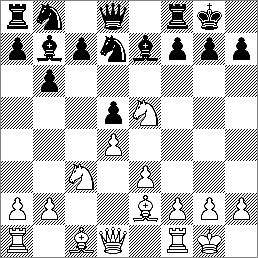
- Gunsberg: Black played the f-knight and not the b-knight, because after 11.f4 Nxe5 12.fxe5, he would have to retire that knight anyhow.
- Steinitz: Hardly advisable, and under the circumstances 10...Nbd7, followed by ...Re8 and ...Nf8 was probably his best plan.
- 11.f4 Nxe5 12.fxe5 c6
- Steinitz: Preparing for his next offer of an exchange, and also preventing pawn to e4, and pawn to d5 eventually.
- 13.Bd2
- Steinitz: As White sees that the adversary enters on an exchanging plan, he simply prepares an attack on the queenside and brings the rooks into communication. Obviously 13.Bd3, which looks a good move, would only have lost time.
- 13...Ba6
- Gunsberg: In order to prevent White from posting his bishop at d3, which would give him a strong attack. Black loses, however, time thereby.
- Steinitz: This was now Black’s best plan, undoubtedly, for if 13...Na6 instead, White would have opened a tremendous attack by 14.Bd3, which he could well back up ultimately with the doubled rooks on the f-file, and those rooks could afterward be brought accordingly to the g-file, or h-file.
- 14.Bxa6 Nxa6 15.Qa4 Nb8 [0:22-0:28] 16.Rac1 f6 17.exf6 Bxf6
- Gunsberg: If 17...Rxf6 White would continue with 18.e4. Black has now the better position for the ending, as he has four connected pawns on the queenside, while the white pawns are dissolved in groups of two. But White’s pieces are far better developed.
- 18.Ne2 Re8
- Gunsberg: A weak move, instead of which he should have played 18...a5, followed by 19...b5.
- 19.Rf3 Qe7 20.Rcf1 Rc8 [0:35-0:54] 21.Bb4 Qe6
- Gunsberg: If 21...Qe4, then 22.Ng3, followed by Nf5 and Nd6.
- Steinitz: If 21...c5 22.Qb3 Rd8 23.dxc5 bxc5 24.Nf4, and clearly Black dare not take the bishop on account of the rejoinder 25.Nxd5, and both his center pawns will become weak and must fall in the end.
- 22.Nf4 Qe4 23.Nh5 Nd7 24.Qa6
- Steinitz: Better than 24.Rc1 on account of the continuation 24...b5 25.Qa6 Bxd4 with the advantage.
- 24...Qe8
- Steinitz: Whereas now, if 24...Bxd4 25.exd4 Qxd4+ 26.Kh1 Qxb4 27.Qb7 Qd6 28.Rf7 with a winning game.
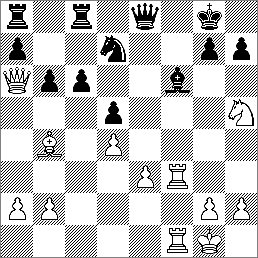
- 25.Rh3 Bg5 [1:19-1:34]
- Gunsberg: 25...h3 instead of the last move seems to be much better.
- 26.Kh1
- Gunsberg: Intending to continue with Nxg7.
- Steinitz: In order to prepare Re1 in case Black should take the e-pawn with his bishop.
- 26...Nf6
- Gunsberg: He cannot capture the pawn because of the reply 27.Qd3. The move in the text is a grave error, as will be seen forthwith. Black’s best play at this juncture was still 26...h6.
- Steinitz: Perhaps the best defense was 26...Bh6, followed by ...Nf8.
- 27.Nxf6+ gxf6
- Gunsberg: If 27...Bxf6 instead, White would win with 28.Rxf6, followed by 29.Qb7.
- Steinitz: Absolutely necessary. If 27...Bxf6 28.Rxf6 gxf6 29.Qb7, followed by 30.Rg3 in reply to 29...Qg6 (the only move) and wins.
- 28.Qb7 Qg6
- Gunsberg: Perhaps it was better to play here 28...h6. The following continuation was likely to occur: 28...h6 29.Rg3 Qf7 30.Qa6 Kh8.
- 29.Qd7 Kh8 [1:51-?:??] 30.Be7(Sealed) 30...Rg8 [1:51-1:46]
- Gunsberg: White threatened 31.Bxf6+ Bxf6 32.Rxf6. Black’s last move prevents it, but at the cost of two pawns.
- Steinitz: He had hardly anything better and this opens to him some prospect of attack against the kingside.
- 31.Qxc6 Rac8 32.Qxd5 Rg7 33.Bb4 Qd3 34.Qf3 Rc2 35.Bc3 Re7 [2:17-2:13]
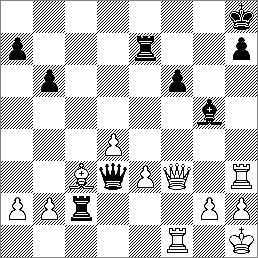
- 36.e4
- Gunsberg: Giving up the pawn in order to bring matters to a speedy termination.
- Steinitz: The best way of getting rid of the adverse attack, as White had sufficient to win in the ending and the e-pawn could not be saved anyhow.
- 36...Qxe4 37.d5 Qg6
- Gunsberg: The exchange of queens would likewise leave him with an untenable position.
- 38.Rg3
- Gunsberg: Threatening to win by Rxg5.
- 38...Rf7 39.d6
- Gunsberg: Better than 39.h4 at once, to which Black had some defense by 39...Qh6.
- Steinitz: Obviously, if 39.Rxg5 Qxg5 40.Bxf6+ Rxf6 and wins, for clearly White cannot retake twice on account of the mate ultimately pending by ...Rc1#.
- 39...h6
- Gunsberg: If now 39...Qh6, White pushes 40.d7 Rxd7 41.Rxg5 and Black cannot reply with 41...Rxc3, for White would mate beginning with 42.Qa8+.
- 40.h4 [2:30-2:38] 1-0
- Steinitz: Winning a piece with an overwhelming attack.
The Sun, New York, 1891.01.08
The World, New York, 1891.01.08
New-York Daily Tribune, 1891.01.08
Morgan's Chess Library, Book VIII, 1891, p58-59
GUNSBERG AGAIN PLAYED AN EVANS
GAMBIT.
The Veteran Altered his Defence, and,
Although Gunsberg Played a Very Clever
and Brilliant Attack, he Could Not Win.
Again the Evans Gambit. This was the order of play yesterday in the championship encounter between Steinitz and Gunsberg at the Manhattan Chess Club in West Twenty-seventh street. But Steinitz, in accordance with the intention of which he had already notified his opponent, declined to continue all through with the same defence he had adopted in the cable game against Tschigorin. Of course, Gunsberg knew quite well that the veteran would alter his method, and, therefore, in again opening the Evans, Gunsberg manifested an enterprise at once admirable and courageous.
Speculation became rife after the opening moves as to where Steinitz would first depart from the cable game, and the spectators did not have to wait for long before this point was decided. The game of Monday was adhered to up to the end of the sixth move. On black’s seventh turn came the anticipated change. In his game by cable with the Russian player, and also in the game played last Monday with Gunsberg, Steinitz moved on his seventh turn Kt-K R 3. Yesterday he varied this move by playing P-K R 3. A spectator who was present when this move was recorded, stated that in tournament play a few years ago this same movement was made by a strong amateur against Steinitz himself, who on that occasion was playing white.
For some time the game was conducted on fairly even terms, Gunsberg pursuing the initiative with marked vigor and ability. At length the opinion of the spectators turned chiefly in favor of the Hungarian’s game, which was considered, long before the adjournment, to be the superior of the two.
Steinitz took a long time to consider his reply, and was still thinking when the time arrived for adjourning the afternoon sitting. At this time it was clear that he was playing for his only hope-a draw.
The move which Steinitz sealed on the adjournment was one by which he attained his object of drawing the game. When it had been opened and the move made on the board of play, the veteran said to his younger opponent “You may think it over and tell me if you want to play for a win.” After a few moments’ consideration, Gunsberg said that if his opponent’s remark was intended to be an offer of a draw, he was willing to accept it. The game was thereupon recorded as a draw, making the score now: Steinitz, 5; Gunsberg, 3; drawn, 6. The greater part of Gunsberg’s play was counted by many as fine chess, and altogether he has proved a surprise.
Steinitz makes the following comments upon the game:
“Gunsberg is certainly very plucky. He offered the Evans Gambit for the second time, although I had given him notice that I thought myself at liberty to alter my defence at any time. In his comments upon this notice he calls it a retraction of a challenge that ought never to have been made, but I do not think that fair-minded chess players will agree with him, for all challenges ought to be accepted formally within a reasonable time, and Gunsberg could not expect that I should wait for his convenience and be bound to a long series of moves, while he would be at liberty to alter his tactics at any time or not play that opening at all.
However, I did not abandon the leading idea of my defence: I played 6...Q-B 3, which was the original bone of contention between Tschigorin and myself. On the seventh move I also advanced P-K R 3, which was the line of play I had intended to adopt against Tschigorin before knowing that he had included in his conditions 7...Kt-R 3. Gunsberg then proceeded with a sort of Ruy Lopez attack by 8 B-Kt 5, and threatened to gain a pawn for two moves in successioa [sic]. Black lost patience on the ninth move, and exchanged pawns in a manner that gave his opponent a good centre attack, which could have been avoided by B-Kt 3 instead.
The fight for position soon afterward resolved itself into an attempt on white’s part to force on his K B P, while black parried that attack an attempted a counter demonstration by the advance of his pawns on the queen’s wing. This was hardly judicious, though it might perhaps have worked well, considering that black was a pawn ahead, if he had on the twenty-seventh move simply protected the weakened Q B P by Q-K sq. As it was, white won the queen’s centre pawn and obtained a passed K P, which at the time of adjournment, looked threatening. However, black had some compensation by the exposed position of the adverse king, while his own was in security, and he had also more freedom of action for his rook on the open files.”
The Sun, New York, 1891.01.11
THE FOURTEENTH GAME OF THE CHESS
MATCH.
GUNSBERG OPENED AGAIN WITH THE EVANS
GAMBIT-ONLY SIX MORE GAMES
CAN BE PLAYED.
The rooms of the Manhattan Chess Club in this city were very well patronized yesterday when Gunsberg opened the fourteenth game in the match for the chess championship of the world. The Hungarian remained true to his intention to open again with the Evans Gambit against the veteran, Steinitz.
The readers of The Tribune will remember that before the match started Steinitz challenged Gunsberg to play the Evans Gambit against him, and undertook to play on four occasions the defence which he had already adopted against Tschigorin on the cable match up to a certain point. Gunsberg played the Evans Gambit for the first time last Monday, winning the game after twenty-four moves. Meantime Steinitz withdrew his challenge, one of his avowed reasons being that he was no longer bound to keep it, since Gunsberg did not take it up at the beginning of their match. Another reason which he gave was that if he played the same continuation against Gunsberg he would be compromising the interests of his backers in the cable match.
He duly informed Gunsberg of his withdrawal, but in spite of this fact the latter declared he would again play the Evans Gambit when his turn came to open, and this he did yesterday. He conducted the attack with great spirit and skill, and at the same time played, on the whole, pretty rapidly throughout. On the other hand, Steinitz played in his usually careful and steady style, defending his position, particularly toward the end, with great penetration and foresight.
After the eighteenth move the position was a very interesting one. As will be seen from the score of the game which is appended, Steinitz varied his defence as early in the game as the seventh move. On that move in Monday’s game he played Kt-R 3, instead of P-R 3. He succeeded in keeping the gambit pawn till a very advanced stage of the game. In fact it was only on his thirty-third and last move that Gunsberg, by clever play, managed to recover it, although for some time prior to this he had possessed a superior game.
Steinitz sealed as his reply move, 33...Q-Q Kt sq., which assured the draw he had for some time been aiming at. The proposal for a draw was made by Steinitz and readily accepted by Gunsberg. The score now stands: Steinitz 5, Gunsberg 3, drawn 6, with six more possible games to be played.
New-York Daily Tribune, 1891.01.11
Another Interesting Contest Between
Two Great Chess Masters.
The extraordinary incident in the chess match of Mr. Steinitz withdrawing his challenge, so confidently issued-the particulars of which have been narrated in THE WORLD of Jan.6-warranted the unusual interest manifested in the fourteenth game. Although the English player had been already told by his opponent that he will not consider himself bound to adhere to his innovation in the defense of the Evans gambit, a line of play which is considered unsound in every chess expert’s opinion but in the author’s, he nevertheless, relying upon his own resources, offered the pawn in the fourth move, greatly to the delight of the numerous spectators, who naturally enjoy a sprightly and spicy gambit more than all the finesses of the “modern school.”
After thirty-three moves the game was drawn. The score now stands: Steinitz, 5; Gunsberg, 3; drawn, 6. The fifteenth game will be played to-morrow.
The World, New York, 1891.01.12
Date: 1891.01.10
Site: USA New York, NY (Manhattan Chess Club)
Event: World Championship Match (Game 14)
White: Gunsberg,IA
Black: Steinitz,W
Opening: [C52] Evans
Annotators: Gunsberg & Steinitz
Site: USA New York, NY (Manhattan Chess Club)
Event: World Championship Match (Game 14)
White: Gunsberg,IA
Black: Steinitz,W
Opening: [C52] Evans
Annotators: Gunsberg & Steinitz
- 1.e4 e5 2.Nf3 Nc6 3.Bc4 Bc5 4.b4 Bxb4 5.c3 Ba5 [0:02-0:01] 6.0-0 Qf6 7.d4 h6
- Gunsberg: In his book Steinitz declares 7...Nh6 the right move to be at this juncture. It seems that his present move is a little better. A still better course seems to be 7...Bb6.
- Steinitz: Perhaps the safest plan, considering Black’s last move.
- 8.Bb5
- Gunsberg: White has an abundance of moves to continue with, as for example 8.d5, or 8.dxe5 Nxe5 9.Nxe5 Qxe5 10.Qb3 with a view to continue afterwards with pawn to f4, all of which give the player good attacking chances. The move actually made seems, however, as good as, if not better than, as any.
- Steinitz: If 8.Qb3, Black intended to play 8...Nge7 9.dxe5 Nxe5 10.Nxe5 Qxe5 11.Bxd7+ Kd8 with an excellent game, though the pawns are even.
- 8...Nge7 9.Ba3
- Steinitz: Of course this prevents Black from castling for a little while, as in that case White would answer 10.Bxe7, thereby winning a pawn.
- 9...exd4
- Steinitz: 9...Bb6 was preferable.
- 10.e5
- Gunsberg: It was perhaps better to retake the pawn first.
- Steinitz: Though Black dare not take that pawn on account of the ultimate Re1, it was far better to retake the pawn at once and leave the center pawns standing abreast, with the option of advancing later on.
- 10...Qe6 [0:06-0:26] 11.cxd4 Bb4
- Steinitz: Hardly a good move.
- 12.Bb2
- Gunsberg: White could here recover the pawn sacrificed on the fourth move by taking the c-knight and in reply to 12...Bxa3 (best) take either the Black b-pawn or d-pawn. But White justly preferred to keep up his attack.
- Steinitz: White could have won a pawn here by 12.Bxc6 Bxa3 (of course 12...Nxc6 13.d5 with a winning attack) 13.d5 recovering the pawn with a good game.
- 12...d5 13.Nc3 0-0 14.Ne2 Ng6 15.Qb3
- Gunsberg: 15.Qa4 was also a strong continuation at this point.
- 15...Ba5 [0:32-0:40]
- Steinitz: If 15...Be7, White would probably have answered 16.Nd2.
- 16.Ne1 Nce7 17.f4 Qb6
- Gunsberg: 17...Bb6 instead and subsequently ...f6 would have been preferable.
- Steinitz: 17...f5 at once was superior.
- 18.Ba3
- Gunsberg: A good move, which effectually meets Black’s plan to force the exchange of queens by 18...c6, for White would retire 19.Bd3, and if Black takes the queen the pawn retakes. Black’s best move would then be 20...Bd8 as both knight and bishop are menaced, and White has an excellent game by playing pawn to f5. If Black, however, takes the knight at e1 instead of retiring the bishop to d8, then White retakes with the a-rook and proceeds likewise with pawn to f5, Black being compelled to play ...Re8.
- Steinitz: A very fine rejoinder, which gives White the pull in a precarious-looking position.
- 18...f5
- Gunsberg: He has to stop the advance of the adverse f-pawn, but this move leaves White plenty of scope, for the array of his forces into an attacking position and gives him a powerful passed pawn.
- Steinitz: If 18...c6 19.Bd3 Qxb3 20.axb3, threatening 21.Bxe7 as well as 21.f5 with an excellent game.
- 19.Qa4 c6 20.Bd3 Qd8 [0:45-1:12]
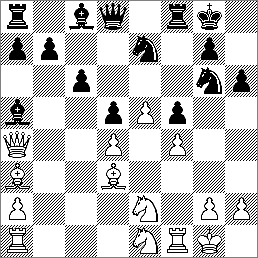
- 21.Qc2 b5
- Steinitz: Maneuvering with the pawns on the queenside was not advisable. The text move weakens the c-pawn, and although there is apparently no danger at present, it is a source of trouble at a later stage.
- 22.Kh1 Bb6 23.g4 a5
- Gunsberg: Perhaps 23...Nh4 would have been preferable.
- 24.Rg1 b4
- Gunsberg: Not good, as the sequel shows.
- Steinitz: Instead of this, Black would have done better to play 24...Qe8.
- 25.gxf5 Bxf5 [0:58-1:22] 26.Bxf5 Rxf5 27.Rxg6
- Gunsberg: A very good move, which at least wins a pawn.
- 27...bxa3
- Gunsberg: It is obvious that 27...Nxg6 28.Qxf5 would be in favor of White.
- Steinitz: Black could again have improved his position here by 27...Qe8.
- 28.Rxc6
- Gunsberg: Here White might have kept up a promising attack by 28.Re6 or 28.Nf3 instead.
- Steinitz: White must have looked far ahead before taking this pawn, for in several ways his game looked dangerous after this; but on examination it will be found that his position remains sound.
- 28...Nxc6 29.Qxf5 Nxd4 30.Nxd4 Bxd4 [1:22-1:30] 31.Qe6+ Kh8 32.Rd1 Bc3 33.Rxd5 (Adjourned)
- Gunsberg: At this point the time for adjournment had arrived. Steinitz devoted nearly half an hour to the consideration of the extremely difficult situation before sealing his reply. An examination of the highly interesting and complicated position shows that Black’s choice of good moves is limited. Had he, for instance played the very plausible looking 33...Qh4, White would have had in all probability a winning game by 34.Ng2.
- 33...Qb8 (Sealed) ½-½
- Gunsberg: The exposed position of the white king now enables Black to draw by perpetual check.
- Steinitz: Probably better than 33...Qh4 34.Ng2 Qh5 35.Qc6 Rb8 36.Qxc3 Rb1+ 37.Ne1 Rxe1+ (Black had no time for 37...Qe2, as White would mate in a few moves beginning with 38.Qc8+) 38.Qxe1 Qf3+, and White’s king has more freedom, although by best play it would also end in a draw. The probable continuation would have been: 34.Rd1 Bxe1 35.Rxe1 Qb7+ 36.Kg1 Ra6, and the game could hardly be won by either side.
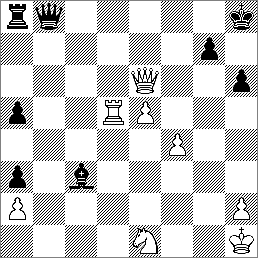
The Sun, New York, 1891.01.11
The World, New York, 1891.01.12
New-York Daily Tribune, 1891.01.11
Morgan's Chess Library, Book VIII, 1891, p59-60
FEATURELESS DAY IN THE CHESS MATCH.
STEINITZ OPENS THE PLAY FOR THE EIGHTH
TIME WITH THE QUEEN’S GAMBIT.
In the chess match for the championship of the world, now in progress under the auspices of the Manhattan Chess Club in this city, Mr. Steinitz yesterday for the eighth time opened the Queen’s Gambit or what comes practically to the same thing, the Zukertort opening--Kt-K B 3. This game having already been played seven times in this contest, it was only natural that the first few moves should be made rapidly on both sides.
Gunsberg adopted again the Fianchetto do Donna style of defence, which is scarcely approved by Steinitz. However, the Hungarian succeeded in getting a much better development of his pieces in this game than in the thirteenth of the series, in which he adopted a similar defence. In the latter part of the opening Steinitz essayed threatening tactics on the Q side with his Queen, which were well neutralized by the defence.
An exchange of Rooks followed, and it finally seemed as if Gunsberg would win a Pawn. In this he succeeded on his twenty-sixth turn. A further exchange of Rooks followed, and when, a few moves later, the game was adjourned for the usual two hours’ recess, the position seemed a dead draw because of the likelihood which existed of Bishops on oppositely colored squares being left on the board.
On the resumption of play at 7 o’clock this anticipation was fulfilled, for Steinitz exchanged one of his Bishops for a Knight. Although Gunsberg was still a Pawn to the good there was nothing left to fight for, neither player having any prospect of a win. Accordingly the game was agreed upon as a draw after thirty-nine moves, making the score now : Steinitz 5, Gunsberg 3, drawn 7.
New-York Daily Tribune, 1891.01.13
The Champions Discussed a Zukertort
Opening.
In their match for the chess championship yesterday Steinitz and Gunsberg again discussed a Zukertort opening on the initiative of the older player, whose persistency in this direction is becoming somewhat tiresome to many of the frequenters of the Manhattan Chess Club. Virtually Steinitz has now made the same opening eight times. Of course, he has varied the opening move by playing at one time P-Q 4, at another Kt-K B 3, but the result after a few moves has been that, practically speaking, the position arrived at has been the same.
Gunsberg managed on this occasion to get his pieces more readily into play than in the thirteenth game, in which his queen’s side, it will be remembered, was very much hampered. Eventually Steinitz made an excursion with his queen into her own territories, and commenced a mode of attack which could hardly be reckoned as satisfactory for his own game. The result was that ultimately he lost a pawn after a fight which was pretty evenly conducted on both sides.
Gunsberg captured the pawn on his twenty-sixth move, and an exchange of rooks followed. When the game was adjourned, after 28 moves had been recorded, the position [...] indicated that bishops on differently colored squares would be left on the board, and that the most likely issue then would be a draw.
This ultimately proved to be the case when Steinitz exchanged his Q B for the opposing Kt, and a draw was announced after white’s thirty-ninth move.
The Sun, New York, 1891.01.13
MAKING SEVEN THAT NEITHER
CHESS-MASTER COULD WIN.
The Game, Which Was Again Opened
Irregularly by Mr. Steinitz, Was One
of the Finest of the Series-Gunsberg
Gets Out of a Hole by a Good
Combination-Next Game To-morrow.
The Fifteenth game of the match, one of the finest battles over the chess-board, was again opened irregularly by Mr. Steinitz. Like in previous games Gunsberg changed his defensive tactics by after white’s B P x Q P not retaking with the P but with the Kt. Mr. Steinitz prepared his usual battle plan, namely, to mass forces on the Q’s side and as pointed out in the notes to the game below, the position assumed a rather dangerous look for black. White, besides, incidentally threatening to win a piece, was, to all appearance, at liberty, after advancing his centre pawns, to throw his forces on the K side or to continue the pressure against the Q’s wing. Black seemed to have only a choice of evils. But black, by a deep and far-reaching combination, not only averted all danger, but emerged with the better position, winning a pawn in the twenty-sixth move. One move later, after the exchange of rooks, Mr. Steinitz proposed a draw, but Mr. Gunsberg preferred to go on with the game. White, who was a pawn behind, managed to remain with Q and a B of different color than his opponent’s B. But notwithstanding Gunsberg could have probably won the game as shown in the appended notes. The game lasted five hours, of which both consumed an equal amount. The score now stands: Steinitz, 5; Gunsberg, 3; drawn, 7.
The next game will be played to-morrow.
The World, New York, 1891.01.13
Date: 1891.01.12
Site: USA New York, NY (Manhattan Chess Club)
Event: World Championship Match (Game 15)
White: Steinitz,W
Black: Gunsberg,IA
Opening: [E14] Queen’s Indian
Annotators: Gunsberg & Steinitz
Site: USA New York, NY (Manhattan Chess Club)
Event: World Championship Match (Game 15)
White: Steinitz,W
Black: Gunsberg,IA
Opening: [E14] Queen’s Indian
Annotators: Gunsberg & Steinitz
- 1.Nf3 Nf6 2.d4 e6 3.e3 b6
- Steinitz: It does not make much difference at which point the fianchetto is adopted early in the opening by the second player, but usually this is deferred.
- 4.c4 Bb7 5.Nc3 d5 [0:05-0:06] 6.cxd5 Nxd5
- Gunsberg: In a somewhat similar position in the thirteenth game, Black retook here with the pawn. The text move is better.
- 7.Bb5+
- Steinitz: It is generally a good plan to compel the adversary to close the diagonal of his bishop in the manner done in the text.
- 7...c6 8.Bd3 Be7 9.e4 Nxc3
- Steinitz: This strengthens the adverse center, and 9...Nf6 was preferable.
- 10.bxc3 0-0 [0:12-0:12] 11.0-0
- Steinitz: 11.Be3 was probably superior.
- 11...c5 12.Be3 cxd4 13.cxd4 Nc6 14.Rc1
- Steinitz: With a view of playing Bb1, followed by Qd3 with a strong attack.
- 14...Ba3
- Gunsberg: With a view of preventing White from carrying out his plan of campaign, namely, to retire his bishop to b1 and to play his queen to c2 or d3, either before or after pushing the pawn to e5, according to circumstances.
- 15.Rc3 Bb4 [0:26-0:21]
- Gunsberg: If 15...Bb2 instead White wins a piece by 16.Rxc6 and 17.Qc2.
- Steinitz: 15...Bb2 was probably Black’s original intention, but he finds now that he would lose two minor pieces for the rook by the reply 16.Rxc6, followed by Qc2, winning one of the bishops.
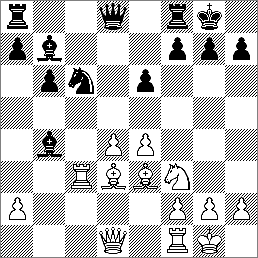
- 16.Rc4
- Gunsberg: A very strong move which threatens to win a piece by pawn to d5 and also to bring the rook over to the kingside.
- 16...Be7
- Gunsberg: If 16...b5 instead, White would obtain a good attack against Black’s loosened queen’s wing after retiring the rook.
- 17.Qa4
- Gunsberg: Had he now played 17.d5, Black would have obtained a good game by 17...exd5 18.exd5 Nb4.
- 17...Na5
- Gunsberg: A good move which, however, required the minutest forecalculation. Black’s game was menaced in the extreme, and it was very difficult to steer clear of all cliffs. Had he, for instance, played 17...Rc8 instead of the text move, White would have obtained an overwhelming position by doubling rooks, followed by pawn to d5. Besides, Black had to guard against pawn to e5 and Be4, or Bb5, after retiring the rook. The move actually made was the fruit of a deep combination which enabled Black to prevent his opponent from playing subsequently Bd2, which would otherwise lose a pawn.
- 18.Rc2 Rc8 19.Rfc1
- Gunsberg: If 19.Rxc8, then Black retakes with the bishop threatening ...Bd7.
- 19...Rxc2 20.Rxc2
- Gunsberg: Steinitz remarked that 20.Qxc2 would have been superior.
- Steinitz: 20.Qxc2 was much superior.
- 20...Qa8 [0:44-0:59]
- Gunsberg: This is the move upon which Black had relied in forming his defense. It not only releases his queen’s wing from the pressure of White’s attack, but also gives him the initiative.
- Steinitz: A very fine move, which wins a pawn by force, at least temporarily.
- 21.Nd2 Bc6 22.Bb5 Bxe4 23.Nxe4 Qxe4 24.Rc7 Bf6
- Gunsberg: Better, perhaps, were 24...Bd6, with the following combination: 25.Rxa7 Qb1+ 26.Bf1 Bxh2+ 27.Kxh2 Qxf1.
- Steinitz: Black could have maintained the pawn by 24...Bd6 25.Rxa7 Qb1+ 26.Bf1 Bxh2+ 27.Kxh2 Qxf1, but his b-pawn would have remained weak.
- 25.Rxa7 Nc6 [1:15-1:19] 26.Ra8
- Gunsberg: If 26.Rd7, Black continues with 26...Ne7 and ...Nd5. It is obvious that White cannot play 26.Bxc6.
- Steinitz: If 26.Rd7, Black would answer 26...Ne7, followed by ...Nd5.
- 26...Nxd4 27.Rxf8+ Kxf8 28.Qa3+ Kg8
- Gunsberg: If 28...Be7, White would have likewise remained with bishops of different colors.
- 29.Qa6(Sealed) 29...g5 30.Bxd4 [2:11-2:10]
- Gunsberg: Of course not 30.Qxb6 because of 30...Qb1+, winning the queen.
- 30...Bxd4 [2:11-2:18]
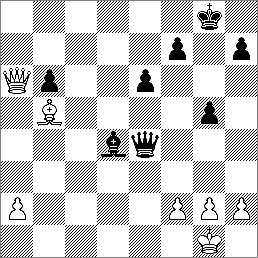
- 31.Bf1 Bc5 32.Qe2 Qd4 33.g4 Kg7 34.Qf3 Qa4 35.Qc3+ f6 [2:20-2:20] 36.Qc4 Qc6 37.Qe2 Qd6 38.Qf3 Qd4 39.Bd3 ½-½
- Gunsberg: Here Black ought to have checked at a1 and captured the pawn, with good chances to win. But he seemed to have overlooked the force of that move, for he accepted here the renewed proposal of a draw.
- Steinitz: Steinitz afterward pointed out that Black could have here proceeded with 39...Qa1+ 40.Kg2 Qxa2 41.Qb7+ Kf8 42.Qb8+ Kf7 43.Qc7+ Be7, and White dare not take the b-pawn on account of the rejoinder ...Qd5+, winning the bishop. However, if White then took the h-pawn he had fair prospects of making his defense good, and though the adverse b-pawn would have been troublesome for some time the game was hardly strong enough to win, especially if White did not exchange queens.
The Sun, New York, 1891.01.13
The World, New York, 1891.01.13
New-York Daily Tribune, 1891.01.13
Morgan's Chess Library, Book VIII, 1891, p60-61
STEINITZ FALLS INTO A TRAP
THE CHAMPION STILL ONE POINT AHEAD IN THE CHESS MATCH.
Gunsberg yesterday opened for the third time, in the match for the world’s chess championship in this city, an Evans Gambit against Steinitz, and as the latter did not feel well his defence was not up to his usual high standard. However, he made a capital fight in the new variation which Gunsberg introduced on his eighth move. After some give-and-take play on both sides the veteran forged ahead with a somewhat premature attack on the King’s side, which Gunsberg defended with considerable skill, and to that end had to bring some of his pieces from the Queen’s wing over to the King’s side.
Just when the game was about to become highly interesting Gunsberg made a move which was intended not only to drive the opponent’s Queen out of play, but also in the other event to lead Steinitz into a trap by which he would lose his Queen. Steinitz, without much hesitation, took the proffered pawn which was left en prise, fell into the trap cleverly laid by his opponent, and had to resign on his twenty-first move. The score now stands: Steinitz, 5; Gunsberg, 4; drawn, 7; and four games to be played.
New-York Daily Tribune, 1891.01.16
STEINITZ IS TRAPPED BY GUNSBERG
ON HIS TWENTIETH MOVE.
Gunsberg Opened Another Evans Gambit
and Won a Fine Game-Steinitz’s Defence
was Somewhat Weak-He was About to
Lose His Queen When He Resigned.
After two and a half hours’ play the sixteenth game in the Steinitz-Gunsberg chess encounter was decided yesterday in a most unexpected manner. It was an Evans Gambit, which was again started by Gunsberg, and the spectators who were assembled in the large room at the Manhattan Chess Club found in a short time a new variation of the famous opening, which not only proved particularly interesting, but in which Steinitz took up a line of defence superior to that which he played last Saturday. At any rate, after nineteen moves had been made on either side there seemed to be no particular danger threatening him.
Naturally, the early moves were made very rapid. The first deviation from the fourteenth game was made by Gunsberg on his eighth move. With this exception Gunsberg’s attack in the opening was similar to that which he played in the previous Evans Gambit. Steinitz deliberated twenty minutes on his thirteenth move, and after another move on either side had been recorded [... it] was generally expected that Gunsberg would now proceed with B x Kt and Q-Kt 4, threatening mate, but this expectation was not realized, for he moved Q Kt-Q 2. The attack and the defence were now conducted on fairly even terms. Steinitz succeeded in neutralizing the attack of his opponent and entered upon a counter attack, for which, however, he had not made full preparation.
Although at the time when the middle game was entered upon Steinitz had not been able to castle, his king seemed to be in safe quarters, protected by pawns and minor pieces, while his queen was engaged in an attack upon the opposing king.
On his twentieth turn Gunsberg made a move which was destined to at once change the whole aspect of affairs. At first sight the object of this move, Kt-R 4, was simply to drive back the adverse queen, at the risk of losing the pawn, which was thus left en prise. But in reality is was a cleverly conceived trap which had for its object the capturing of the queen, the B P being the bait. It is sufficient to say that Steinitz did not see the trap until he had made the fatal move, and when his opponent’s reply came, he at once gave up.
The Sun, New York, 1891.01.16
HIS OPPONENT MOVED IN A WAY
THAT WAS NOT EXPECTED.
The Contest Finely Conducted and Full
of Interesting Postions-Gunsberg
Is Now Only One Game Behind the
Famous Chess Master and Seems to
Enjoy the Evans Gambit.
Yesterday’s game of the contest brought about another Evans Gambit, which the English player pluckily offered. Mr. Steinitz still clung to his new defense, which he, like in the fourteenth game, improved by P-K R 3 on the seventh move. As will be seen by the notes to the appended games, both the attack and the defense were finely conducted, and the middle game was full of intricacies and interesting positions. It is therefore to be regretted that the play, which promised to be a specimen of chess of the highest order, was marred by a mistake on the part of Mr. Steinitz, who, by capturing a pawn on the twentieth move, allowed his opponent to imprison his Queen. Mr. Steinitz, who had only considered the eventuality of white’s playing his Kt to K B 3 on the twenty-first move, resigned immediately after Gunsberg’s move, Kt to K 4. The game lasted 2h. 48m., of which Gunsberg consumed 1h. 28m.
The victorious result of yesterday’s game leaves the London player only one point behind his famous opponent-one point in sixteen game. Mr. Gunsberg has so far achieved the est results of all the experts who have ever antagonized the grand-master of chess over the board. The score is now: Steinitz, 5; Gunsberg, 4; drawn, 7. The seventeenth game will be played to-morrow.
The World, New York, 1891.01.16
Date: 1891.01.15
Site: USA New York, NY (Manhattan Chess Club)
Event: World Championship Match (Game 16)
White: Gunsberg,IA
Black: Steinitz,W
Opening: [C52] Evans
Annotators: Gunsberg & Steinitz
Site: USA New York, NY (Manhattan Chess Club)
Event: World Championship Match (Game 16)
White: Gunsberg,IA
Black: Steinitz,W
Opening: [C52] Evans
Annotators: Gunsberg & Steinitz
- 1.e4 e5 2.Nf3 Nc6 3.Bc4 Bc5 4.b4 Bxb4 5.c3 Ba5 [0:01-0:01] 6.0-0 Qf6 7.d4 h6 8.Qa4
- Gunsberg: In the fourteenth game White played Bb5 first. But as he had to play his queen afterwards to a4 it occurred to him that the present continuation would be better. It may be remarked here that had White now played 8.Qb3 Black could have played 8...Nge7, and if 9.dxe5 Nxe5 10.Nxe5 Qxe5 11.Bxf7+ Kd8 with a good position for the ending.
- Steinitz: An alteration from game 14, which seems to strengthen White’s attack.
- 8...Bb6 9.Bb5
- Gunsberg: Here 9.d5 or 9.Be3 deserves to be considered. But it is doubtful whether in either case White would obtain a better game than by the line of play which he adopted. After 9.d5 in some variations White may bring about an exchange of dark-squared bishops and may compel Black to retake with the c-pawn, but that may hardly be deemed sufficient compensation for the pawn he has sacrificed.
- 9...Nge7 10.Ba3 exd4 [0:17-0:16]
- Gunsberg: If 10...0-0, then of course 11.Bxc6 dxc6 12.Nxe5 would recover the pawn; if 10...d6, then 11.d5 would win a piece. Black might have tried the odd move of 10...Rb8 with a view of playing ...a6 to displace the bishop. White would not do well to exchange both bishops for the sake of regaining the pawn, as he would remain with two knights against two bishops. But there really is no seeming objections against 10...Ng6.
- Steinitz: This seems now Black’s best plan. If 10...Ng8 (or 10...0-0 11.Bxc6, followed by 12.Nxe5) 11.Nbd2, followed soon after by Nc4 with an excellent game.
- 11.e5
- Gunsberg: The only way to continue the attack.
- 11...Qg6
- Gunsberg: White is here of the opinion that Black ought to have taken his chances by 11...Nxe5. Steinitz does not believe that he could have done that. But in practical play it would have been very difficult to find the right way to take advantage of Black’s move. The best seems to be after 11...Nxe5 12.Nxe5 Qxe5 13.Nd2 c6 14.Rfe1 Qxb5 15.Rxe7+ Kd8 and it’s now an open question whether the best continuation for White would be 16.Qxb5 or 16.Qd1. In either case the burden of proving the attack successfully is thrown upon White.
- Steinitz: Evidently if 11...Nxe5 12.Re1 Nxf3+ 13.gxf3, and Black can’t save the piece.
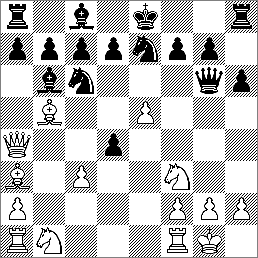
- 12.cxd4 Nd5 13.Re1
- Gunsberg: Best, for it still keeps Black’s game confined and provides for playing Bf1 in certain contingencies.
- 13...Nf4
- Gunsberg: In the next few moves Black worked desperately hard to obtain a counter-attack. However, 13...Nce7 seemed a good defensive move in this position.
- Steinitz: This was probably premature, and 13...Nce7 appears to be the better play.
- 14.g3 Qg4 15.Nbd2
- Gunsberg: It was extremely difficult to decide on the right move here, as Black threatened ...Nxd4. White ultimately found out that he could reply upon the following variation: 15...Nxd4 16.Re4 Nxf3+ 17.Nxf3 Qxf3 18.Rxf4 Bxf2+ 19.Kf1 Qh1+ 20.Kxf2 Qxa1 21.Qc4 and wins.
- 15...Nh3+ [0:47-1:01] 16.Kg2 Ng5
- Gunsberg: If 16...Nf4+, with a view of drawing, then White plays 17.Kh1, and if then 17...Nh3 again, Steinitz points out the following fine variation, showing that White can defend by 18.Re2, as Black dare not continue with 18...Nxd4 on account of the powerful reply of 19.e6 fxe6 20.Ne5 and wins.
- Steinitz: This was Black’s best play. If 16...Nf4+ 17.Kh1 Nh3 18.Re2, and should Black then play 18...Nxd4, then would follow 19.e6 fxe6 20.Ne5 with a winning attack.
- 17.Bb2
- Gunsberg: Though relinquishing the line of attack, it is probably his best. There is nothing much to be gotten out of 17.d5.
- 17...Ne7 18.Be2
- Gunsberg: In conformity with his last moves, White changes his tactics and brings his pieces back to repel Black’s counter-attack, in order to be able to continue afterwards the attack with better prospects.
- 18...Ne6
- Steinitz: Not a good move. Much better was 18...Qe6.
- 19.Kh1 Qf5 20.Nh4
- Gunsberg: “White has now attained the object for which he temporarily withdrew his bishops. The only available square for Black’s queen is on R 2, where she would be badly placed, and white could continue with 21 B-B 3, and his superior development ought to tell soon.”
- Steinitz: A good move under any circumstances but also involving a trap into which the opponent falls. It should be stated that at this point Gunsberg touched the square at h4 with his knight, and then retracted the move, and after taking some time to consider and shaking his head as if he had made a mistake, finally adopted the move. Thereupon I took the pawn, and on seeing my opponent’s reply, 21.Ne4, resigned. Then I taxed my opponent on the manner in which he had made his twentieth move, which was calculated to mislead, and I reminded him that in his match with Chigorin he had in a similar case brought a charge against the Russian master. Gunsberg apologized, and gave his word of honor that he had not done it wilfully.
- 20...Qxf2 [1:17-1:20]
- Gunsberg: An error which loses the queen.
- 21.Ne4 [1:17-1:20] 1-0
- Gunsberg: If 21...Qe3, then 22.Bc4, and the queen has no more moves.
- Steinitz: Of course the queen can only go to e3, and then follows 22.Bf1 and the queen has no move.
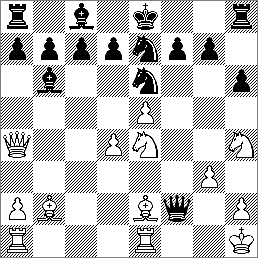
The Sun, New York, 1891.01.16
The World, New York, 1891.01.16
New-York Daily Tribune, 1891.01.16
Morgan's Chess Library, Book VIII, 1891, p61-62
STEINITZ STILL AHEAD OF GUNSBERG.
THE SEVENTEENTH IN THE SERIES FOR THE
WORLD’S CHESS CHAMPIONSHIP.
The seventeenth chess game in the match between Steinitz and Gunsberg, for the championship of the world, was played yesterday at the Manhattan Chess Club in this city. On account of the bearing which this game would have upon the final issue of the contest, its result was anxiously looked forward to by the spectators who had gathered in the club-house, and no doubt a similar feeling would be experienced by all chess players who are watching the encounter.
Another Queen’s Gambit was offered yesterday by Steinitz and declined by Gunsberg in a rather novel fashion by Kt-K B 3. Queens were exchanged at a very early stage, and Steinitz got slightly the advantage. On the fifteenth and sixteenth moves Steinitz sacrificed two pawns for a Knight with the object of breaking through the defence on the King’s Knight’s row, but the admirable defence set up by Gunsberg frustrated this attempt on the part of the veteran, whose Knight got into a position where it was shut up for some time.
A study of the moves from the twelfth up to the twenty-sixth, when an adjournment was made, will disclose to the chess-player a series of incidents of a very interesting character. White appeared to have very good chances before him after Black’s twenty-fourth move, but moving rather hastily, he threw them away. The complicated position at the adjournment after twenty-six moves had been made will be found below. Steinitz sealed his twenty-seventh move, and when play was resumed after the recess Gunsberg found it necessary to deliberate half an hour on his reply.
Both players had now to move rapidly under time pressure, and several exchanges which followed considerably cleared the field, each player being left with one Rook and a Bishop on opposite colors. Steinitz had the advantage of two pawns to one, and as one of then [sic] was a passed pawn many of the onlookers thought this might possibly give him the chance of a win. The majority, however, pronounced it to be a drawn game, and this it resulted after fifty-six moves.
Altogether the game was one of the finest of the series. The score is now: Steinitz 5, Gunsberg 4, drawn 8.
New-York Daily Tribune, 1891.01.18
Date: 1891.01.17
Site: USA New York, NY (Manhattan Chess Club)
Event: World Championship Match (Game 17)
White: Steinitz,W
Black: Gunsberg,IA
Opening: [D06] Queen’s Gambit Declined
Annotator: Steinitz
Site: USA New York, NY (Manhattan Chess Club)
Event: World Championship Match (Game 17)
White: Steinitz,W
Black: Gunsberg,IA
Opening: [D06] Queen’s Gambit Declined
Annotator: Steinitz
- 1.d4 d5 2.c4 Nf6
- Not a good way of declining this gambit.
- 3.cxd5 Nxd5 4.e4 Nf6 5.Nc3 e5 [0:04-0:06]
- As will be seen, Black gets the worst of the position in consequence of this advance.
- 6.dxe5
- Stronger than 6.d5.
- 6...Qxd1+ 7.Kxd1 Ng4 8.Nd5
- White obtains now an attack, which ought to have yielded more profit than it did.
- 8...Kd7
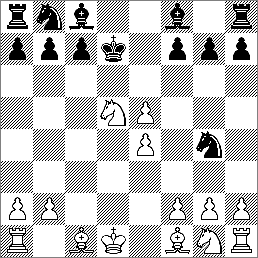
- 9.Nh3
- 9.Bf4 Nxf2+ 10.Ke1, followed by 11.Rd1, had its points, but Black, by then bringing out 10...Bc5, would have obtained a defensible game.
- 9...c6 10.Nc3
- 10.Ne3 was much stronger.
- 10...Nxe5 [0:41-0:20] 11.f4 Ng4 12.Be2 Ke8 13.Kc2 Bc5 14.f5 Ne3+ 15.Kd3
- The attack here obtained is worth the pawn given up.
- 15...Nxg2 [0:51-0:33] 16.b4
- This was hardly as good as 16.Na4.
- 16...Bxb4 17.Rg1 Nh4 18.Rxg7 Ng6
- 18...Nxf5 19.exf5 Bxf5+ 20.Kc4 Bxc3 21.Kxc3 Bxh3 22.Bh5 or 22.Bc4 would have given White an excellent attack, although he was three pawns behind.
- 19.fxg6 hxg6 20.Ng5 Be7 [1:14-1:00]
- A very fine move, which is extremely difficult to answer.
- 21.Rh7
- Probably best. If 21.Rxf7 Bxg5 22.Rc7 Na6, etc.
- 21...Rxh7 22.Nxh7 f6 23.Bf4
- Here 23.e5 at once was much better play.
- 23...Kf7 24.Rg1 Na6
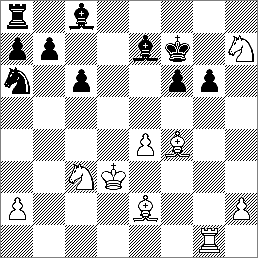
- 25.e5
- Inferior to 25.Kc2.
- 25...Bf5+ [1:43-1:20] 26.Kd2
- 26.Kc4 was now a much better defense.
- 26...Bb4(Adjourned) 27.Rg3(Sealed) 27...Nc5 28.Kc1 Ba3+ 29.Kd1 g5 30.Bc4+ Ne6 [2:16-2:20] 31.Nxg5+ fxg5 32.Bxg5 Rg8 33.h4 b5 34.Nxb5
- There was no necessity for this and White could have kept up the pressure by 34.Bb3, threatening Ne2 or Rf3 with a fine attack.
- 34...cxb5 35.Bxe6+ Kxe6 [2:25-2:25] 36.Rxa3 Kxe5 37.Rxa7 Bd3 38.Kd2 Bf1 39.Kc3 Rc8+ 40.Kb4 Rg8 [2:30-2:40] 41.Ra5 Ke4 42.Ra6 Kf3 43.Rf6+ Kg2 44.Rf5 Be2 45.Be3 Bd3 [2:35-3:05]
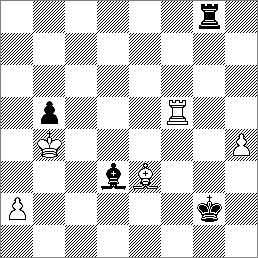
- 46.Rf2+
- 46.Rd5 was much stronger.
- 46...Kg3 47.Rd2 Rg4+ 48.Kc5 Bc4 49.h5 Kf3 50.Bd4 Rg5+ [2:45-3:13] 51.Kb4 Rxh5 52.a4 Ke4 53.Bc5 Bd3 54.axb5 Rh1 55.Rb2 Kd5 [2:50-3:33] 56.Bf2 Rb1 ½-½
New-York Daily Tribune, 1891.01.18
Morgan's Chess Library, Book VIII, 1891, p62-63
The important bearing which each game now has on the final result of the chess match between Messrs. Steinitz and Gunsberg did not fail to attract a large gathering to the Manhattan Chess Club yesterday to witness the eighteenth game of the contest. Additional interest was imparted by the circumstances that the Englishman had the move, and, as it was understood he again would try his lucky Evans, the crowd busied itself with the speculation whether Steinitz would still adhere to his sixth move: Q-K B 3. When the hour for play arrived Mr. Steinitz had not appeared. Mr. Gunsberg moved P-K4, and shortly after 2 a telegram from Mr. Steinitz announced that he did not intend to play. His telegram had been delayed. Under a strict interpretation of the rules Mr. Gunsberg could claim the game, but he is not likely to do so.
The World, New York, 1891.01.20
HE WINS THE EIGHTEENTH GAME IN THE
CHESS CONTEST.
GUNSBERG OPENS AGAIN WITH THE EVANS’
GAMBIT-AN EXCITING STRUGGLE.
The eighteenth game in the championship chess match between Steinitz and Gunsberg, which was played yesterday at the Manhattan Chess Club, proved attractive for many reasons, first of all on account of its inevitable influence on the ultimate outcome of the contest, and, in the second place because of Gunsberg again opening an Evans’ Gambit, the game upon which is centred an unusually keen and widespread interest.
Up to White’s seventh move the game proceeded on the well-known lines, and then Steinitz introduced a new form of defence by moving 7....K Kt-K 7 in place of the move which he made in the fourteenth and sixteenth games of this contest, P-K R 3. Gunsberg devoted twenty-three minutes of his time in deciding upon the reply, 8. Q-R 4. Steinitz, however, emerged from the opening with his pieces intact. He castles on his sixteenth move, and then proceeded with an advance of his pawns on the Queen’s wing, driving his opponent’s pieces back and giving him considerable security on this part of the board.
On his thirtieth move, however, the veteran seemed to overlook a possible combination on the part of his opponent. By playing 30....P-K Kt 3, he lost the pawn, and also allowed the Hungarian to disconnect the three strong pawns on the Queen’s side. Six moves later the afternoon’s sitting was adjourned with the position again slightly in favor of Steinitz.
On the resumption of play at 7 o’clock the veteran improved the advantage which he previously possessed. Gunsberg made a gallant fight, but to very little purpose, for Steinitz’s play, with one or two unimportant exceptions, was of the most masterly character. He pursued the counter-attack which he had set up with all the vigor of a young player combined with the skill of an experienced campaigner. The Hungarian’s valiant resistance was much admired by the spectators, but long before he gave up it was declared that his fight would prove unavailing. Gunsberg resigned on his fifty-fifth move, making the score-Steinitz, 6; Gunsberg, 4; drawn, 8. Only two games remain to be played, the first of which will be contested to-day and the other on Saturday.
New-York Daily Tribune, 1891.01.22
GUNSBERG PLAYED THIS OPENING AT
YESTERDAY’S CHESS MATCH.
Brilliant Tactics Shown by the Veteran,
Who Kept the Game Well in Hand Right
Through-Gunsberg Made a Gallant
Fight, but had at Last to Surrender.
Excitement and interest in the chess encounter between Steinitz and Gunsberg has been growing apace in the interval between the seventeenth game, which was played last Saturday, and the eighteenth game, which was contested yesterday. It being Gunsberg’s turn to open, there was much speculation as to whether he would again offer an Evans Gambit or turn his attention to one of his two favorites-the Giuoco Piano of Ruy Lopez.
What gave yesterday’s game a deeper interest was the bearing which its result would have upon the final issue of the match. Should Steinitz win it, it was considered that the match would be decided in his favor, for it would require that Gunsberg should win both the remaining games to even draw the match. Should the eighteenth game be drawn there would remain a chance for Gunsberg to draw, if not actually win the match, while if he should win this game his chances to make the match a draw would be little short of a certainty and his hopes of winning it would be raised considerably. It will thus be seen that the interest was enhanced to an almost incalculable extent by these various considerations, and that the members and visitors at the Manhattan Chess Club yesterday afternoon were fully en rapport with the prevailing spirit of the fight.
When play was adjourned at 5 o’clock the game [...] as will be seen, had again turned somewhat in favor of Steinitz.
The Sun, New York, 1891.01.22
Date: 1891.01.21
Site: USA New York, NY (Manhattan Chess Club)
Event: World Championship Match (Game 18)
White: Gunsberg,IA
Black: Steinitz,W
Opening: [C52] Evans
Annotator: Steinitz
Site: USA New York, NY (Manhattan Chess Club)
Event: World Championship Match (Game 18)
White: Gunsberg,IA
Black: Steinitz,W
Opening: [C52] Evans
Annotator: Steinitz
- 1.e4 e5 2.Nf3 Nc6 3.Bc4 Bc5 4.b4 Bxb4 5.c3 Ba5 [0:01-0:01] 6.0-0 Qf6 7.d4 Nge7
- In the early games played between Chigorin and Steinitz at Havana this move was always adopted by the defense: 7...Nh6, as in the cable match, was an afterthought that came up in one of the consultation games at the end of the match.
- 8.Qa4 Bb6 9.Bg5
- Chigorin generally played here 8.d5 first, followed by 9.Qa4.
- 9...Qd6 10.Na3 exd4 [0:25-0:05]
- White’s establishing a center is now much neutralized by having his knight at a3 and his being able to maneuver it to c3, his strongest post.
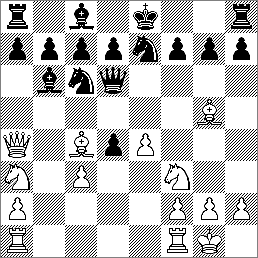
- 11.Nb5 Qg6 12.cxd4 a6
- Threatening ...axb5 followed by ...bxc4.
- 13.d5 Ne5 14.Nxe5 Qxg5 15.Nf3 Qh6 [0:25-0:32] 16.Bb3 0-0 17.Rac1 c6 18.Nbd4 c5 19.Ne2 d6 20.Ng3 Bd8 [0:45-0:45]
- A weak move; 20...Bc7 was much superior.
- 21.e5 b5 22.Qa3 c4 23.exd6 Nxd5 24.Bc2 b4
- Somewhat doubtful. It was perhaps more advisable to keep the pawns on the queenside together.
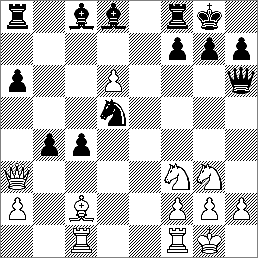
- 25.Qa4 Qxd6 [0:58-1:05] 26.Be4 Nb6 27.Qc2 Rb8 28.Bxh7+ Kh8 29.Rcd1 Qh6 30.Bf5 g6
- A grave error; 30...c3 was the correct play and he had then much less to fear from the knight coming in at f5 after exchanging bishops.
- 31.Bxc8 Rxc8 32.Qb2+ Qg7 33.Qxb4 Bc7 34.Rd4 Rfd8 35.Rh4+
- Serious loss of time that greatly compromises his prospects of drawing.
- 35...Kg8 [1:10-1:50] 36.Ng5 Rd7 37.Re4 (Sealed) c3
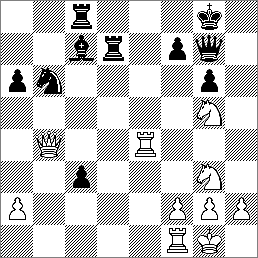
- 38.Rfe1
- 38.Rc1 at once was here much better.
- 38...Rdd8 39.Ne2 Nd5 40.Qa4 Qf6
- This move releases the king and greatly strengthens Black’s attack.
- 41.Nf3 Bb6 42.Rc1 c2
- Quite decisive.
- 43.h3
- Perhaps 43.Kf1 was a better defense.
- 43...Qb2 44.Qb3 Qxb3 45.axb3 a5 [3:05-2:55] 46.Rc4 Rxc4 47.bxc4 Nb4 48.g3 Bxf2+
- Quite good enough.
- 49.Kxf2 Nd3+ 50.Ke3 Nxc1 [3:30-2:56] 51.Nxc1 Rd1 52.Ne2 a4
- Not to let the adverse king pass at once and also gaining important time for finishing quickly.
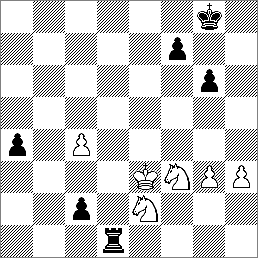
- 53.Nfd4 c1Q+ 54.Nxc1 Rxc1 [3:32-2:58] 0-1
The Sun, New York, 1891.01.22
New-York Daily Tribune, 1891.01.22
Morgan's Chess Library, Book VIII, 1891, p64-65
GUNSBERG LOSES THE CHESS MATCH.
THE NINETEENTH GAME DRAWN-CONGRATULATIONS
FOR THE VETERAN.
The match between Steinitz and Gunsberg for the chess championship of the world, which has been going on at the Manhattan Chess Club, in West Twenty-seventh-st., since December 9, was definitely decided in favor of the veteran player by the nineteenth game, which was contested yesterday. The result of Wednesday’s play still left it possible for Gunsberg to draw the match, but in order to do this he had got to win consecutively the only two games which might still be played before the maximum limit of twenty was reached. Yesterday’s game being drawn, the score was brought to this state: Steinitz 6, Gunsberg 4, drawn 9, which rendered it impossible any longer for Gunsberg to divide championship honors with the veteran player, who has remained unconquerable in match play for a quarter of a century.
This being the condition of affairs last night, it was decided not to contest the twentieth game, which, no matter how it had resulted, would not have altered Steinitz’s position as winner of the match and possessor of the title of champion of the world.
There did not appear to be any particular effort on the part of Gunsberg to win the game, nor on the part of Steinitz either, except at one stage in the end play, when the veteran worked his King out as far as the fifth square of the Q B file with some effect. An earlier effort on the part of Gunsberg to utilize his King in the same way, for purposes of attack on the Q side, proved of no value, and, indeed, it only compromised his position and resulted in his being compelled eventually to retreat, not only the King itself but the Bishop as well, right back to the first row.
Fianally [sic] a draw was agreed upon at the forty-second move, at which time Steinitz was of opinion that he had the superior position, but considered it wise to compound for a draw rather than risk the possibility of a mistake which might have cost him the game and given Gunsberg still a chance to draw the match. The two masters afterward played out the game for a small stake between themselves, and after about the twelfth move Gunsberg resigned.
In the evening Steinitz received the congratulations of his various friends and supporters in the Manhattan Chess Club on his ultimate success in retaining the title of “champion of the world.”
New-York Daily Tribune, 1891.01.23
AMERICA’S CHAMPION REMAIN’S THE
CHAMPION OF THE WORLD.
The Man who has Beaten All Comers for
Twenty-five Years Disposes of the Anglo-
Hungarian -- Beaten but Not Disgraced --
Gunsberg Made a Gallant Fight Through-
out and Played Fine Chess.
Steinitz was greeted on Wednesday night after he had won the eighteenth game in his match with Gunsberg, as possessor of “half the championship,” and received the congratulations of his friends and supporters on having at the very least insured a draw by the brilliant victory which he had achieved. Yesterday, by drawing the nineteenth game in the contest, he became once more his old self, the chess champion of the world, which proud title he had held undisputed for a quarter of a century.
To the spectators at the Manhattan Club the interest in yesterday’s game was reduced to the question of whether Steinitz would succeed in either winning or drawing it, and thereby secure the final victory, or whether Gunsberg would manage to win and thus give the twentieth and concluding game of the match preeminence over all the others in point of supplying chess players with matter which would excite in them a lively interest and enthusiasm.
Having the turn to open, the veteran chose as his subject the Queen’s Pawn’s opening, which ultimately was resolved into a regular Queen’s Gambit Declined. The play was conducted very rapidly on both sides. Queens were exchanged on the tenth move and some active manoeuvring followed.
Gunsberg did not seem to make any great effort to win, and from the nature of the play it seemed as though Steinitz too, would be satisfied with a draw, although when the game reached the end stage the spectators were of the opinion that he was making an effort to win. He marched out with his “fighting monarch” as far as Q B 5, where he surrounded him with the few remaining officers, while Gunsberg confined himself almost entirely to defence, making very few aggressive moves in the end game. A drawn position was finally arrived at, and this conclusion was agreed upon after forty-one moves. The total time occupied in play was considerably short of three hours. The remaining game will not be played, as it could not possibly affect the position of either player, and the final score of the match, therefore, is: Steinitz, 6; Gunsberg, 4; drawn, 9.
Here is what Steinitz had to say yesterday:
“Naturally, as there has been some comment upon the frequent repetition of the same opening on my part, the public ought to be reminded that in some of the best matches this has also been the case. In the match between Staunton and St. Amant each of the players, throughout the contest of over twenty games, played the Queen’s Gambit; Morphy mostly played the Ruy Lopez, Kolisch the Giuoco Piano; Buckle, the great historian, as first player, adopted the Giuoco Piano, and as second player the French Defence. Numerous other instances might be cited. Now, I have never in my life played the French Defence, which is the dullest of all openings, and only once, as far as I can remember, the Sicilian, as second player. I always play an open game when I am on the defence, and accept any gambits that are offered, but, as first player, I have latterly adopted a safe and sound opening like the Ruy Lopez against Zukertort, and the Queen’s Gambit against Tschigorin and Gunsberg, and I made up my mind not to alter the openings until I was a good number games ahead. As all those matches were pretty close I had little opportunity of varying, though in former days, when I had a clearer memory, I ventured into a variety of attacks.
As the score stood in the present match it would have been simple folly in this game to have hazarded a new line of play, and the opening proceeded in the usual manner. There was no deviation of importance. On the fourteenth move black made an attempt of a counter attack, which, however, was quickly repelled, and as the game progressed it seemed almost as if black was playing for a draw himself, for he offered opportunities for effecting various exchanges, including both rooks. The result was that only two minor pieces were left on each side-bishop and knight-with even pawns.
At that stage I offered a draw, but Gunsberg said he would rather go on, and he made some attempt at getting his king into play on the queen’s side, which, however, greatly compromised his position, as his king and bishop were driven right back by the adverse pawns, and white ultimately obtained the command of that wing, while black’s centre was blocked. The game proceeded to the forty-second move, when black offered a draw which white accepted.”
After this Gunsberg proposed to Steinitz that they should finish the game, and the latter assented to this proposal and suggested a small stake, at the same time giving his opponent the odds of a draw. On this understanding they continued the game just for pleasure, and after about a dozen moves Gunsberg’s position became untenable, and he resigned. Steintiz contends that nobody will blame him for having agreed to a draw when he did, because, had he played on in the proper contest he might have made a mistake, as he did on the previous day, and this might have cost him the game.
The Sun, New York, 1891.01.23
Date: 1891.01.22
Site: USA New York, NY (Manhattan Chess Club)
Event: World Championship Match (Game 19)
White: Steinitz,W
Black: Gunsberg,IA
Opening: [D40] Queen’s Gambit Declined
Annotator: Steinitz
Site: USA New York, NY (Manhattan Chess Club)
Event: World Championship Match (Game 19)
White: Steinitz,W
Black: Gunsberg,IA
Opening: [D40] Queen’s Gambit Declined
Annotator: Steinitz
- 1.d4 d5 2.e3 Nf6 3.c4 e6 4.Nc3 Be7 5.Nf3 0-0 [0:02-0:03] 6.Be2
- In the early part of the match Steinitz usually played 6.Bd3, but he has come to the conclusion that it is of no use directing the bishop against the kingside, and that this piece could be better employed in most variations at f3, after removing the knight.
- 6...dxc4 7.Bxc4 c5 8.0-0 Nc6 9.dxc5 Bxc5 10.Qxd8 Rxd8 [0:05-0:05] 11.Bd2
- Hardly a good move. It could have had no other sensible object than to advance ...b5, and, as will be seen, this would have greatly weakened his queenside.
- 12.Rac1 Ba7
- Obviously, if 12...b5 13.Nxb5 axb5 14.Bxb5, and recovers the piece with at least one pawn ahead, even if Black gets the a-pawn.
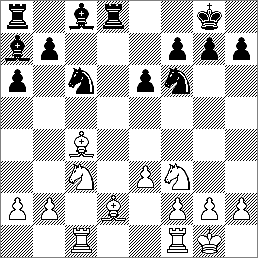
- 13.Rfd1 Bd7 14.Be1 Ng4 15.e4
- Black threatened either ...Bxe3 or ...Nxe3, which would have given him a rook and two pawns for two minor pieces, which is rather more than an equivalent in the majority of cases.
- 15...Nce5 [0:24-0:20] 16.Nxe5 Nxe5 17.Be2 Bc6 18.Kf1 Bd4 19.f3 Rd7 20.Bf2 Rad8 [0:43-0:26]
- If 20...Bxc3 21.Rxc3 Rxd1+ 22.Bxd1 Rd8 23.Be2 (best) 23...Rd2 24.Bg3, followed either by exchanging the knight or, if the knight moves, by 25.Bxa6.
- 21.Bxd4 Rxd4 22.Rxd4 Rxd4 23.Rd1 Rxd1+ 24.Nxd1 Kf8 25.Ke1 Ng6 [0:45-0:30] 26.Ne3 Ke7 27.Kd2 Kd6 28.Kc3 Kc5
- 29.g3
- 29.Nc4, though it looks strong, would have been answered by 29...Bb5, and White could not get any advantage out if the position.
- 29...Bb5 30.b4+ Kb6 [0:54-0:40] 31.Bd1 Kc7 32.a4 Bd7 33.f4 Bc6 34.Kd4 Ne7 35.Bb3 Be8 [1:15-0:45] 36.Nc4 Nc6+ 37.Kc5 Nd8
- Threatening ...b6+, followed by ...Nb7+ in case White takes the pawn.
- 38.Nb6
- Stopping that maneuver and exercising a very commanding position on Black’s crowded pieces.
- 38...f6 39.b5 axb5 40.axb5 Bg6 [1:35-0:55] 41.Bc2 Bh5 [1:36-0:56] ½-½
The Sun, New York, 1891.01.23
New-York Daily Tribune, 1891.01.23
Morgan's Chess Library, Book VIII, 1891, p65-66